
South Africa has spent the past few years learning an uncomfortable lesson about regulation. A country can have the laws, institutions, and frameworks that look right on paper and still struggle to make them work as intended.
South Africa was placed on the Financial Action Task Force’s grey list in February 2023 because of weaknesses in its anti-money laundering and counter-terrorist financing regime. It then spent the next two years addressing the deficiencies identified by the FATF. In October 2025, the FATF removed South Africa from increased monitoring after finding that the country had completed its action plan. But the bigger challenge lies ahead. Staying off the grey list means proving that the laws and systems put in place work – that they can be implemented, enforced, and sustained.
Trevor Manuel, South Africa’s longest-serving Finance Minister and, by reputation, no pushover, knows what it means to build a financial system while the country around it is changing.
That experience stretches back to the early years of democracy, when Manuel moved from the anti-apartheid struggle into government and then, in April 1996, became Minister of Finance under Nelson Mandela.
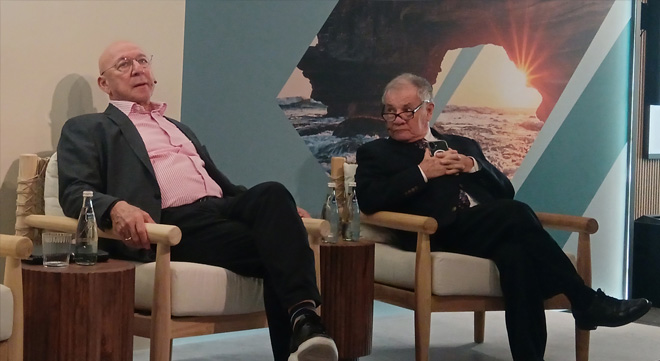
At Ninety One’s Beyond Alpha event on 17 September 2026, Judge Dennis Davis steered a conversation with Manuel about the institutions he helped to build, how the financial system has changed, and whether regulation has kept up. Judge Davis, who has worked with every finance minister since 1994, also knows exactly what it was like to have Manuel on the other side of the table.
“I’ve had the privilege over the last 30 years to work with all the ministers of finance from democracy,” Judge Davis said. “And all I can tell you is that working with Trevor was unquestionably the most challenging.”
He remembered Manuel looking “sort of into the middle distance” before delivering his verdict: “No, we’re not going to do what you suggested. This is what we’re going to do.”
“And inevitably, and upsettingly for me, you were always right.”
Long before Manuel became one of South Africa’s most respected finance ministers, he was an anti-apartheid activist involved in the ANC’s economic policy work. He entered the first democratic Cabinet as Minister of Trade and Industry in 1994 and, in April 1996, became Minister of Finance. He held the portfolio for 13 years, serving under Mandela, Thabo Mbeki, and Kgalema Motlanthe.
He was not inheriting a settled system.
South Africa was reconnecting with global markets after years of isolation while building the economic institutions of a new democracy.
Building the system while building the state
When Manuel arrived at Finance in 1996, some of the machinery that South Africans now take for granted was still being assembled.
There was no South African Revenue Service in its current form. Debt raising had to be repositioned. Monetary policy needed a clearer anchor. Government expenditure was being managed through structures Manuel remembers as cumbersome and dated.
He recalled officials who “had never seen a spreadsheet”, each working with a large calculator and adding figures vertically and horizontally before reaching for an eraser to try to make the numbers balance.
South Africa was trying to modernise the machinery of the state while convincing markets and investors that the new government could manage the economy.
Manuel’s career was shaped by decisions made when there was no established playbook – and by the less visible work of building institutions capable of making those decisions stick.
The regulatory system Manuel helped to build was never meant to be static. Asked whether those frameworks have kept pace with the financial system, he argued that policymakers must be willing to change them as circumstances change.
“You can’t hang on to what you’ve done five years ago,” he said. “Change is a constant.”
The financial system no longer fits the old boxes
The financial system Manuel was helping to regulate in the 1990s was easier to divide up. Banks were banks. Insurance companies were insurance companies. Telecommunications and technology businesses belonged to different parts of the economy.
Those lines are much harder to draw now.
Manuel pointed to the way technology has brought industries that were once separate into the same space. When the financial services rules were being developed, telecommunications, television, and companies controlling spectrum were distinct businesses. Now a telco can sell insurance, a bank can offer far more than traditional banking, and digital platforms can bring together banking, payments, foreign exchange, and investments.
Revolut is a good example. The London-headquartered digital financial services company brings all those services together on one platform. It announced plans to enter South Africa in September 2025 and has since formally applied for a local banking licence.
For regulators, this creates some difficult questions. The rules for banks were built around things such as capital requirements and the source of capital. But how do those rules work when the business in front of you looks very different from the banks those rules were designed around?
Manuel’s answer is not to try to hold back the change. The industry is moving, and regulation must move with it.
“You don’t sort of try and prevent progress,” he said. “But by the same token, I think it’s quite important to be alive to the way in which these issues change.”
The same tension is showing up elsewhere, and Manuel presented an example that had nothing to do with financial services: universities and artificial intelligence.
He had recently been lecturing at a university and said he had noticed how worried academics were about AI. Many universities, he said, had turned to AI-detection software to catch students using the technology, almost as if detecting it could make it go away.
Manuel’s view?
Students are going to use AI, whether universities like it or not. Rather than trying to block it, he argued, academics should be learning how to use it and helping students to understand it.
“Far better that we utilise this moment in world history and help our academics to understand and apply this better,” he said.
He sees much the same challenge in financial services. New technology is going to change the way the industry operates; regulation cannot simply stand in its way. Regulators need to understand the technology, keep learning, and adapt as the industry changes.
“Learning is continuous, and innovation will always be continuous,” Manuel said. “And you need to find each other as you proceed along that path.”
The rules can be good. The system can still fail.
For Manuel, the problem is not that South Africa lacks regulation. It is that the country does not always have enough of the people, experience, and specialist skills needed to make that regulation work.
He compared South Africa’s regulatory environment with the United Kingdom, where institutions such as the Prudential Regulation Authority (PRA) and Financial Conduct Authority (FCA) have large pools of experienced specialists. South Africa often mirrors that regulatory approach, he said, but tries to do the same work with a fraction of the people.
“We try and do all of what they do with a handful of people, and it’s unbelievably difficult,” he said.
And it is not just about having enough people. Manuel said South Africa does not have sufficient skills to introduce and manage regulation, nor always the ability to afford the specialist skills it needs. He also questioned whether transformation in this area has become too narrowly focused on employment equity, excluding people who could contribute to the skills base and leaving the country “always playing catch up”.
A law can be beautifully written, but somebody still must interpret it, follow the money, investigate wrongdoing, and build a case strong enough to secure a conviction. This is where Manuel sees some of South Africa’s institutional weaknesses showing up.
He pointed to the Financial Intelligence Centre, established in 2001, as an example of how early South Africa was in building its anti-money laundering framework. Many countries, he noted, had not yet seriously considered money laundering at the time. But the legislation cannot enforce itself. The institutions responsible for using the information and enforcing the rules need the capacity to do so.
Much of the loss of institutional capacity Manuel is describing dates to the period of state capture under Jacob Zuma, often described as the “nine wasted years”. The Zondo Commission later documented how state institutions were weakened and, in some cases, repurposed to enable corruption. The consequences were not simply financial; the period also saw the loss of skilled people, experience, and institutional capability that can take years to build.
Manuel believes that loss of capacity has continued long after the Zuma presidency.
“A lot of the damage undertaken during the Zuma years continues,” he said.
What concerned him was the loss of institutional experience. People who entered government with relatively little experience learned the job, built up specialist knowledge, and became part of the institutional memory. When they left, the vacancy was not simply a post that could be filled by somebody else. Years of experience left with them.
And even the best legislation is of little use if it is not enforced across the line.
Take the Tembisa Hospital case. Manuel referred to the three blue Lamborghinis bought by businessman Hangwani Maumela, who has been implicated in the alleged looting of money from the hospital.
What about the person who sold him the cars?
Manuel said the dealer did not ask where the money had come from. His view was that the person who stole the money should go to jail – but so should the person who accepted it without asking questions.
If someone can spend allegedly stolen money on luxury goods, he argued, those facilitating the transaction cannot simply be ignored. The prosecutorial service needs to be larger, more dynamic, and capable not only of bringing cases to court, but of securing successful prosecutions.
“You can’t operate in a system where there are no disincentives to bad behaviour,” he said.
The world will not wait for the rulebook
Technology is making the capacity problem harder. Financial services are changing quickly, with digital assets, AI, fintech, and platform-based businesses operating across boundaries that did not exist when much of today’s regulatory architecture was developed.
Regulators will have to keep up. For Manuel, that means government and the private sector spending more time talking to each other, rather than trying to navigate these changes from separate corners. Neither side has perfect knowledge of what the other is dealing with, he said.
“We don’t spend nearly enough time in conversation,” he said.
He hoped there would be more discussions like the one that afternoon at Ninety One’s Cape Town headquarters, with policymakers and regulators sitting down with the people working in financial services and learning from each other.
“These kinds of conversations. And we need more of the policymakers, regulators in this space, so we can understand each other a lot better.”

