

People who exercise just once a week are almost twice as likely to be promoted as colleagues who don’t exercise at all.
At first glance, it sounds like another wellness statistic. Discovery believes it’s also a retirement statistic.
Speaking at Discovery’s inaugural Retirement Fund Forum, Guy Chennells, chief commercial officer at Discovery Corporate and Employee Benefits, argued that South Africa’s retirement challenge cannot be solved simply by asking people to save more.
Slowing salary growth, rising debt, and growing financial pressure have made that increasingly difficult. Instead, Discovery wanted to understand which factors still lie within an individual’s control, and whether changing those behaviours could materially improve long-term retirement outcomes.
That search led to some unexpected findings.
More than a wellness benefit
Most people understand that exercise is good for their health. Discovery wanted to know whether it also changed the way people performed at work.
The physiological benefits are well established. Regular physical activity reduces body fat, builds lean muscle, lowers blood pressure, improves cholesterol levels, and increases insulin sensitivity. What was less clear, Chennells said, was whether those health benefits translated into better workplace performance.
Using employee data, Discovery compared exercise habits with career progression.
The results surprised even the company.
Employees completing just one to four heart-rate workouts a month – roughly one workout a week – were 78% more likely to be promoted than colleagues who recorded no qualifying workouts. Those exercising more than 20 days a month were a further 14% more likely to be promoted.
The relationship extended beyond promotions. Employees exercising one to four days a month took 40% fewer sick days, with average annual sick leave falling from 8.5 days to just over five days. The trend held across the organisation, with additional sick leave declining by 38% among staff, 33% among team leaders and junior managers, 13% among middle managers, and 64% among senior managers.
“People who exercise perform better at work. They get promoted more. They earn more.”
Promotions influence earnings, earnings influence saving, and those choices accumulate over a working lifetime.
Discovery found a similar relationship when it looked beyond health and examined financial behaviour.
Rather than measuring how much money members earn, Vitality Money measures how they manage it. The programme scores members across six financial behaviours, including whether they have adequate savings, manage short-term debt, stay on track for retirement, plan their finances, hold appropriate insurance, and manage property-related investments. Those behaviours are combined into a financial well-being status ranging from Blue to Diamond.
Members with stronger financial habits consistently produced better retirement outcomes.
Among lower-income earners with Diamond Vitality Money status, only 8% had accessed their retirement savings through the two-pot system. By contrast, 27.7% of higher-income earners with Blue status had made withdrawals, despite earning several times more.
Without any intervention, low-income earners were about six times more likely than very high-income earners to withdraw from their retirement savings. But when members demonstrated strong financial behaviours through Vitality Money, that gap narrowed substantially to about 3.5 times.
“The income is not the reason,” Chennells said. “The reason is that they’re managing their money in a different way.”
Looking beneath the salary numbers
Only about 6% of South Africans retire comfortably – a figure Chennells said has remained largely unchanged for about 20 years despite repeated efforts across the industry to improve retirement outcomes.
“If we’re still sitting at 6% after all this time,” he told delegates, “then we’re asking the wrong question.”
Rather than focusing only on how people save for retirement, Discovery set out to understand what determines whether they can save at all.
He started with income.
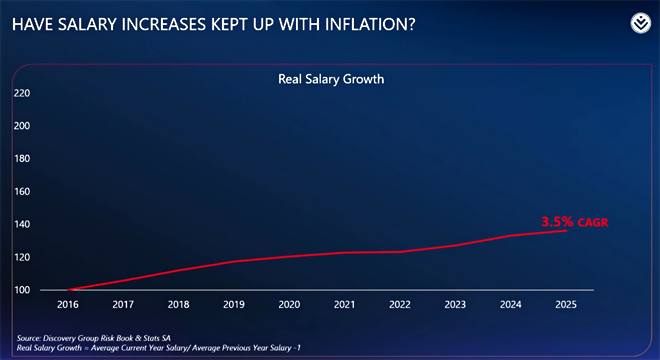
Average salaries across Discovery’s group risk book have increased by just over 8% a year over the past decade, equivalent to real annual growth of about 3.5% after inflation.
On the surface, that sounds encouraging.
“But it doesn’t really gel with the talk on the street,” Chennells said.
Part of the answer lies in how inflation is measured.
The Consumer Price Index reflects spending across the population as a whole. Working households often face a different reality. Education and healthcare account for only a small share of the official inflation basket, yet they are often among the first areas where employed families choose to spend more – and where costs tend to rise faster than inflation.
As incomes rise, many families move away from public schools and healthcare. Those new expenses arrive just as they begin increasing faster than inflation, creating what Chennells described as a “double whammy”.
On paper, salaries are growing faster than inflation.
“For the average person,” he said, “they’re experiencing real headwinds.”
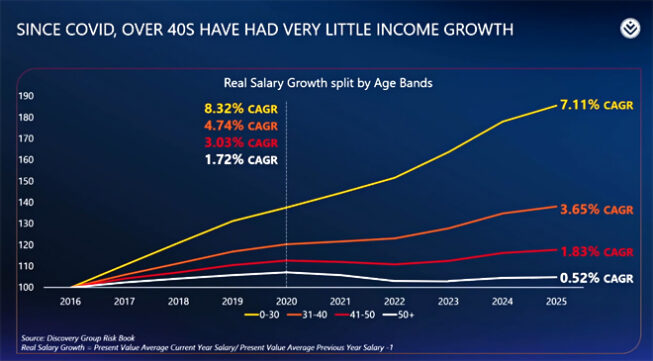
The squeeze becomes more pronounced with age.
Employees in their twenties experienced the strongest real salary growth as they established themselves in the workforce. By their forties, real growth had slowed to about 3% a year, falling to about 1.7% for employees over 50.
Covid-19 made the picture worse.
“What is dramatic,” Chennells said, “is how the over-40s age category has been almost flat since Covid in real terms.”
“For the over-50s… it’s gone backwards.”
The slowdown comes at precisely the stage when financial pressure tends to increase. University fees, rising healthcare costs, and support for ageing parents compete with the need to increase retirement contributions.
“If you pull all of that together,” Chennells said, “you’ve got salary growth that’s ahead of inflation, but only just… and at the ages where it really counts… that salary growth basically stagnates.”
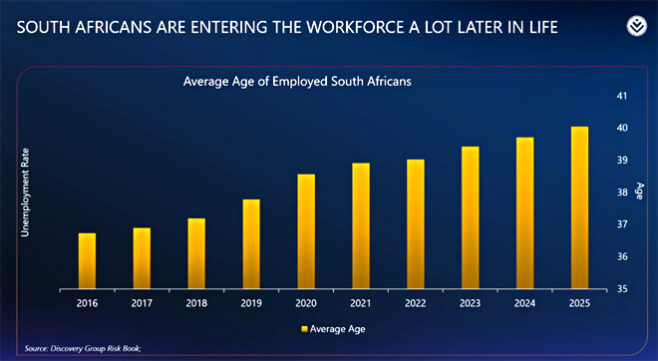
The data disclosed another shift. Rather than getting younger, the employed population has steadily become older.
When compared with youth unemployment, the relationship became difficult to ignore. As youth unemployment climbed between 2018 and 2021, the average age of Discovery’s group risk members rose sharply. People were entering formal employment later, shortening the years in which they typically experience the strongest salary growth and leaving less time for compound investment returns to work in their favour.
“It is harder for people in their 40s and 50s to grow their real income,” Chennells said, “but people on the starting side of that are entering later, having shorter time to grow their real income.”
Individually, none of these trends is fatal. Together, they steadily reduce people’s ability to accumulate retirement savings.
“South Africa has a structural problem that is making it hard, almost impossible, for people to save for retirement.”
The biggest hole in the bucket
But even rising incomes cannot overcome what Chennells described as “the biggest hole in the bucket” – debt.
Discovery’s research suggests the problem extends well beyond monthly repayments. One in three South Africans struggles to meet their debt obligations. Two-thirds say debt has a significant impact on their mental health. Nearly half (47%) say it prevents them from saving more for retirement, while 46% say it limits their ability to invest.
Those figures, Chennells argued, help to explain why so many South Africans find themselves running to stand still financially.
“If your debt is out of control, it is irrational to try to save more in something that grows at a slower rate than your short-term debt grows.”
The scariest finding
If debt explains why many South Africans struggle to save, gambling may show what happens when financial pressure reaches breaking point.
Since 2019, the value of bets placed by South Africans has increased by 226%, reaching about R1.5 trillion a year. South Africa now ranks second globally for online gambling participation, behind only Norway.
For Chennells, that comparison says as much about South Africa’s financial reality as it does about its gambling habits.
“Norway, with the highest per capita income in the world, is the only one just pipping us,” he said. “We do not have the money, people, to be amongst the top gamblers in the world.”
The trend is particularly pronounced among younger adults. About six in 10 South Africans under 35 gamble online, compared with almost four in 10 people aged 35 to 49.
Four in 10 respondents said they gamble to cover day-to-day expenses or repay debt.
Discovery Bank’s transaction data suggests the financial pressure extends beyond gambling itself. As gambling expenditure rises, groceries are often the first household category to come under pressure. About one in four people who gamble also admit they do not keep track of how much they spend, win or lose.
“Perhaps they don’t like the answer,” Chennells said. “They’re losing.”
Testing a new approach
One initiative to emerge from the research is Debt Reset, a new programme designed to help members escape the debt cycle without permanently sacrificing their retirement savings.
The programme went live for Discovery employees over the weekend as an initial rollout. Discovery has not yet indicated when it will be made available more broadly.
Participants complete a four-hour self-paced financial education course, work with a financial coach to develop a realistic budget and then spend three months demonstrating that they can keep their unsecured debt stable. Only after completing those steps do they qualify for the next phase.
At that point, their monthly retirement contributions are temporarily redirected to help pay down high-interest debt instead of being invested in the retirement fund. Once the agreed amount has been redirected, normal retirement contributions resume.
Using the example shared at the forum, a member contributing R5 000 a month to retirement savings while carrying R50 000 in debt costing 20% interest a year would redirect five months’ worth of retirement contributions towards settling that debt.
To ensure the member is not worse off at retirement, Discovery restores the value of those redirected contributions through a separate Boost account, provided the member remains invested in the Discovery Retirement Fund until retirement. As Chennells put it, the company is “putting our money where your mouth is”.
In Discovery’s illustration, the approach allows the member to repay the debt 23 months earlier, save about R14 000 in interest, and remain on track for retirement because the redirected retirement savings are restored through the Boost account. Chennells added that members who are no longer in short-term debt crisis save at 40% higher rates than those who remain trapped in debt.
Whether the approach proves successful remains to be seen, but it reflects a broader shift in thinking: tackling the barriers to retirement saving before they become retirement problems.
“Economic growth has not been enough to pull people out of the situations they’re in,” Chennells said. “People are trapped in this debt cycle.”
The challenge, he argued, is changing that trajectory while people are still building their careers.

