
The Citadel Group has opened to independent financial advisers (IFAs) an investment capability developed within its more-than-three-decade private-client wealth business.
For IFAs, the newly launched CAM Asset Management proposition goes beyond access to another fund range: advisers can delegate functions ranging from portfolio construction and asset allocation to manager research and monitoring, while retaining responsibility for advice and the client relationship.
CAM Asset Management, which officially launched on 21 July, manages just over R115 billion in assets, according to chief investment officer George Herman, who emphasised that this represents assets actually under management rather than a broader “assets under advice” measure.
Although CAM Asset Management is a new market-facing brand, the investment capability behind it has historically been used primarily to support Citadel’s own private-client advisers and their clients.
CAM Asset Management sits within the Citadel Group, which also owns Citadel, an advisory business operating in the same private-client market as independent advisers.
Herman said CAM Asset Management’s relationship is intended to be with the adviser, not the adviser’s client.
“In an adviser’s life, the number-one thing that they do is their relationship with the client,” he told Moonstone.
Citadel remains the group’s client-facing advisory business, while CAM Asset Management operates separately as an investment business. Where advisers want CAM Asset Management’s investment professionals to engage directly with clients – for example, in investment presentations or discussions – Herman said this takes place through the adviser.
What CAM Asset Management wants to take off the adviser’s desk
At the heart of CAM Asset Management’s proposition is the argument that an independent advice practice should not necessarily have to replicate the capabilities of a large investment operation.
CAM Asset Management can take responsibility for portfolio construction, asset allocation, manager selection and monitoring, due diligence, risk management, and investment research.
CAM Asset Management’s proposition is that advisory practices can delegate much of that investment function rather than building the people, systems, and research capability required to perform it internally.
Herman believes one potential “sweet spot” could be practices managing roughly R2bn to R5bn, although he presented this as an indication rather than a defined target market.
A practice at that scale may have several advisers and a growing client base, while the investment governance, manager research, due diligence, and portfolio monitoring required to support that business become increasingly resource-intensive.
Herman also challenges a conventional interpretation of investment independence.
An IFA may have access to hundreds of funds and investment managers, but he argues that having a large universe from which to choose does not necessarily mean an individual adviser has the resources or information required to scrutinise those managers continuously.
CAM Asset Management instead places much of the manager-selection, due-diligence and monitoring responsibility with a dedicated investment team. Where it believes it has the necessary expertise, it manages assets internally; where specialist capabilities are required, it can appoint external managers.
Herman’s argument is that independence can therefore reside at the level at which managers are selected and monitored, rather than requiring the individual adviser to perform that function.
An established capability taken to a wider market
The decision to open CAM Asset Management to independent advisers forms part of a broader growth strategy at the Citadel Group rather than a response to particular investment-market conditions.
Herman said an advisory practice that had operated within Citadel decided to become independent but wanted to continue using the investment solutions it had previously accessed through the group.
The arrangement demonstrated that the advice and investment-management relationships could be separated: advisers could operate independently while continuing to use the investment capability. That experience helped open the door to taking the model to the wider IFA market.
“CAM Asset Management is a new brand, but not a new business,” Herman said in the launch announcement.
The broader CAM group of companies brings together asset management, collective investment scheme management, foreign exchange, and fiduciary capabilities, while CAM Asset Management is the group’s investment-management business.
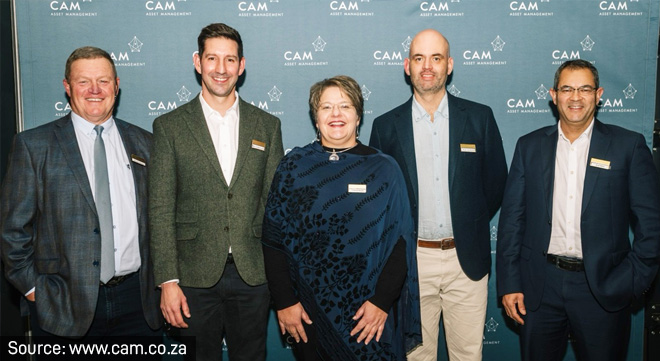
Citadel Group chief executive Sajeel Maharaj (pictured) described it as a “strategic consolidation” of these capabilities under a single adviser-focused brand.
Asset manager or DFM – or something in between?
CAM Asset Management does not fit neatly into one of the familiar categories through which advisers outsource investment management.
It performs some functions commonly associated with discretionary fund managers (DFMs), including asset allocation and manager selection, and manages model portfolios, as well as bespoke portfolios for clients with particular requirements.
At the same time, it is an asset manager in its own right, with much of its existing money managed through collective investment schemes.
Herman describes CAM Asset Management as sitting somewhere between a DFM and a traditional asset manager.
Its initial external offering centres on established funds rather than an entirely new product suite.
CAM Asset Management’s website lists six core funds available on external platforms: CAM Stable, CAM Moderate, CAM Growth, CAM Worldwide Equity, CAM Global Greats, and CAM Diversified.
Several of the funds have histories predating the CAM Asset Management brand, including funds previously carrying H4 or Peregrine branding.
Herman said CAM Asset Management intends to lead with what he called the “meat and potatoes” of asset management rather than promote products simply because a particular strategy or theme has recently performed strongly.
Building portfolios clients can live with
CAM Asset Management describes its investment philosophy in terms of future-proofing portfolios, effective diversification, valuation-led decision-making, and long-term asset allocation.
Herman said its investment process uses scenario analysis rather than relying on a single expected market or economic outcome.
“We do not attempt to predict a single outcome. Instead, we build portfolios that are positioned to remain resilient across a range of possible market scenarios,” he said.
His explanation of another aspect of the philosophy is more practical: an investment strategy needs to be one that clients can remain invested in through difficult cycles.
An adviser may be able to explain a period of underperformance for a quarter or a year. As that period lengthens, however, the conversation becomes progressively more difficult, particularly when clients can see other strategies performing better.
Herman said prolonged underperformance can eventually lead clients to abandon a strategy, potentially at precisely the wrong point in the cycle.
He used value investing as an example. Although buying assets below their perceived intrinsic value has a strong long-term rationale, value strategies can experience prolonged periods of relative underperformance.
He said CAM Asset Management’s multi-asset solutions are deliberately constructed not to carry an overwhelming value, growth, or other investment-style signature. By diversifying these exposures, the aim is to reduce the extent to which prolonged weakness in one style puts pressure on advisers and clients to change course.
The objective is not to eliminate volatility or periods of underperformance. It is to diversify the sources of risk and return so the outcome is not excessively dependent on one style remaining in favour.
Built around private-client money
CAM Asset Management’s investment capability was developed within a business serving South African private clients, including high-net-worth families managing wealth across generations and jurisdictions.
Herman said about 65% of CAM Asset Management’s existing R115bn under management is invested offshore and 35% domestically.
He emphasised that this split should not be interpreted as CAM Asset Management making a tactical 65% offshore asset-allocation call or as a negative view on South Africa.
Rather, it reflects the characteristics of the existing client base. High-net-worth clients managing intergenerational capital often have long investment horizons and seek to preserve wealth across currencies and jurisdictions.
CAM Asset Management’s international capability includes links to the Citadel Group’s Guernsey-based entities, while foreign-exchange capabilities are available within the broader CAM group.
Currency itself is treated as an investment risk that needs to be managed deliberately.
“We think the currency is one of the most important variables that has to be managed,” Herman said.
His point is that buying a high-quality offshore asset does not remove currency risk for a South African investor. Movements in the rand can introduce substantial volatility into the portfolio’s rand value.
Giving advisers something to say when markets get difficult
Another part of the proposition concerns what happens after the investment decisions have been made.
A war, sharp currency movement, interest-rate surprise, or market sell-off can quickly prompt questions about what has happened to a portfolio and whether something needs to change.
Herman said CAM Asset Management gives advisers access to the investment thinking behind their portfolios, including macro-economic research, asset-class analysis, manager research, and commentary on market developments.
The aim is to equip advisers to put short-term events into the context of a client’s long-term investment strategy.
Advisers can also draw on CAM Asset Management’s investment professionals where appropriate, including in discussions with groups of clients.
CAM Asset Management is developing an AI tool that Herman said will give advisers round-the-clock access to the firm’s investment research and current thinking. The intention is to enable advisers to interrogate CAM Asset Management’s house views when client questions arise, with the investment team available for more detailed engagement.
CAM Asset Management’s stated proposition is that this investment capability should support rather than replace the adviser’s role.

