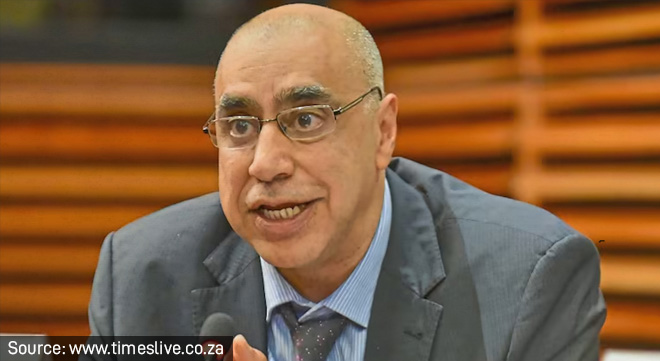
With just a year to go until JIBAR is retired, Deputy Governor Rashad Cassim (pictured) of the South African Reserve Bank this week urged market participants to accelerate their transition efforts. He emphasised the importance of ensuring that all relevant financial contracts incorporate appropriate fallback provisions.
Cassim delivered the keynote address at the 2025 Market Practitioners Group (MPG) conference on 3 December in Johannesburg. The conference, hosted by the SARB under the theme “The JIBAR transition: the last mile”, brought together market experts to discuss the shift from the Johannesburg Interbank Average Rate (JIBAR) to the South African Rand Overnight Index Average (ZARONIA) – the most significant reform of the country’s financial markets in decades.
“We are aware that the pre-cecession announcement will trigger certain contractual provisions for the calculation and future application of fallbacks. We expect credit adjustment spread calculations to crystallize today. However, these spreads will not be applied until after 31 December 2026. The JIBAR rates are expected to remain representative until that point,” Cassim said.
Why the benchmark shift matters
JIBAR has long been South Africa’s standard interbank reference rate, reflecting the rate at which banks lend unsecured funds to one another over short maturities. For decades, it underpinned the pricing of loans, bonds, derivatives, and other financial contracts.
However, like many IBOR-type benchmarks globally, JIBAR relied on indicative quotes from a small panel of banks, leaving it vulnerable to conduct and robustness concerns. (IBOR stands for Interbank Offered Rate, a family of benchmark interest rates used internationally to indicate the cost at which banks lend to one another.)
As global markets moved away from quote-based benchmarks, South Africa initiated its own reform.
ZARONIA, by contrast, is a transaction-based overnight reference rate developed by the SARB. Calculated from actual unsecured overnight lending transactions in the wholesale market, it offers greater transparency, robustness, and alignment with international risk-free standards. ZARONIA is set to become the primary benchmark for pricing floating-rate loans and bonds, derivative valuation, risk management, and broader financial market stability.
“JIBAR is the legacy quoted interbank rate; ZARONIA is the modern transaction-based overnight benchmark designed to take its place,” the SARB notes. The transition strengthens benchmark integrity, reduces manipulation risk, and improves the accuracy of interest-rate pricing across the financial system.
The SARB confirmed that all JIBAR tenors will cease to be provided and considered non-representative immediately after 31 December 2026.
The transition landscape
The MPG was established to develop new reference rates for South Africa. In 2022, the SARB and MPG designated ZARONIA as JIBAR’s successor. Since then, MPG has worked with regulators, market infrastructure providers, and industry associations to ensure a smooth transition, producing reference materials such as recommended market conventions, fallback language, and a JIBAR transition plan.
Cassim reflected on the long journey: “It is often said that creating new benchmark rates for financial markets is like building a new foundation under a house you’re already living in. For those who have experienced a major renovation, you know it can put a lot of strain on a family. That is why I see it as a good sign that the end is now in sight; we can still come together amicably, and no one is asking for a divorce.”
He noted that the transition has taken eight years, starting with the SARB’s consultation paper on alternative interest rate benchmarks. About seven months ago, the ZARONIA first initiative was launched, boosting adoption from R6.4 billion to more than R200bn in the initial months. JIBAR exposures, however, remain substantial: domestic exposures were estimated at R43 trillion mid-2025, with offshore exposures more than R107 trillion.
Earlier this year, the MPG adopted methods for determining credit adjustment spreads and recommended JIBAR fallback rates based on compounded ZARONIA.
The ‘no new JIBAR’ event
With the cessation date approaching, Cassim highlighted three key concerns for SARB and the MPG. The first is the “No new JIBAR” event.
“We are already encouraging market participants to use ZARONIA instead of JIBAR in contracts, but around the second quarter of next year, we plan – along with the Financial Sector Conduct Authority – to issue regulations limiting new JIBAR exposures,” he said.
The aim is to stop increasing the stock of contracts that will need to transition off JIBAR, while accounting for exceptions to avoid disrupting market segments that cannot yet adopt alternative reference rates.
Legacy contracts and synthetic solutions
Cassim warned that legacy contracts remain a critical challenge: “I often ask MPG members what JIBAR transition risks should keep us awake. Almost always they highlight the challenge posed by legacy contracts that cannot easily be changed before JIBAR is discontinued.”
To address this, the SARB and the FSCA proposed amendments to the Financial Sector Regulation Act (FSRA), empowering the SARB to designate replacement benchmarks and determine adjustment spreads for contracts transitioning from one rate to another.
“We may need a synthetic JIBAR, similar to synthetic LIBOR ‒ the London Interbank Offered Rate ‒ for dealing with some tough legacy contracts, but overall, we want to put JIBAR behind us. In the UK, authorities used synthetic LIBOR to reduce disruptions in markets where converting certain outstanding legacy contracts to alternative reference rates was not feasible. However, this was a temporary solution,” Cassim said.
Forward-looking term measure of ZARONIA
The third concern is the forward-looking term measure of ZARONIA. Cassim said the SARB still believes risk-free rates compounded in arrears are appropriate for most cash market segments.
“We are doing this by developing relevant market conventions and infrastructure,” he said, adding that the SARB is seeking a benchmark administrator to calculate and publish forward-looking term ZARONIA rates by April 2026.
Cassim urged market participants to take proactive steps: “We also encourage market participants not to just wait for term ZARONIA, but to start building liquidity in ZARONIA-linked products now.”
Draft finance laws open for public comment
Complementing these market reforms, National Treasury has opened the Draft General Finance Laws (Official Benchmarks and Procurement) Amendment Bill, 2025 for public comment.
Published on 1 December, the draft Bill proposes amendments to the FSRA and the Public Procurement Act to support the JIBAR-to-ZARONIA transition.
The Bill sets out mechanisms for:
- Designation and replacement of official benchmarks, including legacy contracts;
- Limiting liability from the use of replacement benchmarks or adjustment spreads; and
- Consultation processes that the SARB must follow when replacing official benchmarks.
Amendments to the Public Procurement Act would extend timelines for the Minister to review the Act’s implementation, prepare a report, and submit it to Parliament – necessary because the Act has not yet come into effect, pending finalisation of supporting regulations.
Treasury invited stakeholders to submit comments by 31 December 2025, with all feedback to be considered before the Bill is workshopped, finalised, and submitted to Cabinet for tabling in Parliament.
Cassim noted that the SARB will consult on using these proposed powers after the draft amendments are published.