
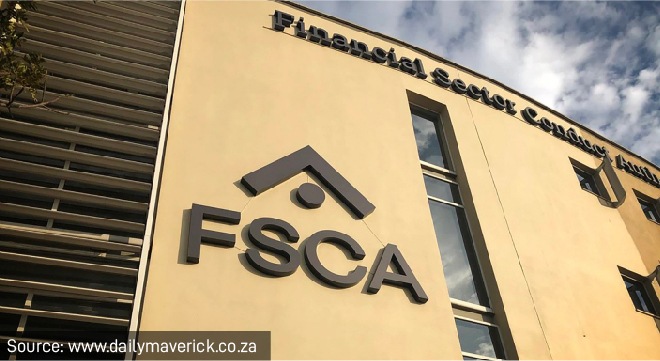
The Financial Sector Conduct Authority has had a busy year, ramping up enforcement, modernising its systems, and pushing forward initiatives to make South Africa’s financial sector more innovative, inclusive, and sustainable.
Its 2024/25 Integrated Report, released last week, details the Authority’s work between 1 April 2024 and 31 March 2025. During the period, the FSCA strengthened its conduct-of-business and market integrity frameworks, adopted a more risk-based, data-driven supervisory approach, and took decisive action against misconduct.
FSCA Commissioner Unathi Kamlana said: “As a result of these efforts, we achieved 89% of our performance targets during the reporting period, demonstrating consistent execution, institutional resilience, and strong alignment with our strategic objectives. In strengthening our regulatory framework, we made meaningful progress in implementing our rolling three-year Regulation Plan and achieved over 80% of its targets.”
Key highlights include granting licences to 779 financial services providers – 111 more than last year, including 264 crypto asset service providers (CASPs) – issuing 131 debarment orders, and concluding 633 investigations, up from 418 in 2023/24. The FSCA also imposed R119 million in penalties and fines.
Tougher AML/CFT oversight after greylisting
In response to South Africa’s greylisting by the Financial Action Task Force, the FSCA has strengthened its supervision of anti-money laundering and combating the financing of terrorism (AML/CFT).
“This resulted in strengthened oversight of financial institutions’ compliance with AML/CFT obligations, as well as the imposition of appropriate enforcement measures and administrative penalties in cases of non-compliance,” said Kamlana.
The regulator has dramatically increased its AML/CFT capacity, growing its supervision staff from seven at the time of greylisting to 26 – a 271% jump. This boost enabled more robust monitoring, including a 67% increase in on-site inspections year-on-year. Inspections now cover follow-ups on previous non-compliance, pre-licensing checks on CASPs, and bilateral meetings with accountable institutions to ensure remediation.
Enforcement has also ramped up. AML/CFT-related financial penalties have risen 127%, from R11.9m in 2021 to R27.1m by March 2025, while non-financial sanctions have jumped by 533%, from three to 19 over the same period. These measures aim to deter misconduct, strengthen compliance, and bolster confidence in South Africa’s financial system.
Cracking down on misconduct and collecting fines
The FSCA finalised 633 investigations in 2024/25, issued 131 debarment orders, withdrew 382 licences, and imposed R119m in penalties and fines.
“These outcomes reflect our commitment to acting decisively where misconduct or regulatory breaches occur and underscore our role in promoting trust, fairness, and discipline across the financial sector,” said Kamlana.
The Authority opened 767 new cases during the year, up from 483, and currently has 494 ongoing investigations. Most cases relate to unregistered financial services and insurance, with unregistered insurance cases surging 134% year-on-year. Enforcement actions also included 51 administrative penalties and 14 enforceable undertakings, mainly linked to unregistered insurance or dishonest conduct.
Banking ads and retirement fund oversight under scrutiny
Banking supervision and retirement funds were also in the spotlight.
In March, African Bank Limited was hit with a R700 000 administrative penalty, with R500 000 payable immediately and R200 000 suspended for two years, after its #KeFestive social media campaign was found to be misleading. The FSCA said the advertisement misrepresented the nature of the loan product, implying it was an investment rather than credit, contravening sections 6(1), 6(3)(a), and 6(3)(b) of Conduct Standard 3 of 2020.
On retirement funds, the FSCA focused on winding down and cancelling terminating funds and administrators, while stepping up compliance checks on active funds, trustees, employers, and administrators.
On-site inspections found persistent issues: vacant board positions left unfilled for more than 90 days, failure to monitor compliance with the Pension Funds Act and Conduct Standard 1 of 2022, late submission of financial statements and valuation reports, breaches of fiduciary duties, increasing arrear contributions, high levels of unclaimed benefits, and delays in processing death and withdrawal claims. Complaints lodged with the Office of the Pension Funds Adjudicator have risen as a result.
Digital transformation boosts regulatory reach
The FSCA is modernising its operations with a major push into digital transformation, aiming to supervise emerging risks more efficiently and respond faster to market conduct issues. Central to this effort is the phased roll-out of its Integrated Regulatory System (IRS), designed to enhance data collection, automate regulatory processes, and improve supervisory agility.
Phase 1 of the IRS included launching an Identity and Access Management solution to tighten user access control, creating four Business Intelligence dashboards, and digitising and automating half of all client-facing processes. Key data consolidation has strengthened insight generation. The FSCA also completed its ERP project, formalised with a project close-out report.
“While our strategic execution remained on track overall, we experienced challenges, including delays in HR system migration and the IFWG website go-live, the latter now scheduled for April following stakeholder feedback. We managed these issues effectively, with minimal impact on our broader ICT strategic delivery roadmap,” the report states.
The FSCA ring-fenced resources to support the roll-out of capital expenditure programmes, including the full implementation of the IRS.
Driving a greener, more inclusive financial system
The FSCA is working to make South Africa’s financial sector more innovative, inclusive, and sustainable, removing barriers for smaller institutions and ensuring regulation encourages rather than stifles innovation.
“With rapid technological advancement transforming financial services, we maintained active participation in the Intergovernmental Fintech Working Group (IFWG), contributing to discussions on emerging technologies, regulatory sandboxes, and responsible innovation,” the report states.
The Authority also advanced its Sustainable Finance Programme, publishing the Investment Providers Sustainable Finance Survey Report to assess market readiness and highlight implementation challenges. Progress continues on South Africa’s Green Finance Taxonomy, a key step in channelling investment toward environmentally aligned projects and integrating climate-related risks into the financial system.
“These efforts contribute meaningfully to South Africa’s broader developmental and climate goals, while positioning the FSCA as a forward-looking regulator in the sustainability space,” the report adds.
Financial regulator posts R202m surplus, keeps finances healthy
The FSCA ended the 2024/25 financial year with a clean audit, reporting revenue of R1.2 billion and a net surplus of R202m. The regulator’s financial position remains strong, supported by moderate revenue growth and healthy liquidity.
Levies and fees from the financial advisory, retirement, and insurance sectors remain the backbone of income, contributing 30%, 21%, and 19%, respectively, with other industries accounting for the remaining 30%.
“Our limited financial resources were efficiently and effectively deployed within the approved budget. Finance policies were reviewed and updated to enhance financial controls. The implemented ERP system continues to optimise resources and drive efficiencies across our value chain thereby improving our overall performance,” the report noted.
Revenue grew 9% year-on-year, largely because of levy increases, higher investment returns, recoveries, and other income. Operating costs rose 5% to R989m, reflecting inflationary adjustments in staff costs and contractual escalations.
The surplus of R202m reflects the second and final year of the special levy under the Levies Act. Working capital remains robust, with net current assets of R703m, up from R544m in 2023/24, and surplus funds invested with the Corporation for Public Deposits at the the South African Reserve Bank.
The FSCA continues to pay suppliers promptly, settling trade payables within 26 days on average, ahead of the 30-day target set by National Treasury. Trade payables stood at R33m, up from R12m the previous year. Levy trade receivables increased to R81m, representing 7.56% of levy income. Enforcement receivables – amounts recovered on behalf of National Treasury – surged to R103m, up from R21m in 2023/24.
Kamlana added: “This report is testament to the hard work that FSCA staff put into the period under review. While we continued to focus on our supervision and enforcement responsibilities, we remained committed to regulating in a way that supports innovation, inclusion, and sustainability in the financial sector.”
View the full report here.

