


The government is forging ahead with plans to introduce a national tax of 20% on online gambling despite warnings of the impact on the regulated market and the potential of fuelling illegal offshore platforms.
Efforts to introduce “sin taxes” to reduce the harm of tobacco and alcohol products have seen a shift towards illicit trade with subsequent revenue losses to the fiscus.
Finance Minister Enoch Godongwana said in his Medium-Term Budget Policy Statement (MTBPS) before Parliament that consultations are ongoing on the proposed gambling tax. An announcement of the final design will be made in the February 2027 Budget.
Wayne Lurie, gambling law expert at Lurie Inc Attorneys, stresses that National Treasury must undertake “rigorous economic modelling and meaningful consultation” before finalising the proposed tax.
Unintended consequences
This is to avoid unintended consequences for South Africa’s government revenue, consumer protection and the regulated gambling industry. Treasury estimated that the combined national and provincial tax burden would amount to approximately 26% to 29% of gross gambling revenue (GGR).
“With the additional value-added tax burden of GGR, the effective tax on the industry would be in the range of 40%, which would make it untenable.”
Although there is broad agreement on the importance of responsible gambling and consumer protection, the question is whether additional tax will achieve these objectives without creating new problems.
“A central concern is the potential movement of customers from licensed South African operators to illegal offshore gambling platforms, which operate outside the country’s regulatory and consumer-protection framework,” cautions Lurie.
A study conducted by Econometrix for the Consumer Goods Council of South Africa (CGCSA) shows the size of the illicit market across 12 economic sectors to be in the range of R280 billion. This results in the displacement of R193 billion in formal production and 87 500 direct employment opportunities.
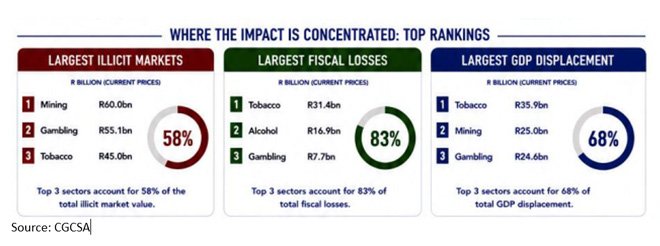
According to the CGCSA study, the overarching “supply enablers” of illicit trade are tax and excise duty differentials, fragmented regulation and enforcement, traceability gaps, import dependence, and complex supply chains.
A September 2026 study by Ipsos, commissioned by British American Tobacco South Africa (BATSA), found that 74.45% of sampled retail outlets sold the cheapest available pack of 20 cigarettes for R27.12 or less. This is the Minimum Collectable Tax (MCT) per pack, comprising R23.58 in excise duty and R3.54 in VAT on the excise. The study also found that 65.27% of sampled outlets sold packs for R20 or less.
Some manufacturers are selling their products for as little as R7 per packet.
Following the MTBPS, the South African Breweries (SAB) called for a “fair, predictable and inflation-linked excise framework” for beer. The company also urged the government to intensify efforts to combat illicit alcohol.
“South Africa is already grappling with a growing illicit alcohol trade that threatens consumer safety, undermines legitimate businesses and deprives government of vital sustainable economic growth.”
Euromonitor International estimated that illicit alcohol cost the fiscus R16.5 billion in lost revenue in 2024. Illicit volumes have reportedly increased by 55% since 2017.
A balanced approach
Across all 12 sectors included in the CGCSA study, the estimated revenue loss is R68 billion.
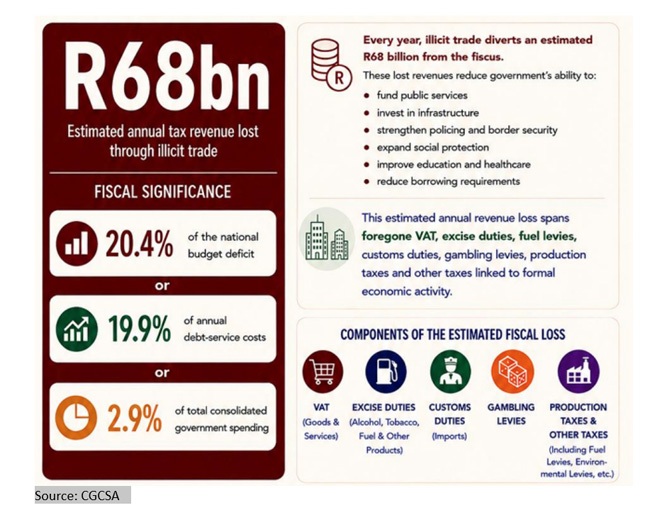
“Addressing this challenge (of rising illicit trade) requires a balanced approach that combines predictable taxation with stronger enforcement against illegal operators,” the brewer said in a statement.
“Excise policy should support a viable legal market rather than inadvertently create conditions that make illicit products more competitive.”
With regards to the proposed national gambling tax, Lurie cautions that “any assessment of the proposed tax must consider the cumulative burden on licensed operators, rather than looking at the national tax in isolation”.
Although the public consultation period on Treasury’s discussion paper has already closed, Lurie believes more detailed economic analysis and engagement are needed before a final decision is taken.
Erosion of tax base
He argues that Treasury should assess the likely impact of different tax rates on customer behaviour, employment, investment, provincial revenue and the sustainability of the regulated market. The modelling should also account for the potential erosion of the tax base if customers move to unlicensed operators.
“If higher taxes undermine the competitiveness of licensed operators, the result may not be less gambling. Consumers could simply migrate to illegal offshore sites, where they have fewer protections and where the South African government receives no tax revenue,” says Lurie.
He believes a more effective approach would combine a sustainable tax rate with stronger enforcement against illegal offshore gambling operators and measurable investment in responsible gambling initiatives.
According to the CGCSA study, the illicit gambling market in South Africa is structurally distinct from every other sector covered in their report. The illegal market is not a marginal parallel economy operating alongside a dominant legitimate sector.
It is a market in which unlicensed operators have captured a substantial share of consumer activity. This reflects the limitations of the current prohibition-based approach.
While online casino and poker products remain unlawful, consumer demand has increasingly migrated to offshore platforms operating beyond the reach of domestic licensing and taxation frameworks.
“The consequences – fiscal losses, consumer exposure to unregulated platforms, amplification of social harm, and the competitive undermining of licensed operators – are direct and material,” the report states.
Amanda Visser is a freelance journalist who specialises in tax and has written about trade law, competition law, and regulatory issues.
Disclaimer: The views expressed in this article are those of the writer and are not necessarily shared by Moonstone Information Refinery or its sister companies. The article is intended for general educational purposes and does not constitute financial advice, investment advice, legal advice, or a regulatory compliance opinion.