
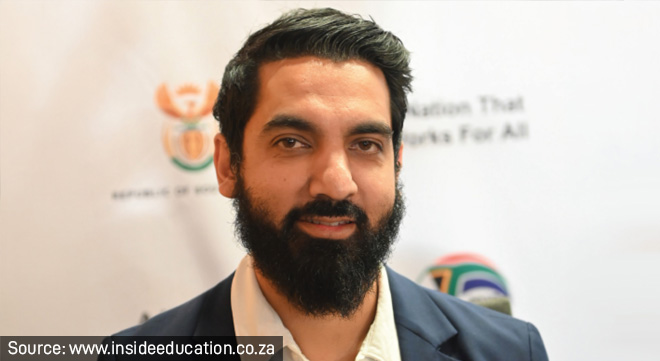
Waseem Carrim (pictured) is taking over the Road Accident Fund at a time when the problems at the institution extend well beyond the CEO’s office.
Cabinet announced on 29 September 2026 that Carrim, a Chartered Accountant and former acting CEO of the National Student Financial Aid Scheme (NSFAS), had been appointed as the RAF’s new chief executive.
His appointment is subject to verification of his qualifications and relevant security clearances.
Carrim takes over from Collins Letsoalo, whose five-year tenure at the RAF has been examined extensively by Parliament’s Standing Committee on Public Accounts (SCOPA).
The committee has looked at the Fund’s governance, financial management, procurement, claims administration, litigation, and human resources.
The RAF had four CEOs in seven months in 2025, with Letsoalo’s contract expiring in August, followed by the suspension of acting CEO Phathutshedzo Lukhwareni, the appointment and subsequent resignation of interim CEO Victor Songelwa, and Radikwena Phora taking over as acting CEO in December.
Carrim arrives at an institution that has been through considerable management instability while its operational problems have continued to build.
What Carrim is walking into
The RAF’s financial position has deteriorated sharply over the past few years.
The Fund moved from a clean audit in 2019/20 to three consecutive adverse audit opinions. Part of that history is tied to the RAF’s decision to move from the Generally Recognised Accounting Practice (GRAP) framework to IPSAS 42. Under IPSAS 42, the Fund reported liabilities of about R34 billion, compared with R327bn under GRAP.
A court subsequently found that the change had not been approved. The RAF spent more than R11.2 million on the litigation before its interim board withdrew its Constitutional Court application. The Fund has since returned to the prescribed GRAP framework and received an unqualified audit opinion.
Read: RAF moves to curb default judgments as legal reforms gather pace
On the ground, the RAF had 301 203 open claims at 30 June 2026. Of these, 253 837 were personal claims and 47 366 were supplier claims. Most – 263 801, or 88% – were still on the Legacy claims system, while 37 402 were on Bokamoso.
During the first quarter of the 2026/27 financial year, the RAF registered 31 269 claims and finalised 17 428.
The Fund paid R8.9bn on 80 665 claims during the quarter, 54% more than the R5.8bn paid in the same period a year earlier. Even so, the amount requested but not yet paid increased from R18.56bn at the start of the quarter to R22.18bn by 30 June.
Read: RAF pays R8.9bn in quarter, but payment queue grows
The number of claims entering and leaving the system has also fallen sharply.
New claims dropped from 328 173 in 2018/19 to 65 732 in 2024/25. Finalised claims fell from 229 534 to 78 384 over the same period.
Weekly registrations, which were once close to 2 000, have fallen to just over 300.
Read: SCA ruling revives rejected RAF claims – and backdates the bill
Former chief financial officer Victor Songelwa told SCOPA that management had ignored internal warnings after the 2020 decision to dissolve the Fund’s panel of attorneys.
Read: RAF management dismissed warnings as ‘negativity’ while claims crisis deepened
More than 100 law firms, representing about 500 attorneys, were removed from the panel. The Office of the State Attorney was expected to take over the RAF’s litigation but had fewer than 20 lawyers nationally available to handle the work.
Thousands of cases were left unattended. Default judgments followed.
SCOPA heard that the RAF paid R8.63bn in legal costs to its 20 largest plaintiff law firms between April 2020 and December 2025. The committee also found that the cost of settling claims had increased from an average of R114 008 in 2018/19 to R286 825 in 2023/24 and R348 100 in 2024/25.
There were more than 7 500 default judgments in the Pretoria High Court alone between April 2022 and May 2024.
Read: SCOPA blames RAF’s litigation failures for billions in legal costs
The RAF is also dealing with a separate problem created by the Supreme Court of Appeal’s ruling on its RAF 1 claim form.
In April 2026, the SCA set aside the 2022 RAF 1 Form regime, leaving the 2008 version in place. Claimants whose submissions were rejected or not acknowledged under the 2022 regime were given until 30 September 2026 to resubmit them using the 2008 form.
By 1 July, the RAF had received 62 643 claims in this post-judgment stream. Based on the rate of intake, the Fund expected a further 96 948 claims to arrive by the September deadline, taking the projected total to 159 591.
These claims are additional to the RAF’s ordinary day-to-day claims workload.
Read: RAF faces surge of almost 160 000 claims after SCA ruling
The Letsoalo years
Many of the issues now facing Carrim were examined during SCOPA’s investigation into Letsoalo’s tenure.
The committee heard evidence about procurement, labour disputes, acting appointments, specialist advisers, and what it described as a parallel management structure.
Between April 2020 and June 2025, 188 RAF employees were suspended. Thirty-five remained suspended when SCOPA considered the matter.
The RAF also spent R121.26m on labour-related legal fees and R5.57m on acting allowances, according to the committee’s findings.
Its close-protection arrangements came under scrutiny too.
A board-approved security benefit that initially cost about R480 000 a year grew into an operation involving nine officers and three vehicles, including an armoured BMW X5. Operational spending on the arrangement reached R20.3m between 2021 and 2025, in addition to R7.18m in officer salaries.
Read: What was Collins Letsoalo thinking?
Letsoalo did not appear before SCOPA despite being summoned.
In June 2026, SCOPA resolved to ask the Secretary to Parliament to lay a criminal charge against Letsoalo for failing to appear before the committee in response to a summons issued during the RAF inquiry. Parliament said the charge related to his failure to comply with the summons.
SCOPA subsequently handed evidentiary documents to SAPS, which was preparing a docket for referral to the National Prosecuting Authority.
The vetting question
SCOPA found that Letsoalo was never vetted by the State Security Agency during his five years as RAF CEO. The committee also heard that security vetting for several other executives was incomplete.
Carrim’s appointment as RAF CEO is subject to verification of his qualifications and relevant security clearances. At least the process will not be entirely new to him. Earlier this year, as part of the process to appoint a permanent CEO at the NSFAS, he underwent a psychometric assessment, as well as criminal, credit and qualification checks.
The Sunday Times reported in May that Carrim had applied for the NSFAS post in June 2025 and underwent the assessments and verification checks in April 2026, while serving as acting CEO.
Carrim’s track record
On paper, Carrim’s CV ticks several of the boxes the RAF needs.
He is a Chartered Accountant who started his career at KPMG before moving into the public sector. He has a BCom Honours in Accounting Sciences and a Master’s in taxation from the University of Pretoria, as well as an MBA from Wits Business School.
His public-sector career has taken him through both financial and executive roles at organisations with large budgets and plenty of administrative complexity.
He served first as CFO and then CEO of the National Youth Development Agency (NYDA). The agency recorded nine consecutive clean audit outcomes during his tenure, according to the government.
He later joined the NSFAS as CFO and became acting CEO in March 2025.
The NSFAS was already under pressure when Carrim took over as acting CEO. There were, however, some tangible improvements in the way the scheme was operating. By February 2026, the NSFAS said it had cleared more than 180 000 outstanding documents, resulting in 50 000 additional funding approvals. By March, it had processed more than 101 000 appeals and made billions of rand in payments to universities and TVET colleges for student allowances and tuition.
There was movement on the financial reporting backlog too. In March, Higher Education and Training Minister Buti Manamela said the NSFAS had resolved its backlog of late financial submissions and was on track to meet its Public Finance Management Act reporting deadlines for 2025/26.
That did not mean the NSFAS’s wider problems had gone away. Its 2024/25 audit resulted in a disclaimer of opinion, with nine material irregularities recorded. In May, Manamela placed the NSFAS under administration, citing governance instability, legal concerns and operational weaknesses.
So Carrim has already had a stint at another troubled public entity. He has had to keep the day-to-day machinery moving while dealing with problems that went well beyond the operations under his control.
The RAF brings all of that, and more, to his new desk.
SCOPA chairperson Songezo Zibi has described the RAF as technically insolvent, pointing to liabilities of more than R100bn against annual revenue of about R50bn from the fuel levy. He has argued that changes to governance alone will not resolve the Fund’s problems.
The immediate task is to get claims moving, deal with the legal consequences of the existing backlog, strengthen the Fund’s internal capacity and work through the governance and accounting issues that have accumulated over several years.
Whether those changes can be made while the RAF continues paying billions of rand in claims each quarter will be one of the first tests of the new CEO.


