
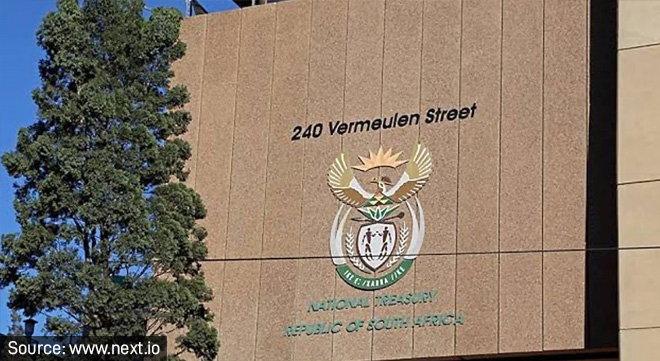

Parliament has given National Treasury, the Department of Co-operative Governance and Traditional Affairs (COGTA) and the Financial and Fiscal Commission (FFC) seven days to resolve legal questions surrounding the withholding of equitable share allocations from 69 municipalities and propose a way forward that safeguards both service delivery and parliamentary oversight.
The directive followed a joint meeting on 17 July of the Portfolio Committee on Cooperative Governance and Traditional Affairs and the Standing Committees on Public Accounts (SCOPA), Finance, and Appropriations, which received briefings from Treasury, COGTA, the FFC, and the South African Local Government Association (SALGA) on Treasury’s intervention in terms of section 216(2) of the Constitution.
Read: Treasury intervention lays bare concentrated municipal debt
Although the committees reaffirmed that Treasury’s constitutional authority to intervene where municipalities repeatedly breach financial management requirements was not in dispute, they said the intervention must be implemented lawfully, transparently, and without unnecessarily disadvantaging communities.
The committees also acknowledged that municipalities are not all in the same position. Although some continue to suffer from governance failures, others face structural constraints, including unpaid accounts owed by other organs of state.
Members also heard that the affected municipalities are owed R217.9 billion by households (R158.3bn), businesses (R46.4bn), organs of state (R11.6bn), and other entities (R1.6bn). SCOPA requested a list of departments and public entities with outstanding municipal debts, widening Parliament’s oversight beyond local government.
Treasury reports early compliance as accountability drive widens
Treasury Director-General Duncan Pieterse said the intervention formed part of the government’s broader shift “from oversight to active structural intervention” aimed at restoring municipal financial sustainability and service delivery.
Responding to questions from MPs, Finance Minister Enoch Godongwana said Treasury and COGTA had already agreed to adopt a differentiated approach for municipalities facing genuine financial distress, rather than treating all affected municipalities in the same way.
“We accept that there should be a differentiated approach,” Godongwana said. “Our teams must begin to isolate those municipalities that are really in distress, and how are we going to work together to support those municipalities.”
He added that Treasury wanted to move “as swiftly as possible” to minimise the impact of the intervention on affected communities.
Pieterse said all 69 municipalities had responded to the Minister of Finance’s letter, and Treasury and provincial treasuries were working with municipalities to assess their submissions and help them meet the conditions for the release of withheld equitable share allocations. Treasury will continue releasing funding weekly as municipalities comply with the required measures.
By 16 July, 27 municipalities had already received payments. Ten municipalities that had fully met Treasury’s requirements received the full amount of their withheld allocations, totalling R1.7bn. A further 17 municipalities received partial payments amounting to R2.9bn to settle debts owed to specified creditors, including the South African Revenue Service, retirement funds, Eskom, the Auditor-General of South Africa, and water boards.
Treasury said the balance of their allocations would be released once municipalities submitted proof that those payments had been made. A further 22 municipalities were expected to receive either full or partial payments during the week of 20 July, depending on their level of compliance.
Pieterse also updated Parliament on Treasury’s efforts to recover money owed to municipalities by other spheres of government. He said all eight provinces that had received Treasury’s letters regarding outstanding municipal debt had responded.
Read: Treasury’s crackdown spreads beyond municipalities
Treasury had analysed their submissions and was preparing a second round of letters requesting outstanding documentation and reasonable payment terms.
At national level, Treasury has used allocation letters to notify departments of its intention to invoke section 216, and now that the Appropriation Act is in force, it will issue final notices before withholding funds where departments fail to settle outstanding municipal debt.
FFC: ‘One instrument cannot fit 69 different municipalities’
The FFC urged Parliament to avoid a one-size-fits-all approach to the 69 municipalities affected by Treasury’s intervention, arguing they face markedly different financial circumstances and should not all be subjected to the same corrective measures.
Presenting the Commission’s submission, chairperson Dr Patience Nombeko Mbava said the municipalities were “not homogeneous”.
“One instrument cannot fit 69 different municipalities,” she told the committees, arguing that oversight and support should be tailored to the underlying causes of each municipality’s financial distress. While some municipalities faced structural constraints, others required stronger governance interventions and consequence management.
The Commission argued that the municipalities’ financial position is more complex than the headline figures suggest. It said the 69 municipalities were collectively owed about R217.9bn by households, businesses, and organs of state, while owing creditors about R97.4bn. Mbava cautioned that the apparent surplus was misleading because nearly 90% of the money owed to municipalities was already more than 90 days old and much of it was unlikely to be recovered, whereas liabilities owed to Eskom and water boards remained immediately enforceable.
“So, the net creditor position is misleading,” she said. “The money coming in is stale and largely gone, while the money that they have to pay is hard and enforceable.”
Mbava also questioned the uneven application of payment rules across the government. She noted that national and provincial departments collectively owed the affected municipalities R11.6bn, with almost 90% of that debt more than 90 days overdue.
“The smallest and weakest sphere of government faces the hardest instrument, while the state’s own arrears to municipalities attract no equivalent sanction whatsoever,” she said. “If the 30-day rule is worth enforcing against struggling municipalities, it must be worth enforcing against all national departments.”
The Commission acknowledged structural challenges such as weak revenue bases, unfunded mandates, and heavy service responsibilities, but said these alone could not explain the deterioration in municipal finances.
“Our answer holds two truths at once,” Mbava said. “The structural constraints are real … but those constraints cannot explain the scale and persistence of this deterioration. The decisive driver then is recurring financial management failure.”
The Commission recommended targeted institutional support for structurally constrained municipalities, alongside stronger enforcement and consequence management where governance failures are the primary cause of financial distress.
Parliament seeks legal clarity
The meeting also exposed differing legal interpretations of Treasury’s intervention.
The FFC argued that the legislation governing the stopping of equitable share allocations required closer examination. The Commission maintained that the Constitution and the Municipal Finance Management Act (MFMA) refer to the stopping of equitable share transfers, while the concept of temporary withholding appears in the Division of Revenue Act only in relation to certain conditional grants. It argued that the current intervention should therefore be assessed against the applicable constitutional and statutory provisions.
Parliamentary Legal Services, however, cautioned that its formal legal opinion was still being finalised. Presenting an interim briefing, parliamentary legal adviser Phumelele Ngema said the office was examining how section 216(2) of the Constitution, the MFMA, and the Division of Revenue Act interact in the current intervention and would provide the committees with a comprehensive legal opinion once that work had been completed.
Ngema acknowledged that the committees had heard different interpretations of the legislation and said Parliamentary Legal Services would consider those views before finalising its opinion. She said Parliament would need to consider the specific legal instrument used by Treasury, the statutory requirements attached to it, and Parliament’s own oversight responsibilities before determining the applicable legal process.
The differing legal interpretations prompted the joint committees to direct National Treasury, COGTA, and the FFC to meet urgently, resolve the legal questions, and report back within seven days with a proposed way forward.



This commission does not know what it is talking about. The majority of the debt owed by state organs is in dispute. The household debt registry could be outdated, which is why the Treasury is engaging municipalities one by one. On the legal question, there must be real consequences for misleading Parliament.