
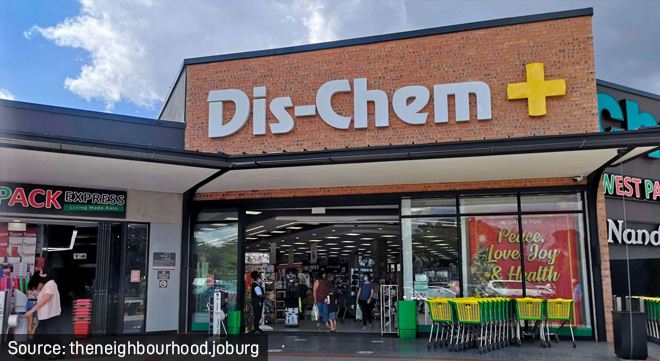
South Africa’s retail pharmacy market appears to be moving towards an oligopoly and could ultimately become a duopoly dominated by Clicks and Dis-Chem, according to an assessment report by the Competition Commission.
The Commission identified likely benefits for consumers at pharmacies acquired by Dis-Chem. These included lower dispensing fees for scheduled medicines, lower prices for unscheduled medicines, a wider range of front-shop products, and the roll-out of additional healthcare services. However, it is concerned that the advantages supporting these benefits may progressively make it harder for smaller groups and independent pharmacies to compete.
The Commission’s final report is dated March 2026 and was made public on 20 November. The study examined Dis-Chem’s acquisitions of independent pharmacies since 2016 to inform future merger and conduct assessments. The study was conducted under section 21A of the Competition Act, which empowers the Commission to review the effects of its previous decisions.
Between 2016 and 2025, Dis-Chem concluded 23 transactions involving about 72 independent pharmacy stores. Only three were notifiable under the merger-control thresholds. The stores accounted for about 23% of Dis-Chem’s 317 corporately owned stores at the end of its 2026 financial year.
In the last notifiable Dis-Chem pharmacy transaction it reviewed, the Commission said the group might be pursuing a “merger creep” strategy. The impact assessment examined the cumulative effects of the transactions against that background.
The Commission found that the acquisitions had expanded Dis-Chem’s retail footprint and increased the scale of its wholesale operation. This enhanced its ability to compete on price and enter medical scheme provider arrangements and other corporate partnerships.
Market position extends beyond store numbers
By store numbers, the Commission’s calculations from MedPages and company data put unaffiliated independent pharmacies at 26.81%, Clicks and The Link (its franchise brand) at 26.16%, and Dis-Chem and The Local Choice (Dis-Chem’s franchise brand) at 14.42%. Other separately listed groups and franchise networks also include independently owned pharmacies, so the 26.81% figure does not represent the full extent of independent ownership.
The Commission cautioned that store numbers were not an appropriate measure of market power on their own because they did not capture the differentiated nature of competition between pharmacies.
Different measures produce different pictures of the market. The Commission estimated that Clicks and Dis-Chem together accounted for 48.3% of dispensary income in 2025, divided almost equally between them. Information submitted by Clicks put independent pharmacies and small independent groups’ share of scheduled-medicine revenue at 40.87% in 2023 and their volume share at 49.76%. These figures use a broader category and measure medicine sales rather than store numbers, so they are not directly comparable with the store-share estimates.
The report cites an earlier Commission finding that the retail pharmacy market was highly concentrated but did not have a presumptively dominant firm.
According to the Commission, Clicks and Dis-Chem’s influence also extends into pharmaceutical wholesaling. Clicks owns United Pharmaceutical Distributors, which had an estimated 26% wholesale share in 2025. Dis-Chem’s CJ Distribution had about 24%. Each supplied more than 1 000 independent pharmacy customers.
The Commission said Dis-Chem’s retail expansion and wholesale scale had created a “virtuous cycle of consolidation”. More stores increase demand through CJ Distribution, while greater wholesale scale can improve procurement terms, logistics, stock availability, and retail competitiveness, supporting further growth.
Dis-Chem also extends its retail and wholesale reach through The Local Choice, its franchise network. The report says it had about 240 franchisees, was targeting 500 stores, and held a first right of refusal when franchisees sold their businesses.
The picture also differs geographically. According to the report, corporate pharmacies are concentrated mainly in large cities. Clicks has the broadest national footprint, while Dis-Chem is concentrated in larger urban and suburban centres. Independent franchise pharmacies have a stronger presence in secondary cities and rural towns.
The Commission said independent pharmacies were likely to survive in rural and less densely populated areas in the short term because of the corporate groups’ current limited interest in these markets. However, the groups were looking to expand into these areas, and into lower-income segments through low-cost offerings, leaving the longer-term position of independents uncertain.
Dis-Chem appeared most competitive for scheme customers
The Commission could not make its preferred comparison of prices immediately before and after each acquisition because Dis-Chem said its relevant pricing data were available only from 2021.
It instead compared Dis-Chem with selected competing pharmacies between 2021 and 2024. The sample covered 10 of Dis-Chem’s top-selling medicines and three front-shop products sold by pharmacies within five kilometres of acquired stores. The results were not necessarily representative of all products, pharmacies, or local markets.
Although the single exit price (SEP) system regulates medicine prices, the Commission found unexplained differences in the SEP data supplied by pharmacies. It regarded these differences as suggesting that some competition was occurring on the SEP component itself. It therefore compared total prices, comprising the reported SEP and dispensing fee, as well as dispensing fees separately.
In this limited sample, Dis-Chem’s prices for customers covered by medical schemes were, on average, lower than those of competing pharmacies. The Commission said Dis-Chem appeared to be the most price-competitive overall, although other firms were competitive in some product and medicine-schedule categories.
Dis-Chem’s dispensing fees to medical schemes were the lowest among the sampled firms across all medicine schedule classifications. The Commission said this indicated that Dis-Chem appeared to price to attract medical scheme business. Competitors generally charged cash-paying customers lower dispensing fees, although the results differed by schedule and year.
The firms were anonymised in the non-confidential report, so the published results do not show whether Clicks was cheaper or more expensive than Dis-Chem in any category.
The report says the corporate groups’ front-shop businesses leave them less dependent on dispensing margins and give them more scope to use lower fees to attract customers. It cites estimates from Camissa Asset Management that medicine sales account for about 70% of independent pharmacies’ revenue, compared with less than 40% for Dis-Chem and less than 30% for Clicks.
Market participants submitted that some dispensing fees charged by vertically integrated corporate pharmacies were unsustainable for independents that relied more heavily on dispensary income. This was their view. The report makes no finding on whether the fees were below cost or constituted predatory pricing.
The Commission could not determine how the acquisitions affected non-price competition, including service quality. It is nevertheless concerned that greater concentration could reduce the personalised service, community-based offerings, and innovation associated with independent pharmacies.
Scheme networks may reinforce scale
The report says designated service provider (DSP) and preferred service provider (PSP) arrangements enable medical schemes to contain costs by obtaining lower set rates for medicines and pharmaceutical services. Network providers gain access to medical scheme member volumes.
Members are encouraged to use network pharmacies to avoid out-of-pocket penalties. Citing information from the websites of GEMS, Polmed, and Discovery Health Medical Scheme, the report says schemes may levy co-payments of between 20% and 30% when members use non-DSP providers. It says members typically avoid co-payments when they obtain approved chronic medicines from in-network pharmacies.
The Independent Community Pharmacy Association submitted that independents often struggled to satisfy network requirements involving geographic reach, information systems, negotiated fees, operating capacity, and performance monitoring.
Medical schemes told the Commission that all pharmacies had an equal opportunity to join their networks. The Commission observed that the largest networks included corporate and independent pharmacies. It also noted, based on earlier investigations, that some schemes contracted store by store, regardless of ownership, while others contracted with pharmacy groups.
The Commission also concluded that Dis-Chem’s acquisitions had expanded its geographic footprint and enhanced its “must-have” status and bargaining power in negotiations with medical schemes.
The report also says higher dispensing fees paid to participating independents may support their viability because they depend more heavily on dispensary income.
Why merger control may not be enough
The Commission said it could be difficult to establish a substantial lessening of competition in an individual single-store transaction, although a series of acquisitions could cumulatively change the market’s structure. Many transactions also fall below the thresholds requiring notification.
Pharmacy licence transfers do not involve a competition assessment. Franchisees may also join networks without the arrangement being assessed as a merger, although this can extend a franchisor’s retail and wholesale reach. Given the difficulty of establishing a substantial lessening of competition in single-store transactions, the Commission said pharmacy licensing might be a more useful intervention tool than competition law.
It is engaging the National Department of Health about the licensing regime and its competition implications.
The report says the pharmacy-licensing framework limits the number of pharmacies that may operate in a shopping centre, depending on its size. It says some landlords terminate independent pharmacies’ leases to accommodate Clicks or Dis-Chem. Under the licensing rules, a new pharmacy may generally not be sited within 500 metres of an existing one, so a displaced pharmacy may have no alternative licensed location within that radius. The Commission described this as a “Hobson’s choice”: selling to a large group or being displaced by the landlord.
Issues identified for further consideration
The impact assessment does not impose remedies or make binding recommendations. It identifies issues for further consideration.
The Commission said future merger assessments may need to look beyond the number of stores added in an individual local market. Revenue shares, vertical integration, franchise arrangements, medical scheme relationships, and the cumulative effect of earlier acquisitions may provide a fuller picture.
Other measures that could be explored include joint negotiations by smaller groups and independent franchisors, competition-law exemptions or advisory opinions, and a more permissive merger-control or licensing approach for smaller competitors. The Commission also identified franchise operations, medical scheme provider arrangements, and corporate partnerships for further scrutiny where they may have exclusionary effects.
Separately, it is investigating a complaint from the Minister of Health about whether loyalty schemes apply to dispensed medicines sold at regulated single exit prices and the implications for competition. The assessment does not disclose the outcome.
The Commission’s possible interventions are intended to address its concern that the cumulative advantages of large, vertically integrated groups could weaken the differentiated services and competitive constraint provided by smaller groups and independent pharmacies. The report identifies these matters for further consideration but does not evaluate the effects of particular interventions on prices, services, or consumer choice.