Some Budgets make noise. This one keeps its head down and gets on with the job. South Africa’s 2026 Budget offers no splashy giveaways or ideological pivots. Instead, it focuses on one thing: stabilising the public finances after a long stretch of pressure, policy drift, and last year’s bruising Budget politics.
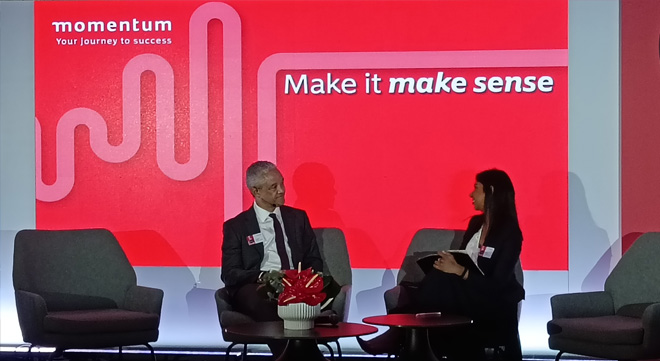
That was the tone of a post-Budget discussion on 27 February between Momentum chief economist Sanisha Packirisamy and National Treasury Director-General Dr Duncan Pieterse. Their exchange showed a Treasury less interested in headlines than in holding the line – locking in discipline, defending primary surpluses, tightening municipal controls, and confronting the structural problems that keep growth weak.
Here is what stood out.
A politically palatable budget with fiscal backbone
Packirisamy called the 2026 framework a rare case of politics and prudence moving in the same direction. Unlike the turbulence surrounding the previous Budget cycle, she said this one was “very politically palatable” while still maintaining discipline. Even frequent critics, she noted, “were quite complimentary of all of the fiscal issues that were announced”.
She asked how Treasury intends to protect fiscal stability in a political environment where major decisions now require broader agreement. Pieterse said the answer starts with process. Treasury now takes Budget guidelines to Cabinet at the beginning of the cycle instead of treating them as an internal technical step.
“We started the preparation for this year’s Budget by tabling those guidelines at Cabinet, and getting Cabinet endorsement,” he said, adding that early engagement helps to secure buy-in and reduces the risk of late-stage compromises that could weaken the framework.
Locking discipline into law
Pieterse also pointed to a structural reform: a proposed fiscal anchor. He described it as “a legislative provision that entrenches the idea of debt sustainability into law by requiring that every new administration must table a plan to stabilize public finances”.
South Africa has seen fiscal metrics improve before, only to slip again when political priorities shifted. A fiscal anchor is meant to make that harder. As Pieterse explained, the anchor is designed to secure “a peak in the debt-to-GDP ratio, and then for that ratio to start coming down”, by locking in a commitment to growing primary surpluses and restraining non-interest spending over time.
In his view, the anchor is not just a technical device but a way of hard-wiring credibility: it “entrenches the idea of debt sustainability into law” so that fiscal prudence becomes a “well-entrenched feature of fiscal policy” rather than something that depends on the preferences of a particular Cabinet. It would not eliminate risk, but it would raise the bar for future administrations, forcing them to table a clear fiscal plan and to publicly justify any departure from a debt-stabilising path.
Growth is the real constraint
What’s really driving the problem, Packirisamy asked – is it spending, revenue, or growth?
Pieterse answered: “I think both of those issues fail in comparison to the first, which is that our growth is structurally low.” When growth trails population expansion, pressure builds quickly because spending cannot keep up with rising demand.
He acknowledged that revenue administration has improved as the South African Revenue Service strengthened its capabilities. But he emphasised that in a low-growth environment, even well-allocated budgets are forced into permanent trade-offs. Fiscal sustainability, he argued, ultimately depends on stronger, sustained growth rather than short-term fixes.
Illicit activity and state capacity
Packirisamy cited estimates suggesting illicit economic activity may now account for 12% to 15% of GDP, up from roughly 5% previously. At that scale, the issue is not marginal – it affects revenue, labour data, and state authority.
Pieterse linked this to lessons from South Africa’s greylisting by the Financial Action Task Force, which exposed weaknesses in enforcement co-ordination and oversight but also prompted reforms.
“That did give us an opportunity to strengthen many of our systems… and I think we are building on those successes.”
Treasury has backed enforcement with targeted funding from the Criminal Assets Recovery Account, including:
- R1 billion for the Department of Defence;
- R1bn for the police; and
- about R800 million over three years for the Border Management Authority, over and above its baseline, to secure ports of entry.
Still, he emphasised that funding is not the main constraint.
“I would say the lack of funding is not the issue. I think it’s about building on inter agency co-operation… strengthening our prosecution system… and greater accountability for the resources that are being allocated.”
Primary surpluses and saying no
Treasury has framed the 2026 Budget as a turning point because it locks in a third consecutive primary surplus, with surpluses projected to grow over the medium term. Packirisamy asked why officials believe that trend can hold despite ongoing risks.
Read: Is South Africa finally turning the corner on debt?
Pieterse said the surplus is the mechanism that stabilises debt.
“We’re pretty confident that we’ll be able to secure a growing primary surplus… because that’s the way… to secure a peak in the debt-to-GDP ratio, and then for that ratio to start coming down.”
He said spending restraint is now embedded and supported by “targeted and responsible savings”, while revenue projections deliberately exclude anticipated commodity windfalls, leaving room for upside if they materialise.
“A growing primary surplus is now a well-entrenched feature of fiscal policy,” he added, noting that before the past three years, the last surplus was recorded in 2009.
The shift is political and technical. Treasury is drawing firmer lines on spending – and sticking to them.
Municipal distress and tighter controls
Local government remains a weak point. Packirisamy noted that 63% of municipalities are in financial distress and asked whether consolidation of the country’s 257 municipalities could realistically happen within five to ten years.
Pieterse said an upcoming white paper from the Department of Co-operative Governance and Traditional Affairs will propose more fundamental reforms to the local government system. In the meantime, Treasury is tightening enforcement:
- Infrastructure grants are being withheld from municipalities with poor spending records and redirected to more capable districts, the Development Bank of Southern Africa, or other implementing agents.
- Equitable share transfers are being handled more assertively where municipalities fail to pay water boards, Eskom, or retirement funds.
Treasury is also rolling out a metro incentive aimed at reversing underinvestment in core trading services such as water and electricity.
“We’ve introduced a new incentive to get these municipalities to reinvest the revenue that they collect from their basic trading services… back into those businesses… And we’ve allocated R54bn for that.”
The aim is to push municipalities towards reinvestment and maintenance rather than using service revenue to cross-subsidise unrelated spending.
Social grants and affordability pressure
Social support remains essential but costly. Packirisamy raised concerns about the trajectory of grant spending and cited the discovery of 35 000 fraudulent child-grant cases. She also asked whether South Africa might move toward more conditional grants, similar to systems used in countries such as Brazil.
Pieterse said grants already have eligibility criteria, but agreed verification can be strengthened. Treasury has worked with departments and the South African Social Security Agency “to really clamp down on that and to make sure that there’s a lot more verification of beneficiaries”.
The bigger concern is affordability.
“There has to be a conversation around the sort of long-term fiscal sustainability of adding new grants,” he said, noting that about 27 million beneficiaries receive payments every month. Expanding support in a low-growth environment carries a significant fiscal cost. Pieterse linked this pressure directly to the relationship between economic and population growth, warning that “when your economic growth is lower than population growth, which it has been for many years now, that creates a lot of pressure, because it means that spending growth cannot keep up with the needs of the population, and very, very tough choices need to be made, and that’s why a lot of our focus has been on how do we accelerate growth?”
Grants remain a core part of South Africa’s social compact, he added, but their long-term sustainability ultimately depends on employment growth.
“We must keep an eye on the long-term sustainability of this… and how do we ensure that we create the kind of work opportunities… so that you reduce the long-term burden on the state.”
Fiscal credibility and sovereignty
Packirisamy closed by widening the lens to global risks – trade fragmentation, geopolitical competition, and shifting capital flows – and asked how Treasury positions fiscal policy in a more volatile environment.
Pieterse linked discipline directly to independence.
“I think what it forces us to do is to think about the implications, or the relationship between fiscal sustainability and sovereignty,” he said. The path Treasury is now trying to chart – one “that has a lot more fiscal credibility and integrity” – is, in his words, what “allows us a greater degree of sovereignty”.
Countries with credible fiscal paths have more room to manoeuvre when global financing conditions tighten or external shocks hit. For Pieterse, that credibility rests on keeping debt on a downward trajectory, sustaining primary surpluses and maintaining stable public finances so that “to the extent that there is a less supportive global backdrop, or the geopolitics of the day disrupt the global order, there is a degree of domestic resilience that can help us to navigate that period more elegantly”.
The mix of primary surpluses, a potential fiscal anchor, and growth-focused reforms is therefore meant to do more than tidy up the books. It is meant to protect policy space – to ensure that, when the external environment turns, South Africa’s fiscal stance does not become another source of vulnerability but rather a source of resilience and room for choice.