

South African equity portfolios attracted net inflows of R13.8 billion in the third quarter of 2026, lifting their net inflows for the 12 months to the end of September to R18.6bn, according to the latest collective investment scheme statistics released by the Association for Savings and Investment South Africa (ASISA).
ASISA said the annual inflow was the highest recorded by SA equity portfolios in the past 10 years.
Of the quarterly inflows, R7.2bn went to portfolios in the SA Equity – SA General category, while SA Equity – General portfolios received R6.2bn. The balance reflected net movements across the other equity categories. Large Cap portfolios attracted R1.08bn, Industrial portfolios R129m, and Financial portfolios R63m. These inflows were partly offset by net outflows of R842m from Mid & Small Cap portfolios and R49m from Resources portfolios.
Sunette Mulder, ASISA’s chief of staff, said SA Equity – SA General portfolios had recorded quarterly net outflows from the fourth quarter of 2025 before receiving net inflows in the third quarter of 2026.
SA Equity – General portfolios, by comparison, recorded net inflows in each of the four quarters to the end of September 2026.
The SA Equity – SA General category was introduced in October 2024 for CIS portfolios that invest exclusively in South African shares.
Before the category was introduced, portfolios invested exclusively in South African shares were included in the SA Equity – General category, together with general equity portfolios that could invest in both local and foreign markets.
ASISA said separating the locally invested portfolios created a more comparable investment universe. Returns from portfolios with foreign exposure can also be affected by movements in the rand.
Inflows recorded during a volatile quarter
Mulder said the timing of the inflows into equity portfolios was noteworthy in view of the volatile investment conditions during the year and their effect on stock-market performance.
According to ASISA, the third quarter was marked by higher fuel prices resulting from a global oil supply shortage following further conflict in the Middle East and the destruction of Russian refineries.
South African diesel prices reached record highs in early October, adding to inflationary pressures. The South African Reserve Bank subsequently raised interest rates by 25 basis points.
During the third quarter, the JSE All Share Total Return Index declined by 0.27% in rand terms.
“Our quarterly statistics usually show that South African investors are quite risk-averse and reduce their exposure to equities when markets become more volatile. We were therefore surprised to see such strong interest in equity portfolios,” Mulder said.
She said equity portfolios tended to be more volatile than multi-asset and interest-bearing portfolios, which were structured to absorb market shocks. Historically, however, equity portfolios had delivered strong long-term performance, she said.
Long-term performance of portfolio categories
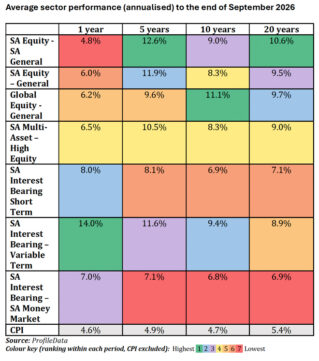
According to performance data from ProfileData, SA Equity – SA General portfolios recorded an average annualised return of 10.6% over the 20 years to the end of September 2026. This was the highest 20-year return among the seven investment categories included in the comparison.
Global Equity – General portfolios returned an annualised 9.7% over 20 years, while SA Equity – General portfolios returned 9.5%.
The performance rankings differed over the shorter reporting periods. SA Interest Bearing – Variable Term portfolios recorded the highest one-year return, at 14%, while SA Equity – SA General portfolios recorded the highest five-year annualised return, at 12.6%. Global Equity – General portfolios produced the highest 10-year annualised return, at 11.1%.
Although the SA Equity – SA General category was introduced in October 2024, qualifying portfolios were allowed to retain their performance histories when they moved into the category. ASISA said management companies had to provide evidence that the portfolios had historically complied with the category’s investment restrictions, based on their asset allocations or restrictions in their supplemental deeds. This enabled statistics providers to calculate historical category averages for periods before the category was introduced.
Multi-asset portfolios offer diversified exposure
Mulder said SA Multi-Asset – High Equity portfolios had provided investors seeking equity exposure with consistent performance across the periods covered by the table.
These portfolios returned 6.5% over the year to the end of September 2026. They produced average annualised returns of 10.5% over five years, 8.3% over 10 years, and 9% over 20 years.
Multi-asset portfolios invest across different asset classes in a single portfolio. The diversification is intended to reduce the effect of market movements in any one asset class.
Investors can choose among eight multi-asset categories: Flexible, High Equity, SA High Equity, Medium Equity, Low Equity, Income, SA Income, and Unclassified.
Local CIS industry records R56bn in quarterly net inflows
The local CIS industry ended September 2026 with assets under management of R4.6 trillion, unchanged from the end of June.
Participating CIS management companies recorded total net inflows of R56bn during the third quarter. New investments contributed R19bn, while reinvested income declarations, comprising dividends and interest, contributed R37bn.
Total net inflows for the 12 months to the end of September amounted to R218.2bn. Of this amount, R84bn came from new investments and R134bn from reinvested income.
At the end of the third quarter, 50% of the assets held in South African portfolios were invested in SA Multi-Asset portfolios. SA Interest Bearing portfolios accounted for 29%, SA Equity portfolios for 19%, and SA Real Estate portfolios for 2%.
CIS management companies that submit quarterly data to ASISA offered South African investors 1 980 local CIS portfolios at the end of September. This was 35 more than the 1 945 portfolios available at the end of June 2026.
Foreign portfolios record quarterly outflows
Assets under management in locally registered foreign portfolios declined from R1.2trn at the end of June to R1.1trn at the end of September.
These portfolios recorded net outflows of R7.7bn during the third quarter. Over the 12 months to the end of September, they recorded net inflows of R11.1bn.
There were 849 foreign currency-denominated portfolios available in South Africa at the end of September, compared with 813 at the end of June.