

Retirement fund trustees who choose investment managers on behalf of their members face a difficult question: what exactly should they be choosing for? Past performance? Where is a manager investing today? Or whether that manager favours the part of the JSE – large, mid, or small caps – that is currently outperforming?
The trouble is that today’s winner may not be tomorrow’s. Market-cap leadership changes, and trying to predict which part of the market will lead next is not possible.
The answer, as is so often the case in investing, lies in diversification. But appointing more managers does not necessarily produce a genuinely diversified portfolio. Trustees also need to consider whether the managers they select have different investment philosophies and sources of conviction, so that the portfolio is not dependent on one manager, one style, or one part of the market performing as expected.
We surveyed the flagship South African equity funds of 18 local asset managers and found substantial differences in their reported market-cap exposures. Ten of the 18 managers, or 56%, were overweight large caps relative to the FTSE/JSE Capped All Share Index. Of the 17 managers that reported small-cap exposure separately, ten, or 59%, were overweight small caps. These differences were not neatly explained by whether the manager was a large established house or a smaller boutique.
Market leadership keeps changing
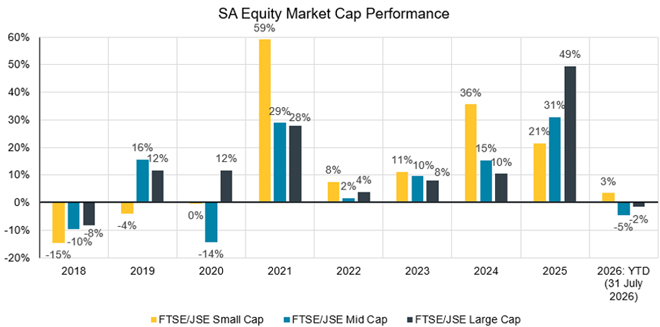
Recent history helps to explain why this matters. Large-, mid- and small-cap shares have each moved through periods of leadership as market conditions have changed. Small caps benefited strongly from the post-Covid growth rebound in 2021 and again from improving domestic sentiment around the government of national unity, economic reforms, and the start of the interest-rate-cutting cycle in 2024.
In 2025, the picture changed as the precious-metals rally favoured parts of the large-cap market. In 2026, as the rally cooled, smaller companies began catching up again.
Chart 1: SA Equity Market Cap Performance
Source: IRESS
The lesson is not which segment performed best. It is how difficult it is to predict which will lead next.
Large caps are fewer in number but dominate liquidity and trading activity on the JSE. Small caps are greater in number but tend to have lower liquidity and less research coverage, creating a different mix of opportunity and risk. Mid-caps sit somewhere between the two.
What managers are doing
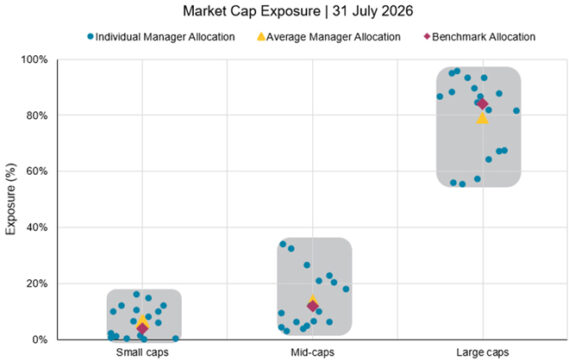
Our research examined the reported small-, mid-, and large-cap exposures of the flagship South African equity funds of 18 local asset managers at 31 July 2026. Managers were selected on the basis of assets under management and their prominence in the South African market, with the sample including large established houses and boutiques.
Chart 2: Asset manager market cap exposures
Source: Asset managers surveyed by Simeka
Where applicable, allocations were rescaled to 100% to account for small cash holdings within the surveyed South African equity portfolios.
At 31 July 2026, the FTSE/JSE Capped All Share Index comprised approximately 84% large caps, 11% mid-caps, and 5% small caps. Managers supplied their own classifications of market-cap exposure. Because they do not necessarily classify companies in the same way, the results indicate broad differences in positioning rather than provide a strictly like-for-like comparison.
Large caps remain the foundation of most portfolios, but the managers surveyed differed considerably in the extent of their exposure. Ten of the 18 managers, or 56%, were overweight large caps relative to the benchmark, while the remainder were underweight. Active managers generally construct their portfolios through bottom-up stock selection, although liquidity and trading costs can contribute to the prominence of large caps in their portfolios.
Of the 17 managers that reported a separate small-cap allocation, ten, or 59%, were overweight small caps. One manager provided only a combined small- and mid-cap figure and was excluded from this calculation. Lower research coverage can create opportunities to identify mispricing among small-cap companies, although lower liquidity can make meaningful positions more difficult to establish or exit. Mid-cap positioning also varied considerably.
Managers do not all classify small, mid- and large-cap companies in the same way, so the findings are best viewed as an indication of relative positioning rather than a perfectly like-for-like comparison.
But the spread itself tells us something important: there was no uniform view among the managers surveyed about where opportunities lay across the market-cap spectrum.
Diversifying conviction, not just managers
This is where the findings can inform trustees’ consideration of manager selection. In practice, a value-oriented manager may see a different opportunity from a growth- or quality-focused manager. One may find attractive opportunities among under-researched smaller businesses, while another may place greater emphasis on liquidity, scale, or earnings resilience.
Neither approach is necessarily wrong.
For trustees, the distinction highlights the potential role of different sources of investment conviction within a diversified portfolio. Establishing whether managers’ portfolios genuinely behave differently, however, also requires consideration of their underlying holdings, investment styles, factor exposures, and return correlations.
Two approaches are commonly seen in practice. A core-satellite model combines lower-cost passive exposure with selected high-conviction active managers. Another approach blends high-conviction active managers across the full equity allocation, giving managers greater freedom to pursue opportunities across the market-cap spectrum, although at a higher cost.
The latter approach depends on genuine differentiation among the managers selected.
Simply appointing several active managers does not necessarily result in meaningful diversification if they own similar companies for similar reasons. The important distinction is the extent to which managers differ, and whether their investment philosophies provide the overall portfolio with genuinely different sources of return.
Tomorrow’s winner is unknowable
Nobody knows with certainty whether the JSE’s next sustained period of leadership will come from large, mid-, or small caps. This uncertainty illustrates the potential value of portfolios that are not reliant on that call being right.
If market leadership continues to rotate, a combination of genuinely differentiated managers may provide exposure to opportunities across the market while reducing reliance on any single investment style, market-cap segment, or view of what happens next.
The dispersion in reported market-cap exposures does not, on its own, prove that the managers have genuinely different investment philosophies or sources of return. It does, however, illustrate why manager differentiation may be an important consideration for trustees constructing diversified portfolios.
Mubeen Abdulla is a senior investment consultant at Simeka Consultants and Actuaries.
Disclaimer: The views expressed in this article are those of the writer and are not necessarily shared by Moonstone Information Refinery or its sister companies. The article is intended for general educational purposes and does not constitute financial or investment advice.