

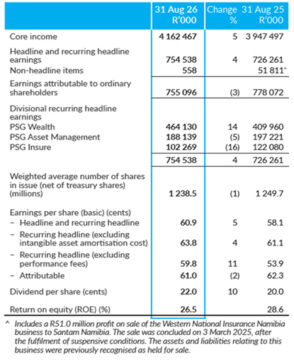
PSG Financial Services increased recurring headline earnings per share by 5% in the six months to August, but the growth was uneven. PSG Wealth reported higher earnings, while PSG Asset Management and PSG Insure made less than they did a year earlier. Return on equity also declined, from 28.6% to 26.5%.
The group’s unaudited results for the six months to 31 August 2026, released on 15 October, show recurring headline earnings rising 4% to R754.5 million. Core income increased 5% to R4.16 billion, and recurring headline earnings per share grew from 58.1 cents to 60.9 cents.
Profit attributable to ordinary shareholders fell 3% to R755.1m. The comparable period included R51.8m in non-headline items, including a R51m profit on the sale of the Western National Insurance Namibia business to Santam Namibia, concluded in March 2025.
PSG attributed its performance to an operating environment in which securities market conditions were “much less favourable than the previous comparable period”. Lower performance fees affected PSG Asset Management, while PSG Insure faced lower investment income and claims arising from the Western Cape storms in May.
“Notwithstanding these headwinds, the performance of our key operating and financial metrics demonstrates our competitive advantage and the resilience of our advice-led business model,” said PSG Financial Services chief executive Francois Gouws (pictured).
Despite these pressures, total assets under management increased 15% to R594.1bn. The results, however, varied considerably across the group’s three main businesses.
Across its distribution network, PSG had 998 advisers and 266 adviser offices at the end of August. This comprised 663 PSG Wealth advisers and 335 PSG Insure advisers.
Wealth delivers the growth
PSG Wealth increased recurring headline earnings by 14% to R464.1m. Core income rose 13%, supported by higher management and other recurring fees, as well as transactional brokerage fees.
Assets managed by its advisers reached R504.9bn, including R12.8bn in net inflows during the period.
The result puts PSG Wealth well ahead of the group’s other two businesses, PSG Asset Management and PSG Insure. Wealth’s R464.1m in recurring headline earnings accounted for more than half of the group’s total of R754.5m.
PSG said the division performed “in line with historical trends”. It also pointed to its investment in digital capabilities to improve the client experience and support advisers in maintaining long-term relationships with clients.
Asset management attracts money, but earns less
PSG Asset Management’s assets under management rose 30% to R89.2bn. Net client inflows reached R5.5bn, while assets administered by the division increased 5% to R339.2bn, supported by R6.2bn in multi-managed net inflows.
Yet recurring headline earnings fell 5% to R188.1m.
Management fees increased 20%, but lower performance fees weighed on the result. Across the group, performance fees accounted for 1.9% of headline earnings, compared with 7.3% in the previous comparable period.
PSG Asset Management said its “long-term track record of delivering top-quartile risk-adjusted investment returns” continued to support recurring earnings under difficult market conditions. However, the interim figures show that growth in assets and management fees was not enough to prevent earnings from declining.
At group level, recurring headline earnings per share excluding performance fees increased 11%, from 53.9 cents to 59.8 cents. This measure excludes the variable contribution from performance fees, although other sources of income remain exposed to market conditions.
Premiums rise as insurance earnings fall
PSG Insure’s gross written premium increased 5% to R4.2bn, but recurring headline earnings declined 16% to R102.3m.
The division reported lower investment income in a weaker securities market, while its underwriting result was affected by the Western Cape storms in May. Its net underwriting margin fell from 15.2% to 14.5%.
PSG said its reinsurance programme reduced the impact of the storm events. It described the 14.5% margin as “commendable” despite the decline from the previous period.
The group is also focusing on growing its commercial lines business, which requires specialist adviser expertise. At the end of August, PSG Insure had 335 non-life insurance advisers.
Premium growth did not translate into higher earnings. The division’s results reflect the effect that claims and investment income can have on profitability, even when the amount of business written increases.
Technology and people remain a priority
PSG increased technology and infrastructure spending by 4% compared with the previous period. Fixed remuneration costs rose 10%, and 95 newly qualified graduates joined the group.
The company says it is investing in technology to simplify processes, improve client onboarding and strengthen cybersecurity. It is also exploring artificial intelligence, with an emphasis on “responsible, secure, and value-driven implementation”.
PSG said technology and infrastructure costs continue to be fully expensed in line with its accounting policy. The spending remains a cost in the current period rather than being capitalised as an asset.
The group expects technology to help it handle higher business volumes more efficiently while maintaining a lean cost structure. The results record the additional spending, but its effect on future earnings remains to be seen.
Dividend increases as return on equity falls
PSG declared an interim gross dividend of 22 cents per share, up from 20 cents a year earlier. The board said the decision reflected the group’s strong cash position.
The dividend is payable on 9 November 2026. The last day to trade cum dividend is 2 November, and trading ex-dividend starts on 3 November. After dividend withholding tax at 20%, the net dividend is 17.6 cents per share for shareholders subject to the standard rate.
The group also repurchased and cancelled eight million shares at a cost of R243.3m during the six-month period.
Its capital cover ratio was 292%, compared with 299% a year earlier, and remained well above the regulatory minimum of 100%. In July, Global Credit Rating Company affirmed PSG’s long- and short-term credit ratings at AA-(ZA) and A1+(ZA), respectively, with a stable outlook.
The higher dividend comes as return on equity declined to 26.5%. The capital cover ratio remains well above the regulatory minimum, but the lower return on equity means the group generated a lower return relative to shareholders’ equity than in the comparable period.
A cautious outlook
PSG remains positive about South Africa’s long-term prospects, while acknowledging the pressures on the economy and global markets.
In its commentary, the group pointed to geopolitical uncertainty, pressure on global trade relationships, rising sovereign debt levels, and asset valuations in some sectors that it considers increasingly dependent on optimistic growth expectations. In South Africa, it said inflation and fiscal outcomes had generally remained well managed, but economic growth was still below the levels needed to address unemployment and poverty. Infrastructure constraints, uneven service delivery, and policy uncertainty continued to weigh on investment and economic activity.
“While we remain constructive about South Africa’s prospects, we recognise that short-term volatility and uncertainty are likely to persist,” PSG said.
The group plans to continue investing in technology and people at levels broadly in line with its long-term historical averages, while remaining disciplined as conditions change.
The next reporting period will show whether PSG Wealth can sustain its earnings growth, whether PSG Asset Management can turn higher assets and management fees into stronger earnings, and whether PSG Insure can improve its underwriting margin while continuing to grow premiums.