

Whoever said the numbers don’t lie has probably never experienced what an accounting standard can do to a set of financial statements.
The Road Accident Fund recorded revenue of R48.1bn last year. At year-end, its total liabilities stood at R452.4bn.
Most of the liability is made up of claims it is obliged to pay. But with assets of only R12.9bn, the Fund’s net liabilities stood at R439.5bn at 31 March 2026.
The figures were presented at Tuesday’s briefing on the RAF’s 2025/26 annual report. For the first time in several years, the Fund’s full financial position is being reported under the prescribed GRAP accounting framework.
The number that disappeared – and has now returned
In 2021, the Fund moved away from the accounting approach it had previously used and adopted an accounting policy based on IPSAS 42, the international public-sector standard dealing with social benefits.
The effect on the balance sheet was substantial. The RAF’s reported liabilities fell from R327bn in 2019/20 to about R34bn in 2020/21.
The Auditor-General rejected the change. The dispute went to court, with the Gauteng High Court finding that the RAF had not obtained the required approval from the Accounting Standards Board to depart from the prescribed GRAP framework. The Supreme Court of Appeal upheld that decision in September 2024 and rejected a further application by the RAF in March 2025.
The litigation cost the RAF more than R11.2m.
The previous RAF board continued the fight, resolving on 24 April 2025 to take the matter to the Constitutional Court.
That board was dissolved by Transport Minister Barbara Creecy on 15 July 2025. An interim board was appointed in August, with Kenneth Brown as chairperson. It was this new interim board that decided to withdraw the RAF’s Constitutional Court application. Brown confirmed the withdrawal to SCOPA on 3 February 2026, bringing the accounting litigation to an end.
Now that the RAF has returned to the prescribed GRAP framework, its 2025/26 annual report provides the first full-year financial picture since that decision — and the liabilities are back in the accounts.
R452.4bn of liabilities
The five-year comparison in the annual report shows how sharply the Fund’s financial position has changed.
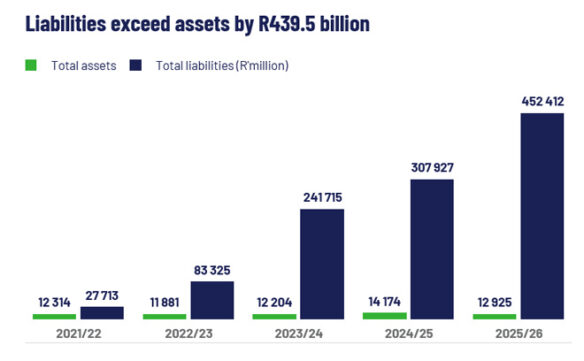
The main driver of the widening gap is the increase in claims liabilities, which reached R449.1bn in 2025/26.
Claims liabilities rose by R142.7bn during the year, compared with R66.2bn in 2024/25.
Much of the R81.5bn increase in the deficit is due to the provision for the RAF 1 Form obligation.
The Supreme Court of Appeal set aside the 2022 RAF 1 Form regime in April 2026. Claimants whose submissions had been rejected or not acknowledged under that regime were allowed to resubmit their claims using the 2008 form.
Read: SCA ruling revives rejected RAF claims – and backdates the bill
By July, the RAF had received 62 643 claims in this post-judgment stream and expected the total to reach almost 160 000 by the September deadline. The potential financial exposure associated with the RAF 1 Form claims is likely to run into the billions.
Read: RAF faces surge of almost 160 000 claims after SCA ruling
Those claims will come on top of the Fund’s ordinary claims workload.
A R145.7bn deficit in one year
The RAF reported a deficit of R145.7bn for 2025/26, more than double the R64.3bn recorded the previous year.
The Fund recorded R48.105bn in revenue and R51.174bn in expenditure during the year. That produced a deficit of R3.069bn before the movement in claims liabilities. It then recognised a R142.664bn net increase in claims liabilities.
Put together, the R3.069 billion operating deficit and the R142.664 billion increase in claims liabilities produced a reported deficit of R145.733 billion for the year.
The R142.664bn is the increase in claims liabilities recognised in the financial statements. The cash actually paid out in claims was R43.273bn.
Of this, R35.038bn went to compensation and medical payments and R8.235bn to legal and other claims-processing costs.
At present, the RAF’s revenue comes almost entirely from the fuel levy. Revenue fell 5% to R48.105bn. Average inflation was 3.3%, while the fuel levy remained unchanged at 218 cents a litre.
The Fund has not received an increase in the fuel levy for five years.
R968m in cash
The RAF ended March 2026 with R968m in cash, down from R2.1bn a year earlier. Cash declined by R1.155bn during 2025/26.
Rather than building an investment portfolio, the Fund directed available revenue and cash reserves towards paying compliant claims.
It adopted a minimum closing cash balance of R1bn and prioritised the oldest verified obligations.
At year-end, cash-to-claims cover stood at just 0.27 months. The current ratio was 0.23:1.
The RAF describes the current compensation system as carrying a R439.5bn unfunded liability and being unsustainable.
59% of open claims are more than five years old
There were 422 477 outstanding claims at 31 March 2026, compared with 421 318 a year earlier.
More than half – 59% – were more than five years old, up from 51% a year earlier.
Twelve percent were less than a year old, 12% were between one and three years old, and 17% were between three and five years old.
There was some movement in personal claims: those outstanding fell by 5%, from 346 967 to 329 369.
Claims where compensation had been paid but legal costs remained outstanding increased from 116 788 to 133 903, primarily because of delays in attorneys submitting their legal-cost bills.
The RAF attributes the increase primarily to delays in attorneys submitting legal-cost bills. A claim is only regarded as fully finalised once compensation and associated legal costs have been settled.
R8.2bn went to legal and other costs
Of the R43.3bn paid in claims during 2025/26, R8.2bn went to legal and other claims-processing costs. That represented 19% of total claims payments.
The higher cost was largely due to settling a backlog of legal and other related expenses. Over the past five years, legal and other claims-related costs have averaged 16% of compensation.
The figures sit alongside evidence presented to Parliament’s Standing Committee on Public Accounts (SCOPA) about the cost of the RAF’s litigation failures.
The RAF has been the subject of a prolonged investigation by SCOPA into its financial management, governance and administration. The inquiry has examined, among other things, the Fund’s procurement practices, litigation and legal costs, employee suspensions, acting appointments and the management of claims.
Read: SCOPA blames RAF’s litigation failures for billions in legal costs
The committee heard that the RAF paid R8.63bn in legal costs to its 20 largest plaintiff law firms between April 2020 and December 2025.
The average cost of settling a claim increased from R114 008 in 2018/19 to R286 825 in 2023/24 and R348 100 in 2024/25.
An unqualified opinion – with findings
The RAF moved from an adverse audit opinion in 2024/25 to an unqualified opinion with findings in 2025/26.
At the same time, the audit report records a material uncertainty relating to going concern. This is based on the RAF’s R145.7bn net loss for the year and the fact that total liabilities exceeded total assets by R439.49bn. The Auditor-General did not modify the audit opinion in respect of this matter.
There was also an emphasis of matter relating to the restatement of the 2024/25 corresponding figures. Irregular expenditure amounted to R104.4m, with the annual report stating that supply chain management prescripts had not been adhered to.
The Auditor-General identified material findings in two areas.
On performance information, three Outcome 1 indicators were not consistently measured and reliably reported.
On compliance, material misstatements in the financial statements submitted for audit were corrected during the audit. The RAF had also not taken steps to prevent irregular expenditure and fruitless and wasteful expenditure.
There were also two categories of material irregularities. The first related to prolonged employee suspensions, which the Auditor-General said resulted in likely financial losses.
The second concerned SAP payment interceptions, as well as duplicate, incorrect and overpayments. These matters remained subject to ongoing processes at the time of the annual report.
The other numbers behind the SCOPA inquiry
The latest annual report provides a snapshot of where some of the issues raised during the SCOPA inquiry stood at 31 March 2026.
The RAF had 2 472 permanent employees at year-end, up 3% from the previous year. It made 195 permanent appointments during the year and reported an attrition rate of 3.68%.
Several senior vacancies were still being worked on, although there had been movement by the time of Tuesday’s briefing.
The chief claims officer position was being handled by a headhunting agency, with shortlisting due to be completed on 9 October. For head: Legal Services, shortlisting had been finalised, and interviews were due to be scheduled during October.
The chief executive officer appointment had been made, with the appointee taking up duties on 1 October.
Read: Waseem Carrim takes over RAF as claims and governance crises mount
The chief corporate support officer appointment had also been made, with a start date of 1 November.
The annual report had identified critical vacancies and reliance on acting appointments as governance and delivery risks. The latest update suggests that some of those gaps are now moving towards resolution.
Between April 2025 and March 2026, 61 employees were suspended for various allegations of misconduct.
Thirty-four cases were concluded during the year, with 25 employees dismissed.
At 31 March 2026, 27 employees remained on suspension. Twenty were suspended with pay; 17 had disciplinary processes under way and 10 were under investigation.
SCOPA’s inquiry found that 188 RAF employees had been suspended between April 2020 and June 2025, with 35 still suspended when the committee considered the evidence.
The annual report also records 7 707 training interventions during 2025/26, involving 2 257 employees. People with disabilities accounted for 2% of the workforce, against a target of 4%.
Some of the RAF’s operational targets also remained out of reach.
Only 0.97% of new compliant personal claims were settled within 120 days, against a target of 15%.
The Fund validated and verified 92.09% of new personal claims within 60 days against a target of 95%, while 68.75% of claims were settled by agreement against a target of 70%.
The investment strategy was not implemented, and the second release of the Integrated Claims Management System was not rolled out.
There were also targets that the Fund exceeded. Net open claims fell by 15.71%, against a target of 10%, while 80.31% of total compensation was paid to claimants, against a target of 75%.
The RAF’s priorities for 2026/27 include reducing the aged claims backlog, improving early validation and settlement by agreement, completing the next stages of the claims management system, filling critical vacancies and strengthening governance and controls.
With the RAF back on the prescribed GRAP framework, its underlying claims, cash pressures and operational problems are now much harder to miss. The challenge now is to change the numbers – something that, at this point, looks close to impossible.



RAF is a financial pit! Abused, badly run and possible (?) legal fraud.
Close it down, stop the fuel levy and institute personal vehicle insurance by the owner of the vehicle. If the vehicle is uninsured make the driver, alternately the owner, the responsible person.
Make it with a reasonable legal maximum for reimbursement to a claimant.
Blood tests on very claimant for alcohol and/or drugs at the accident scene by paramedics or at the hospital emergency. If no paramedic or emergency a voluntary blood sample within a couple of hours (no sample no claim). A blood sample is not difficult? what may be is the pathology result in time. Intoxicated by either alcohol or drugs. No claim!
And as far as collecting future income from the fuel levy, with advent of alternate, i.e. electric, vehicles there is no fuel levy collection.