
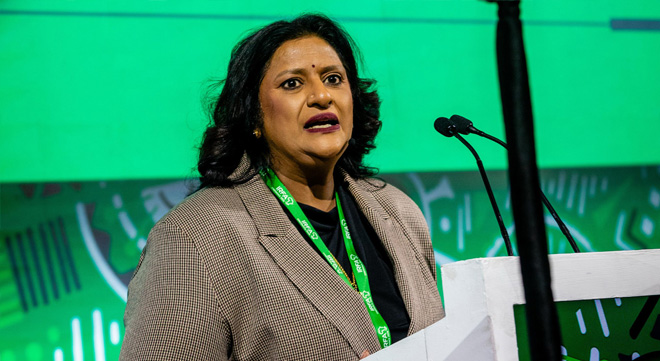
The retirement industry cannot afford simply to react to the latest regulatory, technological, or market development, newly elected Institute of Retirement Funds Africa (IRFA) chairperson Nancy Andrews (pictured) said on Monday.
Sound judgement, responsible stewardship, and a clear focus on long-term member outcomes will be increasingly important as the retirement environment continues to change, she said.
The comments came during Andrews’ first public appearance in her capacity as IRFA chairperson, giving an early indication of how she sees the role of the industry body and the issues it should be addressing.
Opening IRFA’s 2026 conference at the Cape Town International Convention Centre, Andrews said the theme, “A New World – A New Normal”, reflected the environment in which retirement funds now operate.
Markets are shifting, regulation is evolving, technology is changing how people work and communicate, and members are becoming more demanding about how they engage with their retirement savings.
“Good stewardship means more than reacting to the latest development,” Andrews said. Decision-makers need to look beyond the immediate, test their assumptions, and remain clear about the outcomes they are trying to achieve.
A role beyond advocacy
Andrews identified three principles that would guide her role as chairperson: advocacy, education, and service.
She said IRFA has a responsibility to represent the industry thoughtfully and to speak up for approaches that serve members’ best interests.
Education was equally important, particularly in building the capability of people entrusted with governance responsibilities and helping members to understand the choices that affect their financial futures.
Service, she said, meant leading with integrity and accountability and recognising that expertise came with a responsibility to those who placed their trust in the industry.
Andrews said IRFA was at its best when it brought people together around the issues that mattered most to the industry and to the people who depend on retirement funds.
Her focus will therefore be on dialogue, learning, and collaboration, while remaining open to new voices and ideas.
She also highlighted the importance of IRFA’s role across the continent, saying that although African countries faced different circumstances, there was a shared ambition to build retirement systems that inspired confidence and created opportunity.
Governance and judgement
Governance was one of the central themes of Andrews’ address.
She said sound decision-making depended on having the right information, being prepared to ask difficult questions, and accepting responsibility for the consequences of decisions.
That applies beyond formal governance processes, she said, including investment committees and operational decisions.
Investment choices need to be robust, while governance should be about more than simply following a process.
The challenge, Andrews said, was to make decisions that remained defensible over the long term rather than being driven by the pressure of the latest development.
Keeping members at the centre
Technology and innovation were another part of the changing retirement landscape.
Andrews said the way members experience retirement funds increasingly depends on technology, service, and communication, particularly when it comes to understanding their options and engaging with their savings.
Innovation should therefore be judged by whether it makes the system clearer, more accessible, and more effective.
“If not, challenge it,” she said.
The emphasis on member experience also fits into Andrews’ broader view that the industry’s decisions should ultimately be measured against the outcomes they produce for members.
What comes next
For Andrews, the role of IRFA is not simply to provide information about a changing industry, but to help the people working in it make better decisions.
She said the organisation needed to continue creating opportunities for dialogue and learning, strengthen collaboration across the industry, and support responsible and useful innovation.
The measure of the conference, she suggested, would ultimately not be what happened in the conference rooms in Cape Town, but what delegates did with what they had heard.
Success would be reflected in a new perspective, a more searching question, a useful connection or knowledge that was taken back and applied within an organisation.
“At the conference we have an opportunity to strengthen our collective ability to meet the challenges ahead. I believe we can do so in a way that honours the trust placed in us and gives our members greater confidence in the future they are working towards.”
Building on the past
Andrews also acknowledged the leadership that preceded her appointment.
She paid tribute to outgoing chairperson Geraldine Fowler for her leadership and service to IRFA, and to Mandla Nkosi, who retired from the board at the annual general meeting after reaching the applicable time limit for re-election.
Their work, she said, had created a strong platform from which the organisation could move forward.
Andrews will work with vice-chairperson Cedrick Pila, the other directors, executive officer Wayne Hiller van Rensburg, and the wider IRFA team.
She described leadership as a shared responsibility, strengthened by experience, listening, and a common commitment to doing the right thing.
“I am conscious that leadership is never an individual undertaking. It is a shared responsibility, strengthened by experience, by the willingness to listen and by a common commitment to doing the right thing.”

