

The Financial Sector Conduct Authority has credited enhanced biometric verification measures introduced by Moonstone Information Refinery with a significant decline in identity fraud involving the FAIS regulatory examinations.
Moonstone Information Refinery is the officially mandated body responsible for administering the regulatory examinations on behalf of the FSCA.
In its latest Regulatory Actions Report, covering the period from 1 April 2025 to 31 March 2026, the Authority says the decline in reported identity fraud cases was primarily attributable to enhanced verification measures implemented by Moonstone Information Refinery, including biometric authentication and facial recognition technology for candidates writing regulatory examinations at various venues. According to the FSCA, these measures have materially strengthened the integrity of the identification process and mitigated the risk of impersonation and related fraudulent activity.
The Authority says regulatory examination fraud is treated as a serious matter because the examinations assess an individual’s knowledge, understanding, and application of the Financial Advisory and Intermediary Services Act, the Financial Intelligence Centre Act, and other financial sector legislation. They are compulsory for certain financial services providers, key individuals, and representatives. Fraud in this context therefore calls into question a person’s fitness and propriety.
The statistics show a marked improvement in the FSCA’s examination fraud caseload.
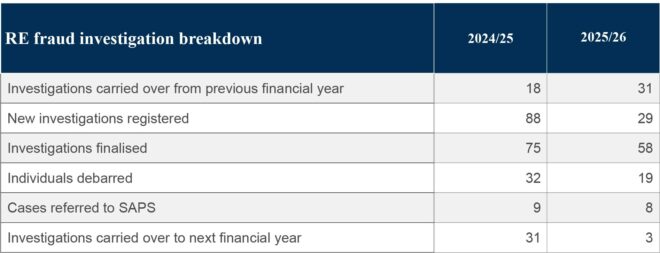
The reduction in police referrals was more modest. The FSCA explains that these cases were referred to the South African Police Service where the individuals involved were not authorised representatives at the time of the fraudulent activity. In those circumstances, the Authority lacked jurisdiction to impose regulatory sanctions, although its investigation team continues to support the SAPS with ongoing investigations.
The report says the incentive to obtain fraudulent regulatory examination certificates can be significantly curtailed through consistent due diligence and qualification verification by FSPs. It also notes that the investigation team recorded only one case involving a Facebook-based scam relating to fraudulent regulatory examination certificates. According to the FSCA, this notable decline may reflect increased public awareness, with individuals actively warning others against purchasing fraudulent or forged certificates.
Although the figures point to substantial progress, the FSCA makes it clear that regulatory examination fraud remains an integrity issue rather than simply an administrative offence. It says such conduct reflects negatively on a person’s fitness and propriety and can ultimately affect that person’s ability to participate in the financial services industry.