
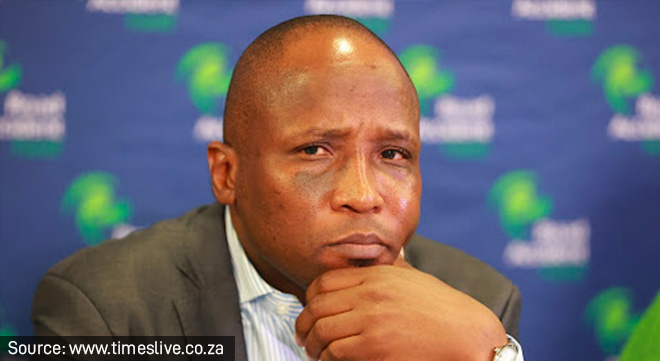
The Standing Committee on Public Accounts (SCOPA) has voted to press ahead with criminal charges against former Road Accident Fund chief executive Collins Letsoalo (pictured) for failing to appear before Parliament after being summoned during the committee’s inquiry into the RAF.
The decision, taken on 3 June 2026 by a vote of eight to three, comes despite legal advice that the case could run into difficulty because of uncertainty over how the summons was served.
SCOPA resolved in November last year to pursue charges after Letsoalo failed to appear before the committee on 25 and 26 November, despite being summoned to answer questions linked to its inquiry into the financially troubled RAF.
Although the committee had already decided to lay charges, it later sought the Speaker’s concurrence before proceeding.
Read: Letsoalo stand-off: SCOPA vs RAF’s former CEO
One reason was that Parliament appears to have no precedent for a committee laying charges under the Powers, Privileges and Immunities of Parliament and Provincial Legislatures Act (PPIPPLA).
That request has now been answered.
According to a letter tabled before the committee, the Speaker, Thoko Didiza, advised that her concurrence is not required under the Act. She also advised that if SCOPA still wished to proceed, it should ask the Secretary to Parliament to lay the charge on its behalf.
The committee accepted that advice and resolved once again to move ahead.
The sticking point
At the heart of the dispute is a fairly simple question: does it matter that Letsoalo appears to have known about the summons if Parliament cannot prove it was delivered to him personally?
Briefing the committee, parliamentary legal adviser Fatima Ebrahim said the dispute centres on section 14(4) of PPIPPLA, which sets out how parliamentary summonses must be served.
The sheriff made several attempts to serve the summons on Letsoalo personally but was unsuccessful.
Parliament then turned to alternative methods. The summons was advertised on social media and Parliament’s website, sent by email and SMS, and affixed to a door.
Ebrahim said the sticking point is whether the law requires a summons to be handed directly to a person, or whether other methods can do the job.
“The Act doesn’t say in person; it says to the person,” she told the committee.
In her view, there was little doubt that Letsoalo knew about the summons.
“As a legal adviser, I am fairly confident that Mr Letsoalo had full knowledge of the summons, but still didn’t appear, notwithstanding,” she said.
She added that the purpose of the law is to ensure that a person knows they are expected to appear before Parliament, and she believed that objective had been achieved.
A recognised risk
The Speaker sought independent legal advice before responding to SCOPA, and that advice highlighted a potential risk.
According to Ebrahim, counsel agreed that the summons had been properly authorised and signed by the Secretary to Parliament. The concern was whether the way it was delivered would pass legal muster if the matter ended up in court.
If a court interprets the Act as requiring personal service, the case could struggle. On the other hand, Letsoalo’s apparent knowledge of the summons could support an argument that Parliament met the spirit and purpose of the law, even if it did not follow the traditional route of personal delivery.
The issue is unlikely to turn on whether Letsoalo knew SCOPA wanted him to appear. At the time, his attorneys exchanged correspondence with Parliament challenging the committee’s authority, and Letsoalo himself gave media interviews rejecting suggestions that he was “missing” and explaining why he would not attend the hearings. In one such interview, he said he was “not going to that kangaroo court” and maintained that Parliament had been able to contact him through his legal representatives.
The legal advice also suggested that the National Prosecuting Authority (NPA) might be reluctant to proceed if there is uncertainty over whether the summons was properly served.
Why Letsoalo’s objections may not help him
The legal advice was more clear-cut on another issue raised by Letsoalo.
After being summoned, he challenged SCOPA’s authority to investigate the RAF, arguing that oversight of the fund belongs to Parliament’s Portfolio Committee on Transport rather than SCOPA.
Ebrahim told members that counsel did not believe this amounted to sufficient cause for failing to appear.
Parliament had already responded to Letsoalo’s objections and explained why it believed the inquiry could continue. Even if he disagreed with the committee’s mandate, he could still have attended the hearing and raised those concerns directly.
In her view, disagreeing with SCOPA’s authority was not a valid reason simply to stay away.
Three routes available
The Speaker’s letter left SCOPA with three possible routes.
It could proceed with criminal charges despite the legal risk, issue a fresh summons and attempt to secure Letsoalo’s attendance again, or decide not to pursue the matter any further.
Ebrahim strongly cautioned against the third option.
She warned that walking away from the matter could send the message that Parliament is not serious about enforcing its summonses.
It could also encourage future witnesses to ignore parliamentary summonses if they believe there are no consequences for doing so.
The Speaker appeared to share that concern.
While noting the legal uncertainty around service of the summons, she observed that a wilful failure to appear before a committee of Parliament is an extremely serious matter that Parliament cannot condone or ignore.
A possible gap in the law
The dispute has also highlighted what may be a gap in Parliament’s summons process.
The Speaker indicated that she has asked Parliament’s Constitutional and Legal Services Office to review PPIPPLA to determine whether changes are needed to better support Parliament’s constitutional power to summon people to appear before its committees.
That review will not affect the Letsoalo matter, but it could influence how similar cases are handled in future.
What happens next?
The committee’s latest resolution clears the way for formal action.
In a statement issued after Wednesday’s meeting, SCOPA said chairperson Songezo Zibi will communicate the committee’s decision in writing to the Secretary to Parliament for immediate action.
Section 17(1) of PPIPPLA provides that a person who has been duly summoned and fails, without sufficient cause, to attend commits an offence punishable by a fine, imprisonment for up to 12 months, or both.
The next step now lies with Parliament’s administration and, potentially, the criminal justice system.
If the matter goes further, much could hinge on the same question that occupied most of Wednesday’s discussion: whether Parliament’s efforts to notify Letsoalo amounted to lawful service of the summons.

