When the promised funding failed to arrive, the house of cards collapsed.
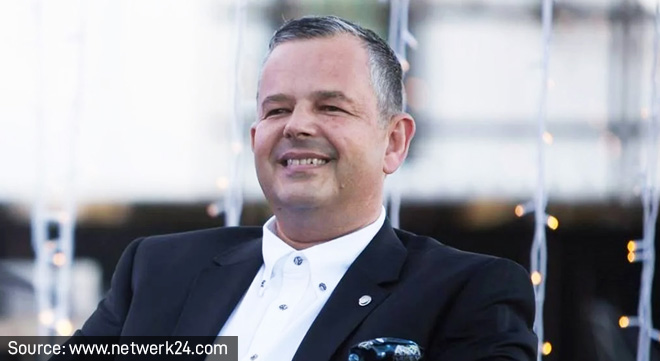
On 4 March 2022, the body of Hendrik Gerryts (pictured) – the controlling mind behind Somerset West-based investment business HGG Financial Group – was found in Hermanus, a day after he had been reported missing. Just over a month later, the Western Cape High Court placed HGG in provisional liquidation as investors scrambled to understand the scale of what had gone wrong.
It soon became clear that HGG had been operating what the Court later described as an unlawful and fraudulent Ponzi-type scheme.
Now, four years later, a judgment handed down by Judge Judith Innes Cloete on 13 February not only clears the way for HGG’s liquidators to pursue a R20.49-million claim against Veritas Capital Africa (Pty) Ltd (Veritas SA) but also lays bare how Gerryts attempted to secure external funding in 2020 in an apparent bid to keep the scheme afloat – his “Plan B” – and how that effort ultimately failed.
Why the liquidators were in Court
HGG’s appointed joint final liquidators approached the Court for two primary orders:
- That the deregistration of Veritas SA by the Companies and Intellectual Property Commission (CIPC) on 20 January 2024 be declared void; and
- That Veritas SA be placed into liquidation.
The application was opposed only by Veritas SA and its sole director and shareholder “at all material times”, Sharl van Rensburg.
The CIPC initiated deregistration proceedings against Veritas SA on 27 July 2021 because it had failed to file annual returns for two or more consecutive years. In terms of section 82(3) of the Companies Act, the CIPC may remove such a company from the register. Veritas SA was ultimately deregistered on 20 January 2024.
That deregistration created a significant legal obstacle.
Upon deregistration, a company ceases to exist as a legal person. Its assets pass to the state as bona vacantia, while its liabilities remain but are rendered unenforceable for as long as deregistration subsists. A deregistered company cannot institute or defend legal proceedings.
For HGG’s liquidators, this meant they could not pursue their intended compulsory winding-up application – or recovery action – unless the dissolution was first set aside.
In Court, they relied on section 83(4) of the Companies Act, which permits a liquidator or any person with an interest in a dissolved company to apply for an order declaring the dissolution void.
What the Court decided
Judge Cloete granted the relief.
The Court declared that:
- The dissolution of Veritas SA upon its deregistration on 20 January 2024 was void in terms of section 83(4) of the Companies Act;
- The CIPC must restore Veritas SA’s name to the companies register;
- The assets of Veritas SA, immediately prior to its dissolution, are no longer bona vacantia and re-vest in the company;
- Its liabilities remain vested in the company; and
- Veritas SA is placed under provisional liquidation.
For the liquidators, the path has been cleared to pursue recovery proceedings against Veritas SA.
But the judgment does more than resolve a procedural impasse. It provides insight into what was happening inside HGG in the critical period before its collapse.
A classic Ponzi structure
Founded in 1998, HGG operated an unlawful scheme in which investor funds were solicited on the promise of fixed, and often excessive, returns. In reality, new investor money was used to pay earlier investors who sought to withdraw – a textbook Ponzi structure.
The scheme finally unravelled in early 2022. Within days of Gerryts’ reported suicide in March, a Helderberg construction group and a married couple from Cape Town launched a winding-up application against the company he had founded, as first reported by Netwerk24. In their court papers, they alleged they were owed millions.
Shortly thereafter, in April 2022, the High Court placed the company into provisional liquidation, triggering a formal investigation into its financial affairs.
The R20.49 million in dispute
During the period July to October 2020, HGG transferred R20.49m to Veritas SA from accounts it held with Absa, Nedbank, and Grindrod Bank.
The liquidators argue these transfers were not legitimate commercial payments but “dispositions without value” – a legal term under the Insolvency Act referring to payments made by an insolvent entity for which it received no real benefit in return.
Under section 26 of the Insolvency Act, payments made within two years before liquidation can be set aside if the recipient cannot prove that the company’s assets exceeded its liabilities immediately after the payment. Veritas SA did not attempt to demonstrate that HGG was solvent at the time.
On that basis, the liquidators contend that they have a statutory claim to recover the funds for the benefit of creditors.
The failed funding deal
According to the liquidators’ investigations, HGG made the R20.49m in payments on the understanding that loan funding would be advanced to it by Veritas Group Ltd, a Bermuda-listed mezzanine equity market company, in “co-operation” with Veritas SA.
Judge Cloete records that, to secure this anticipated funding, HGG had to – and did – make payments into the First National Bank account of Veritas SA. The transfers formed part of what was presented as a funding structure designed to unlock the promised loan capital.
The loan funding, however, “did not materialise”.
The judgment notes it subsequently transpired that the proposed funding arrangement was itself “no more than a scam to fraudulently obtain investor funds so that HGG could continue with its scheme”.
“In the face of the loan funding not being forthcoming,” Judge Cloete observes, “the proverbial house of cards collapsed.”
‘We were only a conduit’
In their answering affidavit, Veritas SA and Van Rensburg did not dispute receiving the R20.49m from HGG. Judge Cloete notes that Van Rensburg provided “a long, and at times convoluted, explanation” for the payments, although he did not deny that they were received.
He maintained that Veritas SA acted solely as a special purpose vehicle (SPV) intermediary – a conduit – for Veritas Group and/or its subsidiary, Veritas Botswana (Pty) Ltd. According to this account, Veritas SA’s only role was to allow Veritas Botswana to use its banking platform with Mercantile Bank/Rand Merchant Bank to make payments to third parties under the intended loan funding arrangement with HGG.
Van Rensburg further asserted that, from 23 November 2020, he no longer “participate[d] in the affairs of Veritas Group” and was not privy to negotiations between Veritas Group and HGG.
The judgment notes that Van Rensburg claims:
“In summary, the payments were made to Veritas SA as an intermediary which merely acted as a conduit for onward transmission of the payments to third parties and in terms of written agreements between Veritas Botswana and … the clients of HGG to which I have referred above.
“The payments were not made for the benefit of Veritas SA, and Veritas SA did not benefit from these payments.
“The payments were made to Veritas SA, as nominated SPV, who, in turn, paid the money to third parties as expenses associated with the contractual obligations between Veritas Botswana and the … entities.”
The “entities”, Judge Cloete explained, were the clients of HGG who were ultimately meant to receive the loan funding from Veritas Group. The associated “contractual obligations” arose from four separate shareholder funding agreements (SFAs), reportedly concluded during the same period that HGG was transferring funds to Veritas SA, between July and October 2020. These SFAs were entered into between Veritas Botswana and four South African companies – Bretagna (Pty) Ltd, HDK Invest (Pty) Ltd, Urban Land Riverside (Pty) Ltd, and Stellenvest (Pty) Ltd.
The paper trail
Judge Cloete was not persuaded that the conduit explanation neutralised the liquidators’ case.
The Court observed that, even on Van Rensburg’s own version, Veritas SA was not entitled to utilise the payments it received from HGG. Any payments to third parties in fulfilment of contractual obligations under the shareholder funding agreements should have been made from monies received from Veritas Botswana – not from funds transferred by HGG.
It was common cause that Veritas Botswana never made any payment to Veritas SA for that purpose. It was also common cause that the convertible promissory notes allegedly issued by Veritas Botswana were issued at a time when Veritas Botswana “had no funds to support those notes”.
On the objective documentary evidence presented by the liquidators, it was clear that Veritas SA had in fact used the payments received from HGG. Judge Cloete records that, from its FNB account, Veritas SA made substantial payments between July 2020 and March 2021, including:
- July 2020: R2 476 400.15
- August 2020: R1 183 181.19
- September 2020: R8 594 657.76
- October 2020: R2 744 329.15
- November 2020: R3 532 379.81
- December 2020: R3 310 351
- January 2021: R3 382 340.50
- February 2021: R3 258 014.62
- March 2021: R3 128 499.41
Included in these were payments to Van Rensburg himself totalling R347 206.85, described by him as commissions to which Veritas SA was entitled for “administering payments” to third parties. Some of these payments were made even after his claimed withdrawal from involvement on 23 November 2020.
“Moreover, an exchange of WhatsApp messages retrieved by the liquidators from the late Mr Gerryts’ cellphone demonstrates that, as late as February 2021, Mr Van Rensburg was still very much involved in the affairs of HGG, when he discussed ‘Plan B’ with Mr Gerryts in order to try to secure the funds which still had to be paid by Veritas Botswana on behalf of Veritas Group,” Judge Cloete wrote.
The Court concluded that the documentary trail undermined the assertion that Veritas SA had merely acted as a passive conduit.
Sufficient interest to proceed
The immediate issue before the Court was procedural: whether HGG’s liquidators had sufficient legal interest to seek the re-registration of Veritas SA to pursue their recovery claim.
Judge Cloete found there was enough evidence to suggest that:
- HGG made the payments without receiving value in return; and
- Veritas SA benefited from those payments.
That was sufficient to establish that the liquidators are “persons with an interest” under the Companies Act and entitled to seek the company’s re-registration so that recovery proceedings can continue.
The ruling does not finally determine whether Veritas SA is liable for the R20.49m. That question will be decided in separate proceedings. However, the judgment significantly strengthens the liquidators’ position and ensures that the recovery action can proceed.
Read the full judgment here.