
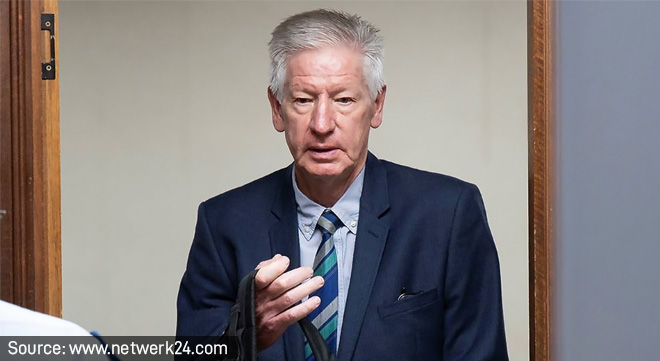
Former Steinhoff executive Hein Odendaal (pictured) has been sentenced after entering a plea-and-sentence agreement, becoming the fourth person convicted in South Africa in criminal cases linked to the retailer’s accounting scandal.
Odendaal appeared in the Pretoria Specialised Commercial Crimes Court on 12 March 2026 and pleaded guilty under section 105A of the Criminal Procedure Act (CPA), which allows an accused person and the prosecution to conclude a plea-and-sentence agreement subject to judicial approval.
The Court imposed a R2-million fine or four years’ direct imprisonment, together with a further two years’ imprisonment wholly suspended for five years.
The suspended portion of the sentence is subject to standard conditions, including that Odendaal must not be convicted during the suspension period of contravening section 34(1) of the Prevention and Combating of Corrupt Activities Act (PRECCA).
Section 34(1) of PRECCA creates a statutory duty for persons in positions of authority to report to the South African Police Service any knowledge or reasonable suspicion of corruption-related offences involving R100 000 or more. Failure to report such conduct constitutes a criminal offence.
In addition to the fine and suspended sentence, the Court ordered one year of correctional supervision in terms of section 276(1)(h) of the CPA.
Odendaal previously served as managing director of two Steinhoff affiliates in the United Kingdom and was a long-standing director of Steinhoff Africa Holdings and Steinhoff At Work. The 68-year-old Chartered Accountant also held the position of group audit executive within the Steinhoff group.
The conviction arose from a fraudulent transaction dated 21 November 2016, in which a fictitious invoice was generated to the Swiss entity TG Sources SARL.
According to the National Prosecuting Authority (NPA), Iwan Peter Schelbert, acting on instructions from then chief financial officer Andries “Ben” la Grange, created the invoice and supporting documentation. Payments were processed in a manner intended to make the transaction appear legitimate, inflating Steinhoff’s financial statements by more than R376m and contributing to misleading audited results.
Schelbert was sentenced to five years’ direct imprisonment in January 2026 after pleading guilty to fraud in relation to the same transaction.
Read: Former Steinhoff director jailed for 5 years in R376m fraud case
Odendaal’s conviction is the fourth secured in South Africa in criminal cases arising from the Steinhoff scandal, all resulting from plea-and-sentence agreements.
Those convicted locally so far are:
- Dr Gerhardus Diedricks Burger – convicted in 2024 on insider-trading charges and given a wholly suspended five-year sentence.
- La Grange – sentenced in October 2024 to 10 years’ imprisonment, with five years suspended, resulting in an effective five-year custodial sentence.
- Schelbert, former director and board member of Steinhoff At Work – sentenced in January 2026 to five years’ direct imprisonment for fraud relating to the R376m invoice scheme.
- Odendaal, sentenced in March 2026 following his guilty plea.
Another accused, former Steinhoff treasurer Stéhan (Stephanus Johannes) Grobler, still faces criminal charges, including fraud and racketeering. His case has been postponed to 14 May 2026 for further proceedings, and he has indicated that he intends to plead not guilty.
Separately, the Financial Sector Conduct Authority in March 2026 imposed an administrative penalty of R358.75m on Grobler for contraventions related to Steinhoff’s financial statements between 2014 and 2017.
Read: Former Steinhoff executive Stéhan Grobler fined R358.75m
The Steinhoff accounting scandal came to light in December 2017, when the group announced that irregularities had been identified in its financial statements. The disclosure triggered an immediate collapse in the company’s share price, erasing roughly R200 billion to R230bn in market value.
Former chief executive Markus Jooste became the central figure in the fallout from the scandal. In 2023, the FSCA imposed an administrative penalty of R475m against him for publishing false or misleading financial statements. Jooste died by suicide in March 2024.
An independent forensic investigation conducted by PwC later identified €6.5bn in transactions it described as fictitious or irregular, which investigators said had materially overstated the group’s financial position.
Criminal proceedings linked to the scandal have unfolded slowly over several years, with prosecutors pursuing cases against a number of former executives and associates connected to the group’s financial reporting practices.




Will the highly qualified board of directors be held accountable?