
The Financial Sector Conduct Authority says the Conduct of Financial Institutions (COFI) Bill will be implemented on a phased basis, while cautioning financial institutions against delaying preparation for what it describes as a significant shift in conduct regulation.
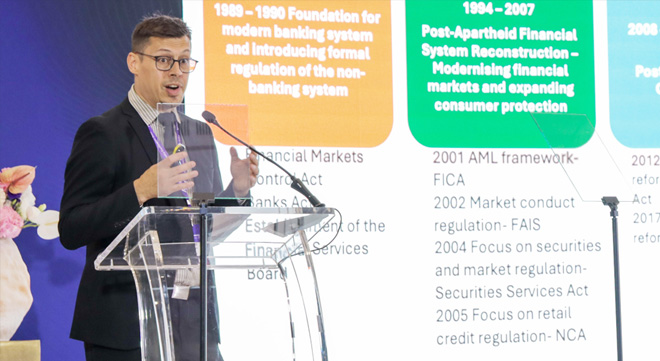
Addressing the FSCA Industry Conference on 18 March, Eugene du Toit (pictured), the Authority’s divisional executive for regulatory policy, declined to commit to a firm timeline but was “willing to go out on a limb” and said it was “fairly certain” the Bill would probably be tabled in Parliament this year.
He said the phased approach to implementing COFI is intended to allow for transition and ongoing industry engagement but emphasised that firms should not wait for formal tabling or enactment before beginning to assess the potential impact on their operations.
Du Toit positioned COFI as a structural reform that is intended to simplify and rationalise a fragmented conduct framework, with an increased focus on whether firms are delivering fair customer outcomes in practice.
Du Toit described COFI as a form of “strategic simplification”, aimed at bringing together conduct requirements that are currently dispersed across sectoral legislation and subordinate instruments.
This rationalisation, he said, is intended to make the framework easier to navigate and apply, while enabling more consistent supervisory and enforcement approaches across the financial sector.
He added that the move to an outcomes-based approach means that compliance will increasingly be assessed with reference to customer outcomes, rather than adherence to prescriptive rules alone.
Accountability moves to the governing body
A central feature of the proposed framework is the allocation of responsibility for conduct to the governing body of a financial institution.
Du Toit said boards will be responsible for conduct culture and for ensuring that customer outcomes are appropriately considered in both strategic decisions and operational decisions.
This represents a shift away from a model in which conduct is primarily managed within compliance or risk functions and extends accountability across the full value chain – from product design to distribution and servicing.
The framework places emphasis on incorporating conduct considerations at the product design stage. Du Toit said this includes identifying target markets, assessing distribution strategies, and considering potential risks of customer harm before products are brought to market.
The intention is to reduce the likelihood of poor outcomes arising from misaligned incentives or products that are not suited to the needs of intended customer segments.
Licensing, activities, and broader impacts
Du Toit noted that changes to the licensing framework will form part of a broader set of impacts under COFI.
He said firms will need to map their current licensing activities to the new licensing schedule expected under the framework, as part of a wider impact assessment covering governance, products, systems, data, and operating models.
He indicated that early analysis will assist firms in identifying potential gaps and structural implications.
A theme in Du Toit’s presentation was the role of data in supporting an outcomes-based regulatory approach.
He said firms will need to be able to generate management information that demonstrates whether they are delivering fair customer outcomes in practice. This is expected to require investment in systems and data capabilities that can identify, measure and report on conduct risks and outcomes, supporting a more evidence-based approach to supervision.
A ‘theory of change’ as a roadmap
Du Toit framed preparation for COFI using what he described as a “theory of change” – a structured way of linking regulatory intent to practical outcomes. In this model:
- Inputs include governance frameworks, skilled personnel, ethical culture, and data infrastructure.
- Activities include licensing mapping, framework redesign, and enhancements to management information.
- Outputs include updated policies, controls, and reporting dashboards.
- Outcomes include improved product suitability, clearer disclosures, and fewer conduct failures.
- Impact is a financial sector that is trusted, inclusive, and competitive.
Du Toit indicated that firms can use this framework to assess their current state, identify gaps between inputs and desired outcomes, and prioritise areas requiring change.
Preparing for a phased transition
Although the implementation of COFI will be phased, Du Toit said preparation should begin ahead of the Bill’s formal introduction.
He said firms should undertake comprehensive impact assessments across key areas, including:
- governance and board accountability,
- product design and distribution,
- licensing and business activities,
- systems, data, and reporting,
- and remuneration and incentive structures. This includes considering whether remuneration and incentive structures are aligned with the delivery of fair customer outcomes.
Beyond these areas, Du Toit said preparation should not be approached as a compliance exercise but as a review of how customer outcomes are delivered across the business.
This includes assessing the full value chain – from product design through to distribution and ongoing servicing – to identify where conduct risks may arise and how these are currently managed.
He indicated that firms should consider whether:
- governance structures adequately support oversight of conduct and customer outcomes;
- product design processes sufficiently take account of target markets and potential customer harm;
- distribution practices align with intended customer segments; and
- management information provides meaningful insight into customer outcomes, rather than only compliance metrics.
He added that early preparation will assist firms in identifying gaps and prioritising changes before the framework is finalised.
A shift in regulatory approach
Du Toit reiterated that COFI represents a shift in regulatory approach rather than simply a change in rules.
For financial institutions, this means preparation will need to extend beyond legal interpretation of the Bill to include governance structures, business processes, and organisational culture.
Although implementation will be phased, the FSCA’s message was that firms should begin preparing early and consider the changes as broader than a compliance exercise.




N/a