
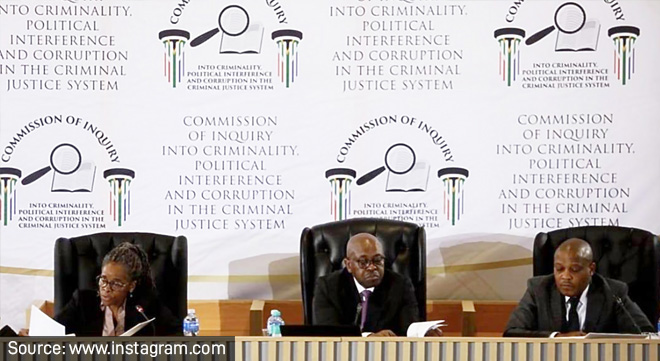
South Africa has a functioning democracy, independent courts, Chapter Nine institutions, and an independent media. Yet it is one of the world’s most violent societies. Why?
At a PSG Think Big webinar on 25 August 2026, Chad Thomas, the chief executive of IRS Forensic Investigations, said the Madlanga Commission has given South Africa an answer.
“It was the deficit of leadership within our policing structures, and it was the empire building within our policing structures that led us to this horrendous situation that we hope will now be undone.”
President Cyril Ramaphosa established the Judicial Commission of Inquiry into Criminality, Political Interference and Corruption in the Criminal Justice System in July 2025, after KwaZulu-Natal police commissioner Lieutenant-General Nhlanhla Mkhwanazi made a series of allegations on 6 July.
Mkhwanazi alleged that then Police Minister Senzo Mchunu had interfered in sensitive police investigations and was involved in the disbandment of the Political Killings Task Team in KwaZulu-Natal. He also alleged that a Gauteng police investigation had uncovered a criminal syndicate controlled by a drug cartel, with links extending into politics, the South African Police Service, metro police, correctional services, prosecutors, the judiciary, and business.
The allegations became the basis for the Commission’s mandate to investigate whether criminal syndicates have infiltrated or exerted undue influence over South Africa’s criminal-justice system.
The Commission was also tasked with examining the suppression or manipulation of investigations, the inducement of law-enforcement officials into criminal activity, and the intimidation, victimisation, or targeted removal of whistleblowers or officials resisting criminal influence.
More than a year later, two interim reports have gone to the President, referrals have been made for criminal and disciplinary investigation, a special investigations task team has been established, and the Commission is still hearing evidence.
The full interim reports have not been released publicly.
What has the Commission established this far?
Unlike a criminal trial, testimony before a commission of inquiry is inquisitorial and must still be tested and investigated before it can support criminal proceedings.
The Commission’s first interim report was submitted to Ramaphosa on 17 December 2025 and the second on 29 May 2026.
The Presidency has released details of recommendations and referrals arising from the two reports, but not the reports themselves.
Following the first report, the Presidency said the Commission had referred five SAPS officials for investigation: Major-General Lesetja Senona, Major-General Richard Shibiri, Brigadier Mbangwa Nkhwashu, Brigadier Rachel Matjeng, and Sergeant Fannie Nkosi.
It also said prima facie evidence of wrongdoing had been identified involving current and former employees of the City of Ekurhuleni and the Ekurhuleni Metropolitan Municipality Police Department (EMPD), including suspended EMPD Chief of Police Commissioner Julius Mkhwanazi.
The allegations covered criminality, corruption, fraud, murder, perjury, and other unlawful conduct.
The Presidency said that, apart from Mkhwanazi, the Commission had not yet heard the responses of some of the people named. The allegations therefore remained prima facie allegations and were not findings of guilt.
Ramaphosa directed the Minister of Police and SAPS national commissioner to establish a special investigations task team to investigate matters identified by the Commission.
The second interim report revisited the SAPS recommendations made in the first report. According to the Presidency, the Commission confirmed those recommendations, with one exception, after the relevant implicated parties had appeared before it to give evidence. The Presidency did not identify the exception.
It also contained new referrals.
The Presidency said the Commission recommended disciplinary proceedings and immediate investigation of criminal conduct involving Lieutenant-General Shadrack Sibiya, Witness G, Nkosi, and Brown Mogotsi. If sufficient evidence were found, criminal proceedings were recommended.
It also recommended an investigation into an alleged off-the-books Crime Intelligence operation involving Mogotsi and Witness G.
The matters were to form part of the work of the SAPS special investigations task team.
Thomas sees a difference between this process and what happened after the State Capture Commission, chaired by former Chief Justice Raymond Zondo. The Zondo Commission investigated allegations of state capture, corruption, and fraud in South Africa’s public sector and state-owned enterprises.
Zondo’s testimony still had to be investigated and tested before it could become evidence capable of supporting prosecutions. With Madlanga, Thomas said, the referrals and accountability processes are happening while the Commission is still at work.
“With Madlanga, things are happening parallel. There have been reports in stages to the President. He’s received two reports so far, he’ll get his third. And after each report, he initiated a process to hold those accountable. We’ve seen arrests, we’ve seen dismissals, we’ve seen suspensions, we’ve seen resignations.”
From criminal markets to legitimate business
Thomas describes an illicit economy operating on a massive scale.
“We’re definitely talking billions,” Thomas said. “But what’s grown out of this illicit market is organised crime that is now permeating normal business.”
He cited illicit tobacco and alcohol, illegal mining, and illicit gold as examples of markets that have grown into organised criminal activity.
Construction is another.
Thomas described a KwaZulu-Natal bridge project that was approved just before Covid-19 and initially budgeted at R1 billion. According to his account, so-called business forums demanded 30% of the project’s value. The project was stopped amid violence associated with the alleged extortion. It has since been reinitiated, he said, with the budget now at R4bn.
“You can’t now have a government tender without being extorted by a so-called business forum, which is a nice name for a mafia of sorts or a cartel of sorts,” he said.
He also referred to alleged fraud at Tembisa Tertiary Hospital in Ekurhuleni, Gauteng. Thomas said transactions were repeatedly kept below R500 000 so they would not go through the normal bid process. Those involved then had to go to the hospital to obtain sign-off on purchase orders and bid documents before payment could be made.
More than R2bn was ultimately plundered, Thomas said, with the money intended for medication, diagnostic equipment, and medical care for some of the country’s poorest patients.
“That means they had to walk past the very patients whose lives they were meant to be changing,” he said. “Now imagine being that criminal driving a Ferrari, walking past those patients, the actual victims of your fraud, and feeling nothing.”
The consequences extend into the private sector. Thomas said the government is the private sector’s biggest client, yet some businesses are increasingly reluctant to take government work because of extortion and compromised procurement.
“They don’t want to be strong-armed. They don’t want to pay protection fees. They don’t want to be part of a compromised, corrupt process.”
At the same time, he said, companies willing to operate within that environment continue to compete for government contracts.
“And you now have companies that are tendering for business that are willing to be compromised, all willing to be a part of the problem, and this needs to be addressed.”
Who watches the watchers?
The Commission’s terms of reference require it to examine whether the mechanisms designed to oversee South Africa’s criminal-justice institutions are working.
“Who watches the watchers?” Thomas asked.
The Hawks, or Directorate for Priority Crime Investigation (DPCI), are part of SAPS rather than an independent Chapter Nine institution. Thomas said the DPCI receives about 2% of the police budget, while VIP protection and the Blue Light Brigades receive about 3%. The Hawks are also dependent on SAPS for their funding.
The Office of the Inspector-General of Intelligence is responsible for oversight of Crime Intelligence and the Secret Service Account. Thomas said the office is currently non-operational because the Inspector-General has been suspended.
Thomas also spoke about the Investigating Directorate Against Corruption (IDAC), which was established to investigate corruption matters arising from the work of the Zondo Commission and turn that evidence into prosecutions. He said IDAC had itself become affected by what he described as “empire building and political interference”.
A private member’s bill proposing a Chapter Nine anti-corruption body is before Parliament. Thomas said Police Minister Firoz Cachalia, who also heads the National Anti-Corruption Advisory Council, supports the establishment of such an agency.
“Having this super body is perhaps the right route to go, and Madlanga can lay the foundation for this,” he said.
“We shouldn’t be shy about spending money in the short term for a commission of inquiry that, for the long term, will lay the foundation for a better South Africa and a safer South Africa.”
The FATF question
South Africa was placed under increased monitoring by the Financial Action Task Force (FATF) in February 2023 and spent more than two years implementing an action plan to strengthen its ability to combat money laundering and terrorist financing.
In October 2025, following an on-site assessment, the FATF removed South Africa from the grey list. South Africa had completed its action plan, which included reforms to legislation and institutions as well as improvements in operational effectiveness.
“The grey listing came with a lot of good things. We had new acts promulgated, we had acts amended, and we had more powers given to organisations such as the FIC, the Financial Intelligence Centre,” Thomas said.
Removal from the grey list did not end the FATF process. South Africa continues to work with the FATF, in co-ordination with the Eastern and Southern Africa Anti-Money Laundering Group (ESAAMLG), through the normal follow-up process. The FATF currently lists February 2027 as the possible on-site period for South Africa’s next mutual evaluation, with a possible discussion at the October 2027 Plenary.
The areas South Africa had to demonstrate progress in included a sustained increase in investigations and prosecutions of serious and complex money laundering, as well as the identification, seizure, and confiscation of proceeds from a wider range of predicate crimes.
“All that time and effort spent getting us off the grey list and now finding out that law enforcement is still compromised … it leads to the possibility of our grey-listing situation being relooked at,” Thomas said.
Thomas said the reforms introduced during the grey-listing process have nevertheless strengthened the country’s ability to recover illicit funds and hold offenders to account.
“Coming off meeting those 22 requirements put us back in good standing. But the fact remains that there still are bad actors, but the legislation that’s come into being as a result of the grey listing will be able to ensure that we can claw back funds and hold those to account far better than before we were grey listed.”
The cost of fixing it
The Madlanga Commission was initially allocated R147.9 million for its first six months. By April 2026, about R123m had been spent, according to the Department of Justice, while additional funding was being sought for the Commission’s extension.
Thomas puts the cost of the Zondo Commission at about R1bn.
“Criminal syndicates have had unfettered access to the very top echelons of our state security leadership for the past 26 years. We really need Madlanga, and whatever it costs, we need to spend,” he said.
Thomas pointed to the Special Investigating Unit and the Criminal Assets Recovery Account (CARA) as potential sources of recovered funds.
“If CARA can be managed correctly, we can have more clawback by fully capacitating the Asset Forfeiture Unit, we will be able to pay for this from the monies derived in the clawback from the criminals themselves.”
What crime costs the economy
Thomas sees the economic consequences well beyond the money lost directly to illicit markets and corruption.
“If this works and we no longer have compromised police officers who are supporting illicit tobacco, illicit alcohol, illegal mining, it’s going to create jobs. It’s going to bring more money into the fiscus. It’s going to boost the public fiscus in respect to the monies that SARS is able to collect,” he said.
He also sees scope for businesses operating in the informal economy to move into the formal economy if they can operate without criminal interference. Extortion, he said, is keeping some of those businesses from growing.
For smaller businesses, the problem is compounded by their limited ability to detect sophisticated fraud or maintain the fraud, ethics, compliance, and governance functions available to large corporates.
“They rely heavily on the state,” Thomas said.
The damage also travels beyond our borders. Thomas said crime has affected the country’s reputation and its ability to attract investment.
“Crime has impacted our economy, it’s impacted our reputation, and it’s impacted our investability as a state. It can’t happen just in the short term. We need to have a proper long-term manner in which we’re going to address the problems.
He added that if the proposed reforms are not introduced, South Africa could face the possibility of reaching failed-state status because the criminal networks operating in the country are no longer purely local.
“We are now a transit point for international drugs coming into the country. We are also a trans-shipment point for drugs going to other countries,” Thomas said.
What happens after Madlanga?
The Commission is continuing to hear evidence.
Businessman Vusimuzi “Cat” Matlala has been giving evidence this week in connection with allegations involving senior police officials and matters already before the inquiry. His testimony has included questions about his interactions with Sibiya and Nkosi.
The Commission is due to conclude its evidentiary phase on 2 October, with its final report due to Ramaphosa on 16 November 2026.
The Commission can make findings and recommendations and refer matters for investigation. Prosecution and disciplinary action remain the responsibility of the relevant institutions.
Thomas said, what happens next will determine whether the Commission’s work changes the system it was established to examine.
“We need to be able to fight these transnational organised crime syndicates, and the only way we’re going to do that is effective policing, capacitated crime intelligence, infiltration of these syndicates, disruption, and dismantling of these syndicates.”


Nothing happened after Judge Zondo evidence was given to the President. We should have acted on some of it. The Madlanga commission are doing the same. Will we act on it or wait years to do it. The evidence is there.