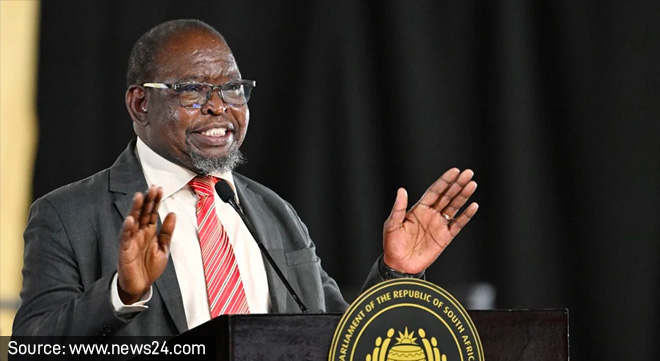
The High Court in Cape Town has declared section 7(4) of the Value-Added Tax Act unconstitutional – a provision that allows the Minister of Finance to announce a change to the VAT rate in the Budget, with the new rate taking effect before Parliament passes legislation confirming it.
The judgment, delivered on 5 March, held that the mechanism amounts to an impermissible delegation of Parliament’s taxing power to the executive.
“It is declared that section 7(4) of the Value-Added Tax Act 89 of 1991 is inconsistent with the Constitution and invalid,” said Judge Matthew Francis, with Judge Judith Cloete and Judge James Lekhuleni concurring.
The declaration of invalidity was suspended for 24 months to allow Parliament to remedy the defect, and the order was referred to the Constitutional Court for confirmation.
National Treasury told Moonstone on Friday that it was studying the judgment and was not yet in a position to comment on it.
Background to the dispute
The litigation arose from the 2025 Budget.
Section 7(4) allows the Minister of Finance, when tabling the annual Budget, to announce that the VAT rate will be altered from a specified future date. The altered rate then applies for up to 12 months unless Parliament passes legislation confirming the change.
During the 2025 Budget Speech, Minister of Finance Enoch Godongwana announced an increase in the VAT rate from 15% to 15.5%, followed by a further increase to 16% the following year. The announcement drew political opposition, and the proposed increase was ultimately withdrawn.
The Democratic Alliance nevertheless challenged the constitutionality of section 7(4), arguing that the provision delegates to the Minister the power to impose, increase or reduce a national tax – a power that the Constitution vests in Parliament.
By the time the case was heard, the proposed VAT increase had been abandoned. The respondents – who included the Minister and the Commissioner of the South African Revenue Service – argued that the dispute had therefore become moot.
The Court accepted that the specific rate change announced in the 2025 Budget was no longer operative. However, it held that the constitutional validity of section 7(4) remained a matter of public importance that justified determination.
The Court’s reasoning
The Court framed the issue as whether “section 7(4) of the VAT Act, properly construed, amounts to a constitutionally impermissible delegation to the executive of Parliament’s power to determine the rate of a national tax”.
In analysing that question, the Court began by emphasising the constitutional relationship between taxation and democratic governance. Quoting Constitutional Court authority, it noted that the power to tax is closely linked to representative democracy and must ultimately be exercised through elected representatives in Parliament.
The respondents argued that section 7(4) does not amount to the imposition of a tax but merely allows the Minister to adjust the rate of an existing tax. In considering this argument, the court referred to authority emphasising the importance of the rate in defining a tax, quoting the Supreme Court of Canada in Ontario English Catholic Teachers’ Association: “This must be the case, for if the rate is zero, there is no tax.”
The High Court relied on this reasoning to illustrate that the rate of a tax is not a peripheral detail. Because the rate determines how much tax must be paid, the authority to set or change the rate forms part of the substantive power to tax.
The Court then considered whether section 7(4) constitutes an impermissible delegation of legislative authority. Relying on Constitutional Court jurisprudence, it noted that delegations of legislative power are not automatically unconstitutional. Their validity must be assessed contextually, having regard to the scope of the power conferred, the safeguards attached to it and the degree of parliamentary oversight.
Applying that approach, the Court examined the breadth of the authority granted by section 7(4).
“Section 7(4) empowers the Minister to alter the VAT rate. This is a significant power. It directly affects the tax burden borne by every consumer of goods and services in South Africa. It is not a power to make minor, technical adjustments; it is a power to change the central charging provision of the VAT Act.”
The Court also emphasised that the provision contains no meaningful statutory constraints on the Minister’s discretion:
“There is no statutory cap on the extent of the increase or decrease. There is no statutory guidance on the circumstances in which the power may be exercised, beyond the requirement that the announcement be made in the national annual Budget.”
The respondents argued the provision nevertheless contains safeguards because the altered rate operates only temporarily unless Parliament passes confirmatory legislation.
The Court accepted that the temporary nature of the power counts in favour of constitutionality. However, it concluded that this safeguard does not eliminate the constitutional difficulty.
“For the duration of the 12-month period, the operative tax rate is the Minister’s rate, not Parliament’s rate. Parliament’s failure to act does not invalidate the tax already collected; it merely prevents the alteration from continuing beyond 12 months. The tax imposed during that period is, in every practical sense, a tax imposed by the executive.”
Taken together, these considerations led the Court to conclude that section 7(4) confers a broad and insufficiently constrained power on the executive to determine the rate of a major national tax – a function that the Constitution assigns to Parliament.
The order
The Court therefore held that section 7(4) constitutes an impermissible delegation of legislative power to the executive and is inconsistent with the Constitution.
It declared the provision unconstitutional and invalid but suspended the declaration of invalidity for 24 months to allow Parliament to correct the defect. As required by the Constitution, the order was also referred to the Constitutional Court for confirmation.