
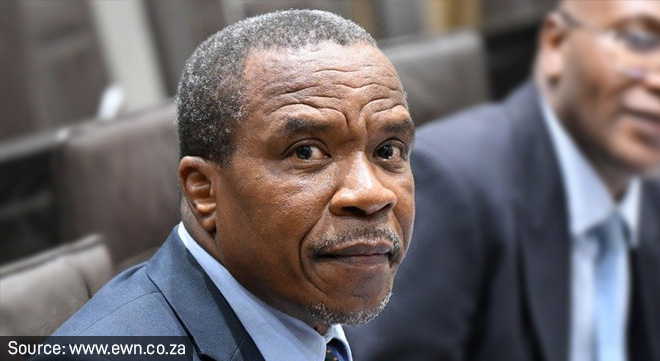
When former Road Accident Fund (RAF) acting chief financial officer Victor Songelwa (pictured) took his seat before the Standing Committee on Public Accounts (SCOPA) this week, he made a statement that cut to the heart of the Fund’s long-running accounting controversy.
“I struggled initially to say, why would the Road Accident Fund want to make changes in its liabilities,” he told MPs, adding that “the only thing I think would have happened is that … there was something called debt restructuring”.
For years, the RAF has been embroiled in disputes over its financial statements, culminating in three consecutive adverse audit opinions and costly litigation with the Auditor-General of South Africa (AGSA). Now, the committee heard, even the person who oversaw the Fund’s finances during the crucial transition year admits the rationale for the accounting change still escapes him – except as a possible attempt to improve the RAF’s financial optics to obtain better borrowing terms.
SCOPA’s formal oversight inquiry into the RAF’s finances and governance inquiry, which runs until November, examines the RAF’s growing backlog of unpaid claims, suspended staff, procurement irregularities, and long-standing accounting disputes that have left the entity effectively unaudited for years.
Now in its third week, the committee, on 22 October, heard from Songelwa and chief actuary Itayi Charakupa, who provided detailed statements on the RAF’s liabilities and accounting practices.
A leaner balance sheet
Songelwa’s testimony traced the decision back to March 2021, when the RAF adopted International Public Sector Accounting Standard 42 (IPSAS 42), a framework intended for entities that distribute social benefits. Until that point, the RAF’s claims liability had three components:
- RNYP (Requested Not Yet Paid): approved claims awaiting payment;
- ORC (Open Reported Claims): claims lodged but not yet finalised; and
- IBNR (Incurred But Not Reported): potential claims arising from accidents that had occurred but not yet been filed.
When the Fund switched to IPSAS 42, it effectively excluded the latter two categories, recognising only claims payable within the next 12 months. A new item, “Offers Made But Not Yet Requested for Payment”, replaced the broader long-term provisions.
The impact was immediate: the RAF’s liabilities shrank dramatically. What had previously represented the full extent of the Fund’s financial obligations – including claims still under negotiation or yet to be reported – now reflected only a narrow slice of near-term payments.
The RAF’s 2020/21 annual report records that the implementation of the new accounting policy reduced the claims liability from R361.9 billion to R29.6bn as at 31 March 2021. An actuarial valuation cited in parliamentary documents put the liability at R331bn (valuation dated 30 September 2020).
“The change in accounting policy would actually result in the understatement of a claims liability,” Songelwa told MPs. He explained that the RAF Act itself creates a present obligation the moment an accident occurs, because the Fund indemnifies the wrongdoer and is therefore potentially liable for compensation. Excluding those obligations, he said, “already understates the liability – that is the issue”.
A review ignored
In April 2021, before implementing the change, the RAF sought a technical opinion from Morar Incorporated, an external audit firm. The advice was: do not adopt IPSAS 42.
Morar’s view was that the Accounting Standards Board (ASB) – the only body legally empowered to set standards for South Africa’s public sector – had not yet adopted IPSAS 42 for local use. The ASB was still tailoring it to South African conditions and had communicated that it was “not ready or conducive for the South African environment”.
Morar therefore recommended that the RAF continue using its existing accounting policy until the ASB completed its work and the Minister of Finance formally approved the new standard.
That advice appears to have been disregarded. Management, Songelwa testified, later appointed PwC, not to provide another opinion but merely to review the decision already taken to proceed with the change.
“PwC did not offer an opinion,” he told SCOPA. “They were told a decision has been made; all you need to do is review the financial information.”
SCOPA chair Songezo Zibi told the hearing that his own line of questioning during earlier sessions revealed there was no record of the matter being taken to the RAF board, and no legal opinion had been sought. Those omissions, he said, were striking given that the change later triggered prolonged litigation with the AGSA and delayed the Fund’s financial statements for three consecutive years.
A standard that shrank the problem – but not the debt
By adopting IPSAS 42, the RAF limited its liabilities to those due within a single year. Long-term obligations disappeared from the balance sheet. For decision-makers in Treasury or Parliament, this meant the RAF suddenly appeared far less indebted than before.
“In effect,” Songelwa said, “for decision-makers … it sort of shows a lesser liability. And we’ve seen this.”
AGSA officials warned earlier in the inquiry that the change created financial statements that no longer reflected the Fund’s true financial position – a point underscored by the fact that the Auditor-General has refused to issue an unqualified audit since.
Read: RAF inquiry | ‘You can’t fix liabilities through accounting’
When asked by Zibi whether removing known liabilities from financial statements would be acceptable in any other organisation, Songelwa was blunt: “Definitely not.” Doing so, he said, “would lead to a qualification by the auditor … and would be misleading the public.” If such distorted accounts were used to raise funding, “the bank or funders would come and say, we’ve been misled for us to advance the funding”.
Why change at all?
Pressed on why the RAF went ahead regardless, Songelwa conceded that the decision never made sense to him from an accounting standpoint. “Whether the figure is a trillion or one rand, we are a public entity,” he said. “It is critically important that we show the true state of affairs.”
The only rationale he could discern, he told MPs, was debt restructuring. Around 2021, the RAF faced aggressive collections by sheriffs attaching its assets and freezing its bank accounts. Management was exploring ways to raise between R15bn and R20bn to settle outstanding short-term claims (the RNYP component).
“The thinking,” he said, “was that if you raise a loan, perhaps the interest would be less than the interest you are paying on the RNYP.” In this sense, he explained, the RNYP was treated as a form of debt – “a short-term liability” that could be refinanced through borrowing.
The logic, according to Songelwa, was to exchange those immediate payment obligations for a longer-term loan, potentially at a lower cost. Cleaner financial statements – showing fewer liabilities – would make the RAF more presentable to lenders.
The broader implications
For accounting professionals, the testimony raises troubling questions. If the RAF’s move to IPSAS 42 served to make its balance sheet appear stronger for borrowing purposes, that would amount to a manipulation of reporting standards for financial engineering – something explicitly prohibited under both the Public Finance Management Act and accepted accounting ethics.
It also reveals how fragile the governance ecosystem around the RAF has become. Despite clear guidance from the ASB, a formal warning from external auditors, and years of adverse opinions from AGSA, management proceeded with an accounting change that stripped away hundreds of billions in recognised liabilities – apparently without board approval or legal vetting.
The consequences have been profound: a public entity still mired in litigation, operating under adverse audits, and struggling to restore confidence in its numbers. As one Treasury official told SCOPA earlier this month, “you can’t fix liabilities through accounting”.
Yet, as the inquiry continues, MPs are still trying to understand why the RAF tried to do exactly that – and at what cost.



RAF is dismally failing us I registered my claim in 2022 but it has not been attended to every time when I called in to enquire about the progress I am being told the same story over and over again that my claim is under validation. Please assist in facilitating this delayed process.
I went to court in 2011 and was awarded an amount as well as 50% of my accounts for treatment to my back. Since 2022 after having surgery again I forwarded my accounts for payment. 3 years later they still have not settled accounts. Pathetic
Is it not a criminal offences for RAF CFO to endorse the unethical auditing standards not approved by ASB and National Treasury as well as the AG. And what about the statutory bodies registering this CFO. Why can’t they bar her from putting the profession into disriputs