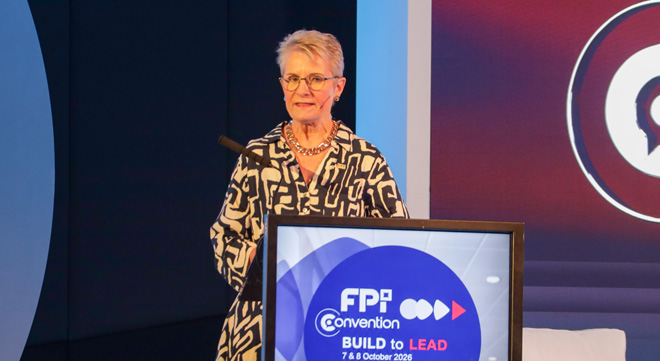

Technology can give financial advice greater speed and scale, but advisers will remain indispensable if they continue to earn clients’ trust, Kirsty Scully CFP® (pictured) told delegates at the FPI Professionals Convention in Cape Town on 7 October 2026.
Scully, chairperson of the Financial Planning Standards Board Council, said artificial intelligence is confronting advisers with an important question: which parts of financial planning require them to be genuinely human?
“Technology can give us speed. Technology can give us scale, but only humans can earn trust,” said Scully, who is a senior investment specialist at Core Wealth Advisory Services.
The experience with robo-advice was instructive. Automated investment services provided efficient and affordable solutions, particularly for clients with relatively straightforward needs. But people continued seeking human guidance during market volatility and when facing difficult financial decisions within their families.
This produced hybrid models that combine technology with human guidance. The lesson was not that automated advice had failed, but that efficiency alone was insufficient for many clients.
Drawing on research undertaken by the US-based CFP Board, Scully outlined five trends already affecting financial planning and four possible scenarios for how AI could change the profession over the next five years.
1.Earn the next generation’s trust before wealth transfers
The intergenerational transfer of wealth is changing both who owns assets and what clients expect from financial advice.
Scully said younger clients expect digital access, transparency, speed, and advice aligned with their values. Advisers are consequently moving beyond relationships with individuals and engaging with families across generations.
She is increasingly seeing parents bring adult children and even teenagers into financial-planning meetings. Shortly before the FPI Convention, she met parents whose two teenage daughters were becoming investors.
These meetings give advisers an opportunity to educate younger family members and begin earning their confidence before assets change hands.
“The future of client retention is not going to be won once the money transfers to that next generation. It is going to be won years earlier by us earning the trust of that future generation,” she said.
A longstanding relationship with parents does not, by itself, secure a relationship with their children. Advisers who want to retain intergenerational clients must engage with the future recipients of the wealth before they inherit it.
2.Reframe retirement planning as preserving choice
Longer lives mean financial plans may have to support clients through retirements lasting between 20 and 40 years. Inflation, rising healthcare costs, and longevity can place sustained pressure on their capital.
Scully said clients increasingly tell her they do not intend to retire because they enjoy their work. Instead of assuming that retirement planning concerns a fixed date on which work will end, advisers can frame it as creating freedom.
“This conversation is not about you stopping work. This conversation is about creating freedom,” she said.
The aim is to ensure clients continue working because they want to, rather than because they must. A sound plan should preserve their ability to keep working, reduce their hours or stop entirely.
“Retirement planning is no longer just about retirement. It’s about ensuring that the choice remains that of our clients,” Scully said.
3.Succession must transfer trust as well as ownership
Clients want to know that an advice firm will continue serving them after their adviser retires.
Scully said succession planning therefore involves more than transferring business ownership. Practices must invest in younger planners and prepare them to assume responsibility for the business and its client relationships.
“The best succession plan that we can put together is not in the document,” she said.
A document cannot, by itself, transfer the knowledge and confidence built up during a longstanding advisory relationship. The next generation must be ready before the senior adviser leaves.
Succession planning is therefore both a business-continuity exercise and a professional-development responsibility.
4.Connect money with personally meaningful goals
Clients, particularly those from younger generations, increasingly expect advice tailored to their circumstances instead of a standard plan or product offering.
AI can perform calculations and process information, but advisers must still understand what clients want their money to make possible.
Financial plans should not be built around products, Scully said, but around “people’s dreams and people’s goals”.
She referred to a client in her 50s who wants to buy a camper van and travel around South Africa after turning 60. The client has an investment associated specifically with this objective and contributes the amount required to work towards it.
“People don’t remember portfolio allocations, but what they do remember is the dreams that you have helped them to achieve,” Scully said.
Her example suggested that hyperpersonalisation involves more than tailoring recommendations with data. The financial arrangement must also be linked to an outcome that is specific and meaningful to the client.
5.Human talent will become a competitive advantage
Attracting and retaining professionals who combine technical knowledge with empathy, strategic thinking, and integrity has become one of the biggest challenges facing financial-planning businesses, Scully said.
An advice practice’s competitive advantage does not lie only in the products it offers. It also lies in the quality of the person guiding the client through the planning process.
The most valuable planners simplify complex information, inspire confidence, and build strong relationships.
“In a world of AI, human connection remains probably our greatest differentiator,” she said.
Four possible futures for AI and financial advice
Scully distinguished the five observable trends from four uncertainties identified by the CFP Board.
The scenarios are shaped by two questions:
- Will clients trust AI with financial planning?
- Will financial planners or large technology companies lead the future delivery of advice?
Scenario 1: AI empowers advisers
In the first scenario, financial planners successfully adopt AI and use it to enhance their services. Technology supports the advice process without displacing the planner, who remains central to client guidance and the application of professional judgement.
Scenario 2: Big technology firms dominate
In the second scenario, large technology companies become the dominant providers of financial advice. This would put pressure on planners to demonstrate the value of professional guidance alongside the convenience and scale of digital services.
Scenario 3: Trust is broken by AI
In the third scenario, AI fails to meet clients’ expectations, causing confidence in technology-led advice to decline. If clients then returned to human advice, the profession might struggle to supply enough certified planners, Scully said.
Scenario 4: The market splits
In the fourth scenario, AI platforms provide cost-effective services to the mass market, while human advisers serve clients whose complex circumstances require personal guidance. This would preserve a significant role for financial planners, although their target market and the nature of their work could change.
Across the four possibilities, Scully said one principle remained constant: “Technology may scale advice, but trust will scale relationships.”
The future is AI plus trust
Scully said advisers should use AI to enhance their work without surrendering their professional judgement or responsibility.
To remain indispensable, they should understand clients’ motivations, commit to continuous professional development, and provide behavioural guidance when people face uncertainty.
When markets fall or families disagree, clients may need more than information. They may need help interpreting it and deciding how to respond.
“The future isn’t AI versus humans; it is AI plus trust,” Scully said.