
The bank made R370 million in the year to June, compared with a loss of R68m the previous year. Its client base grew by 26% to 1.57 million, while revenue increased by 31% to R3.1 billion.
Seventy percent of the bank’s new business came from outside the Discovery Group – a sign that the bank is growing beyond Discovery’s traditional customer base in health, life, and investments.
These are some of the numbers in Discovery’s annual results for the year to the end of June 2026, which show a group that is still heavily dependent on its established businesses, while some of the newer parts are beginning to make a bigger contribution.
Normalised profit from operations increased by 17% to R17.75bn. Discovery South Africa accounted for R13.87bn of this, an increase of 16%.
In a nutshell, the 2026 results say less about a single year of strong growth than they do about a group gradually changing where its future growth is coming from.
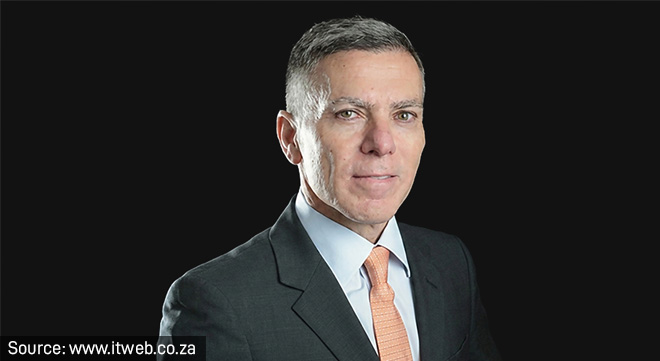
Adrian Gore (pictured), founder and chief executive of Discovery, described it as “a new strategic phase in South Africa”, with Discovery Bank evolving into an integrated platform connecting banking with health, insurance, and investments.
The bank is a big part of that change. Discovery has moved well beyond its original health-insurance business over the years, and banking is now becoming another part of the group alongside life insurance, investments, and Vitality.
From bank to Super Bank
The R370m profit is still small compared with the established insurance businesses. But the bank has grown substantially alongside its move into profitability.
The annual financial statements still describe Discovery Bank as being in a start-up phase. They also show how much the business has grown: net loans and advances to customers reached R13bn in June, compared with R8.5bn a year earlier, while customer deposits increased to R27.2bn from R23.3bn.
The loan book is no longer just a collection of card balances. It included R8.1bn in unsecured personal-card advances and R3.9bn in home loans, alongside R1bn in reverse repurchase transactions.
The bank’s common equity tier 1 ratio was 16.29% at year-end, broadly unchanged from 16.31% in 2025. The annual financial statements say the bank also maintains an internal management buffer for unexpected growth and volatility in risk-weighted exposures.
Discovery says the next phase of the business is its “Super Bank” strategy, which will connect customers’ banking, health, insurance, and investment products.
“This evolution underpins Discovery’s Super Bank strategy, which aims to create a more connected customer experience across the ecosystem and makes the delivery of shared value seamless,” said Gore.
Whether the cross-selling works at the scale Discovery envisages will take longer to establish.
For now, the bank is growing, and Discovery’s financial statements say the risk of a material adjustment to the carrying value of goodwill allocated to the Bank is now remote. The group’s impairment assessment found significant headroom between the Bank’s estimated recoverable amount and its carrying value, supported by its continued growth and financial performance.
The established businesses are still paying the bills
Discovery Health, Life, Invest, and Insure generated R13.67bn of normalised operating profit between them in the year to June, accounting for almost all of Discovery South Africa’s R13.87bn.
Discovery Life remains the largest, with normalised operating profit of R5.87bn, up 6%. Health generated R4.63bn, up 9%, while Invest produced R2.16bn, also up 9%.
New business growth was strongest in Invest. Discovery Health’s new business annualised premium income increased 10% to R10.5bn. Invest was up 13% to R3.87bn, while Life increased 1% to R3.24bn. Insure’s new business API (Annualised Premium Income) rose 2% to R1.39bn.
Invest’s operating profit increased 9%, supported by strong asset growth and positive net inflows.
Life and Invest generated R469m of value from new business after the cost of required capital, compared with R461m in the previous year. New business annualised premium equivalent (APE) increased 13% to R3.7bn, while the annualised profit margin fell from 1.8% to 1.6%.
Excluding Invest, the Life margin increased from 2.1% to 3.8%. Invest accounted for R2.9bn of the R3.7bn combined new business APE, compared with R803m for Life.
Discovery Health’s administration and managed-care fees from Discovery Health Medical Scheme (DHMS) increased to R8.83bn from R8.39bn. Vitality membership fees from DHMS members increased to R2.53bn from R2.33bn.
Life retained a 27% share of the affluent retail protection market. Its operating profit increased 6%, while new business API increased only 1%.
South African Life and Invest risk insurance claims fell to R7.94bn from R8.33bn. Death claims fell from R5.81bn to R5.48bn, while disability claims increased from R4.37bn to R5.04bn.
Insure produced the largest increase in operating profit among the four established businesses. Normalised operating profit rose 24% to R1.01bn. Before associates, the increase was 29%, and the operating margin widened from 11.9% to 14.8%.
Across the group, Discovery says behaviour change generated R2.2bn in claims savings during the year. Engaged Discovery Insure clients experienced 74% lower road-fatality rates, while DHMS members had a 17.7% lower cost per benefit unit than competitors.
Vitality is becoming a business in its own right
Vitality is becoming increasingly difficult to treat as an add-on to the insurance businesses.
The Vitality composite produced R3.88bn in normalised operating profit, up 21%. The figure brings together VitalityHealth, VitalityLife, Vitality Global Markets, the group’s interest in Ping An Health Insurance, and Vitality AI and central costs.
The model has been developed over years around linking behaviour to insurance. Ping An provides a large-scale example of how it can work inside an existing health insurer rather than through a wholly owned business.
A 25% stake in Ping An Health in China was acquired in 2009. Ping An Health Insurance provides cover for private healthcare-related claims in China. The current holding is 24.99%, and PAHI is accounted for as an associate rather than a subsidiary.
The relationship goes beyond the investment itself. Through Vitality Health International, Discovery uses its health and Vitality intellectual property to build strategic partnerships with health insurers. In the case of Ping An, this includes managing the investment in PAHI, supporting capability-enhancing projects and managing the relationship with the wider Ping An group. The Vitality platform was introduced to Ping An Health clients in China in 2012.
PAHI reported revenue of R47.6bn and net profit of R6.37bn for the year. The group’s share of its after-tax operating profit, after associated costs, was R1.317bn, up 9%. Its 24.99% interest in PAHI had a carrying value of R8.16bn at year-end.
Ping An had more than 35 million insured lives, up 10%, although new business API fell by 10% to R2.723bn.
The international operation is not all moving in the same direction. Vitality Global Markets’ profit fell 29% to R186m, while Vitality AI, which includes R56m of other central Vitality costs, recorded a R299m loss, compared with R89m previously.
The group is still investing in the next generation of the model, while the businesses built around earlier versions are already producing substantial profits.
The group has room to keep investing
For now, Discovery’s financial position gives it some room.
Embedded value increased from R126.6bn to R142.9bn. Embedded value earnings were R17.85bn, compared with R17.31bn the previous year. The annualised return on opening embedded value was 14.1%, compared with 15.7%.
Cash conversion improved to 85% of after-tax normalised operating profit, while financial leverage fell from 16.8% to 15.4%. Total debt was R17.787bn and total equity R82.661bn at year-end.
The final dividend was increased by 36% to 273 cents a share.
Discovery’s financial position gives it the capacity to continue putting money into businesses that are still being built.
The question is what those businesses will look like in a few years.
Discovery Health remains the foundation. Life and Invest remain substantial businesses. Insure is producing more profit from its existing operation. And now the bank is profitable, with 1.57 million customers and most of its new business coming from outside the Discovery customer base.
Vitality has grown into an international business that contributes billions of rand to the group.
The pieces are still recognisably Discovery. But the balance between them is changing.

