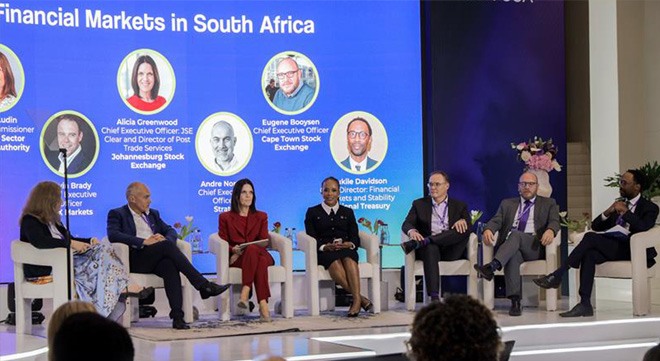

South Africa’s capital markets face a combination of declining liquidity, reduced depth, and intensifying global competition. To meet these challenges, industry leaders set out a range of measures aimed at improving market attractiveness, access, and efficiency during a panel discussion at the Financial Sector Conduct Authority’s Industry Conference on 18 March.
The session, moderated by FSCA Deputy Commissioner Astrid Ludin, included contributions from Alicia Greenwood, the chief executive of JSE Clear and director of post-trade services at the JSE, Cape Town Stock Exchange chief executive Eugene Booysen, A2X Markets chief executive Kevin Brady, Strate chief executive Andre Nortje, the FSCA’s divisional executive for market integrity and decision sciences, Kedibone Dikokwe, and National Treasury’s chief director: financial markets and stability, Vukile Davidson.
Ludin referred to the 2025 OECD economic survey on South Africa, which stated that although the country’s capital markets are sophisticated, they are becoming shallower and less liquid. She also pointed to negative net listings on the JSE and declining turnover in the local bond and equity markets, which is resulting in lower liquidity in the domestic market. In addition, competition from global markets is increasing, and South Africa’s weighting in major global indices is declining, which means South Africa is no longer an automatic allocation destination for large foreign funds.
Against this backdrop, Greenwood reported strong recent market performance. She said the All Share Index reached historic highs in 2025 and had outperformed several global and emerging-market peers. Equity value traded rose 32% in 2025 compared with the prior year and was up a further 40% year-to-date in 2026, which she attributed to improved fundamentals and returning international investor interest.
JSE initiatives: listings, infrastructure and clearing
Greenwood outlined a broad programme to enhance attractiveness for local and international investors. Listing requirements have been simplified, including shorter documentation, lower voting thresholds, reduced free floats, tiered fee structures, and fast-track dual-listing arrangements from major international exchanges.
She said infrastructure upgrades – including co-location services – are designed to attract high-frequency and algorithmic traders, which she linked to improved liquidity. A multi-year modernisation programme is under way across trading and clearing systems, alongside operating model changes aimed at reducing friction and aligning with global norms.
On settlement, Greenwood said the JSE is consulting market participants on shortening the current T+3 cycle, in line with global moves towards T+1. JSE Clear – a central counterparty clearing and risk management business – will extend central counterparty clearing to bonds and repos by the end of 2026, with a potential later extension to equities.
She also referred to international roadshows conducted with the government, regulators, banks, and listed-company executives to market South Africa to investors, as well as collaboration to address policy barriers.
Greenwood said delistings is a global trend across all the major exchanges – driven by capital-raising in lower-friction private markets and by mergers and acquisitions.
Although the JSE has not been immune to this trend, six companies listed on the JSE in 2025, two more will list soon, “and we’ve got a very strong pipeline for the year ahead”.
Retail democratisation
Booysen said the single most effective way to increase liquidity and improve overall market quality is to expand retail investor participation by opening markets directly to ordinary individuals. Liquidity, he emphasised, is fundamentally a function of the number of participants, the number of trades, and the time over which they occur.
Booysen illustrated the potential impact with international examples where similar decisions delivered explosive retail growth:
- The Moscow Stock Exchange implemented T+0 settlement, together with an in-house banking vertical, onboarding 40.5 million new retail accounts in one year; those accounts now drive 60.5% of liquidity.
- Kazakhstan followed a comparable model and achieved 40.5% retail-driven liquidity with 4.5 million retail clients.
- India has reached 120 million retail participants through wallet-based direct access.
“The single biggest benefit for moving to T+0 was not just the atomic settlement. It was actually it gave them a mechanism to include retail investors within their platforms, and immediately they increased the participation rate. That’s it. It seems like a simple solution, but that was the hard decision they made. They opened their markets up to retail investors, and they bypass banks, they bypass custodians, they bypass stockbrokers,” he said.
Booysen cautioned against extending trading hours as a liquidity solution. He argued that longer sessions would introduce significant asymmetric information risk.
With roughly 60% of the South African market held by local investors, extended hours (for example, to overlap with trading in the United States) would expose them to large price gaps from offshore news flows (such as commodity price movements) while they sleep, benefiting only a smaller group of international participants.
Friction costs
Brady said shortening the settlement cycle would be positive for liquidity – provided it is well managed – but would have limited impact on its own in the South African context.
On trading hours, he noted that liquidity is concentrated towards the end of the trading day and suggested that targeted realignments or limited extensions may be more effective than full-day expansion.
He identified friction costs – including predictable fees and certainty of execution – as key drivers of liquidity, particularly for systematic quant trading.
“What’s important to them? Speed and cost – knowing what those costs are going to be before they actually start the trade. Reduce friction costs, you attract more players, you bring more liquidity. To use the adage, trade begets trade, you start feeding the system, and that actually drives liquidity.”
Brady said another priority is providing stockbrokers with sufficient order type tools. “They’re managing different orders from different types of investors, and they need these tools to actually achieve the right outcomes for their different clients.” An exchange should innovate order types to align with the type of demand.
He called for liberalization of the market and for the Financial Markets Act to be updated to reflect an advanced market that has more than one exchange.
“Deal with the issues of creating a fair and level playing field. Healthy competition will drive liquidity. It will drive innovation. It will find solutions to listings. Free markets globally show you how it grows. And I think South Africa is horribly behind.” The problem does not lie in the lack of good ideas but with slow implementation.
Infrastructure and private markets
Nortje said South Africa has the world-class infrastructure to drive transformation – the issue is whether enabling securities to become a true “store of value” (usable for payments and collateral) would enable better liquidity.
“Within the South African environment, we’ve still got, to a large extent, nominee structures that sit between the core infrastructure and the end client, and I think that’s something we need to debate.”
He highlighted innovative platforms such as EasyEquities, which use fractionalisation to drive rapid retail growth (with deposits growing at R1.5 billion a month), demonstrating strong latent demand for lower-barrier participation. This highlighted the need to reduce friction between issuers and end investors.
Nortje emphasised the untapped potential in private markets – R50 billion in private debt and R1 trillion in money-market instruments already under Strate custody – and the opportunity to extend trusted infrastructure to retail bonds and other instruments, opening distribution through broader networks.
Additional steps include the Euroclear link, which enables local investors to buy and sell foreign securities more cheaply (settling and holding in their own name via Euroclear custody), with potential to bring equities and bonds onshore in future.
There was a need to enable private companies to access trusted capital market infrastructures, which would lead to more listings.
Regarding later settlements, Nortje said the South African Reserve Bank is working with the banks to extend cut-off times by two hours to allow foreign bond buyers to trade later into the market. However, this requires changes to operational sequencing and participant business models.
Regulatory and policy considerations
Dikokwe acknowledged the rapid global evolution in market structures, including the widespread adoption of shorter settlement cycles and discussions around extended trading hours. She supported South Africa’s alignment with these developments to maintain competitiveness and attract international and local investors.
From a regulatory standpoint, Dikokwe outlined three key considerations that must guide any implementation:
- Market integrity and surveillance – ensuring that changes (particularly extended hours) do not introduce new risks to trading activities or create opportunities for unfair practices; enhanced monitoring would be essential in any non-standard periods.
- Operational resilience – assessing whether market participants, exchanges, and infrastructures can absorb the systemic risks that could arise from faster cycles, longer hours, or other innovations without compromising stability.
- Investor protection – with a particular focus on retail investors, who may face heightened vulnerabilities such as price deficiencies, information asymmetries, or execution risks in altered market conditions; safeguards must be strengthened accordingly.
Dikokwe reaffirmed the FSCA’s support for market innovation and modernisation but emphasised the critical need for co-ordination across the ecosystem – involving exchanges, infrastructures, intermediaries, and other regulators – to adapt frameworks effectively while preserving strong protections for investors and the integrity of the system.
Davidson provided the policy lens, explaining that reforms in the capital markets space are evaluated through two overlapping dimensions: what advances the broader economy (by intermediating domestic and foreign savings into productive uses, both locally and regionally) and what supports a growing, dynamic capital markets sector. The primary focus is on the intersection of these interests, underpinned by what benefits customers and the real economy.
He noted that although some areas (such as certain innovative instruments like crypto or predictive markets) may diverge in their alignment, the core policy targets overlapping benefits. Recent expressions of this approach appear in Budget announcements and planned amendments to the Financial Markets Act. National Treasury is prioritising:
- infrastructure finance;
- climate-related investment;
- increased retail participation in capital markets; and
- the development of a synthetic financial centre to enhance South Africa’s role as a regional financial hub and improve domestic savers’ ability to manage portfolios effectively.
Davidson observed that global delisting trends – driven by structural shifts, including the dominance of technology sectors where South Africa has fewer large players – are not unique to the country.
He suggested that evolving geopolitical contexts – with policymakers worldwide rebalancing towards domestic and regional priorities amid concerns over global integration – could create opportunities for South Africa to position its markets more intentionally for local and regional growth. Treasury is actively considering how to pre-position frameworks to capitalise on any such shift while keeping the environment competitive and fit-for-purpose.