

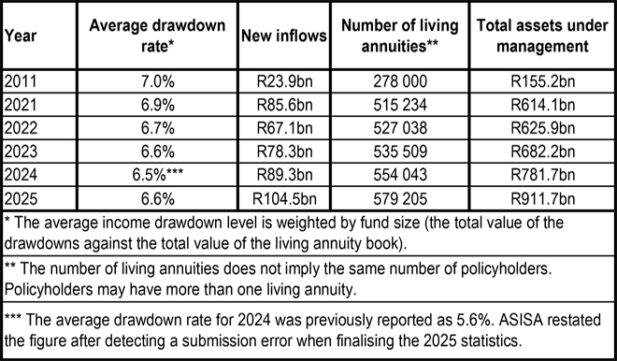
New inflows into living annuities reported by members of the Association for Savings and Investment South Africa (ASISA) reached a record R104.5 billion in 2025, an increase of 17% from R89.3bn in 2024.
Assets under management represented in the statistics increased by R130bn during the year, from R781.7bn at the end of 2024 to R911.7bn at the end of 2025. This represents growth of 16.6%.
The number of living annuities increased by 25 162, or 4.5%, from 554 043 to 579 205 over the same period. ASISA cautioned that the number of living annuities does not represent the number of individual policyholders because a policyholder may hold more than one living annuity.
The latest figures extend the substantial growth recorded since ASISA began compiling its living-annuity statistics in 2011. At the end of that year, there were 278 000 living annuities in force, with assets under management of R155.2bn.
By the end of 2025, the reported number of living annuities had more than doubled, while assets had increased almost sixfold. New inflows increased more than fourfold from R23.9bn in 2011.
ASISA said the 2025 figure represented new inflows into living annuities and included transfers.
Drawdown rate remains broadly stable
Despite rising living costs, the asset-weighted average income drawdown rate remained within the narrow range recorded over the past three years.
The average income drawdown rate is weighted by fund size and calculated by comparing the total value of drawdowns with the total value of the living-annuity book.
The average was 6.6% in 2025, compared with 6.5% in 2024 and 6.6% in 2023. Although it increased marginally in 2025, it remained below the 7% recorded in 2011.
Jaco van Tonder, deputy chairperson of ASISA’s Marketing and Distribution Board Committee, said the longer-term decline suggested living-annuity investors had sought to preserve their capital by lowering spending rather than increasing their income through higher drawdown rates.
Van Tonder said the 0.1 percentage-point increase in the average drawdown rate, from 6.5% in 2024 to 6.6% in 2025, was not statistically significant and did not signal an underlying change.
ASISA restated the average drawdown rate for 2024 to 6.5% after previously reporting it as 5.6%. The Association said it detected a submission error while finalising the 2025 statistics.
Almost three-quarters of assets below 7.5%
Van Tonder said annual drawdown rates of 4% to 5% during the first decade of retirement, and below 8% in later retirement years, were generally considered prudent, giving annuitants a high probability of preserving their purchasing power over their lifetimes.
He said it was therefore encouraging that 45% of living-annuity assets, worth R410.2bn, were in the 2.5% to 5% income band at the end of 2025.
A further 27.3%, or R248.9bn, was in the 5% to 7.5% income band.
Together, these two bands accounted for 72.3%, or R659.1bn, of the R911.7bn in living-annuity assets reported by ASISA members at the end of 2025.
“This means that almost three-quarters of living annuity assets are subjected to annual drawdown rates of 7.5% and lower,” Van Tonder said.
These percentages relate to the value of assets in each income band and should not be interpreted as percentages of policies or policyholders.
How living-annuity income works
A living annuity is a compulsory-purchase annuity that does not guarantee a regular income.
Living-annuity policyholders must select an annual income of between 2.5% and 17.5% of the value of the investment. The selected percentage can be reviewed once a year on the policy’s anniversary date.
The income available from a living annuity depends on the performance of its underlying investments.
Van Tonder identified three key factors that determine how long the capital can continue producing an income:
- the level of income selected;
- the performance of the underlying investments; and
- the lifespan of the annuitant.
To prevent the erosion of invested capital over time, Van Tonder said the percentage of income drawn should not exceed the real returns of the investment portfolio supporting the living annuity.