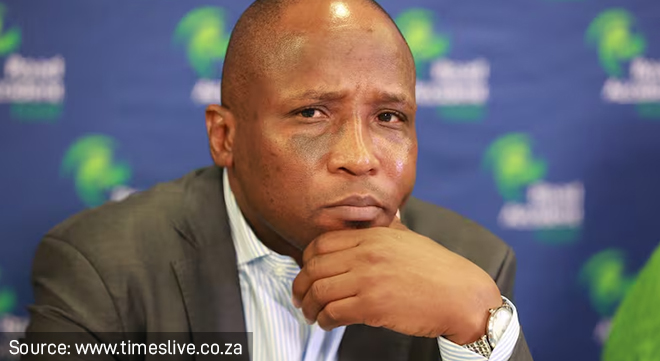
Parliament’s 26 November announcement that the Standing Committee on Public Accounts (SCOPA) would seek the Speaker’s concurrence to lay criminal charges against former Road Accident Fund CEO Collins Letsoalo (pictured) made headlines – but since then, silence. No updates from Parliament, no new statements from SCOPA, and no public comment from Letsoalo or his legal team.
Does this signal the quiet before decisive action or the slow legal trench warfare familiar to South Africans when senior officials face allegations of malpractice?
The stand-off stems from Letsoalo’s failure to appear before SCOPA after being lawfully summoned. The committee sought answers about alleged financial mismanagement, irregular appointments, the dismantling of the RAF attorneys’ panel, and disputes with the Auditor-General on the accounting standard used to reflect the fund’s financial standing.
These issues are central to SCOPA’s inquiry into the RAF’s finances, launched in early October after nearly a year of attempts to obtain credible information.
Speaking to SABC News, OUTA’s Andrea van Heerden said Letsoalo’s refusal to appear is a setback but not a derailment. She noted that officials often use legal processes to delay accountability.
“It might make the process a little bit more difficult, but I don’t think it’s going to hamper or it’s going to put a stop to what SCOPA is trying to do… Collins is doing exactly the same thing. He is playing the long game because he doesn’t want to account for his role in what is happening at RAF,” she said.
The summons was issued on 21 November, instructing Letsoalo to appear on 25 and 26 November. The sheriff attempted personal service multiple times, all unsuccessful. SCOPA says the summons was ultimately served via substituted service: online publication, email, and by affixing it to a door. The committee maintains that all legal requirements were met.
Parliament has emphasised its authority. The Powers, Privileges and Immunities of Parliament and Provincial Legislatures Act allows it to summon anyone to give evidence under oath or submit documents. Refusing to appear without valid cause may constitute a criminal offence and is treated as contempt of Parliament.
Hours before his scheduled appearance, Letsoalo’s attorney issued a cease-and-desist letter instructing SCOPA to halt the inquiry. The letter challenged the committee’s authority, questioned the legality of the process, and asserted SCOPA lacked mandate in its current form. Letsoalo, through his lawyer, maintained he would not appear.
‘I am not missing’
Speculation arose when Parliament stated the sheriff could not locate him. Letsoalo dismissed claims he was “missing” as inaccurate and unfair. In an SABC interview, he said Parliament had always been able to reach him through his legal representatives:
“Does Parliament actually go look for people? I was shocked. I mean, I’m told I’ve been looked for, is it? They say I’m missing… I wrote a letter to them. I put an address. They go to that address and but that was the postal address… My lawyers wrote to them. If they were interested in serving those summons, my lawyers told them, we’ll collect them on behalf of the guy. We’ll receive those summons… so I’m unperturbed by that.”
In the interview, Letsoalo again stood by his refusal to appear before SCOPA.
“I’m not going to that kangaroo court where Songezo Zibi is the chairperson, the evidence leader, the interrogator, the witness selector, and the adjudicator in one. Where have you ever seen something like that?”
What’s next?
Van Heerden called it “absolutely ludicrous” that one person could think they are above the law, adding it was encouraging to see Parliament finally exercising its powers.
She explained that the committee already has a strong basis for action. “But I think, honestly, with regards to all the information they already have in front of them through this inquiry and through speaking to individuals or whistleblowers, I think they have already a good basis to refer him for criminal prosecution without him setting his side of the story.”
Van Heerden added that once referred, the police would investigate and gather the necessary documentation. “So, it’s not necessarily the end of the road if Letsoalo does not appear before SCOPA. It might make the process a little bit more difficult, but I don’t think it’s going to hamper or it’s going to put a stop to what SCOPA is trying to do.”
Letsoalo has argued that the committee lacked jurisdiction, claiming oversight should fall to the Portfolio Committee on Transport.
Read: SCOPA presses former RAF CEO for firm commitment to appear before inquiry
Van Heerden dismissed this argument. “It’s Parliament. So, whether or not in front of the portfolio committee on transport or SCOPA, it’s still a parliamentary function to investigate… it’s just a deflection… at the end of the day, we are one Parliament, and he needs to account for the decisions that he made.”
The cease-and-desist letter
In the letter sent to SCOPA on the day that Letsoalo was supposed to appear before the committee, Letsoalo’s attorneys argued SCOPA had overstepped and violated procedural rules.
They emphasised that only the Speaker speaks for Parliament, and a chairperson’s correspondence does not bind the institution. The letter highlighted contradictions and procedural irregularities, including SCOPA’s claim that a letter from Letsoalo’s team “had not been received” while acknowledging it circulated among members.
Invoking the constitutional principle of audi alteram partem (the right to be heard), the letter demanded SCOPA pause the inquiry to address concerns about jurisdiction, lawfulness, and scope. The attorneys warned proceeding without considering these issues “violates procedural fairness” and denies Letsoalo a chance to respond.
On jurisdiction, they argued SCOPA’s mandate is limited to public accounts, expenditure, audit outcomes, and financial performance, not operational decisions of autonomous entities such as the RAF. Oversight of RAF administration, governance, and policy, they said, falls to the transport committee.
The letter noted: “An inquiry into matters falling outside financial accountability amounts to a material expansion of your mandate.”
It warned that ignoring these points could expose SCOPA to judicial review under the Promotion of Administrative Justice Act. The letter formally demanded that the committee:
- suspend meetings until procedural fairness is restored;
- clarify the legal basis for SCOPA’s jurisdiction; and
- provide Letsoalo with a reasonable opportunity to be heard.
The attorneys concluded: “Our client’s intention is not to impede parliamentary oversight but to ensure that it is exercised lawfully, fairly, and within the limits of the Constitution and Parliamentary Rules.”
With SCOPA waiting on the Speaker’s concurrence to lay charges and Letsoalo maintaining his legal stance, the matter appears poised for a protracted legal battle. For now, the silence over this confrontation hangs heavy, leaving South Africans to watch whether Parliament will assert its authority – or whether this will be another drawn-out saga of delayed accountability.