
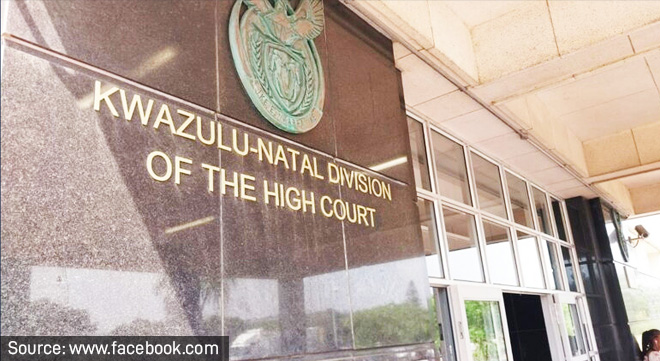
The High Court in Durban has reaffirmed that the state may be held delictually liable when police officers fail in their constitutional duty to protect life and property.
In a judgment handed down in September, Judge Mokgere Masipa ordered that the Minister of Police is liable to Arnold Fourie Raath for damages amounting to R2 029 000, plus interest at 9% a year from the date of demand to final payment. The minister must also pay Raath’s legal costs, including reasonable travel and accommodation expenses, to be taxed on scale C “given the serious nature and extent of this matter”.
“This case illustrates in stark terms the constitutional obligations of the state. When individuals’ lives and property are threatened, and when the police are forewarned and present, a failure to act undermines the Constitution itself,” Judge Masipa said.
The case concerned the police’s failure to act when a large group of community members entered Raath’s farm, Kroonvrug, on 19 May 2015, setting alight equipment and slaughtering about 80 to 90 head of valuable game. The central issue was whether the South African Police Service failed in its constitutional and statutory duties to protect Raath and his property, and whether such failure was wrongful and negligent.
The unrest followed the discovery two days earlier of several cattle belonging to members of the Mdletshe community that had strayed onto Raath’s property and were later found dead. Community members accused Raath of poisoning the animals – a claim that intensified tensions in the area. However, laboratory tests later confirmed that the cattle were not poisoned, disproving the allegations that had fuelled the hostility.
Evidence before the court
Raath testified that he farmed macadamias, pineapples, and game. On 17 May 2015, after the cattle were found dead, SAPS officers and SPCA officials attended the scene but agreed to the community’s demands to leave the carcasses unburied until the MEC and media could view them the next day, despite the evident tension this caused.
On 19 May, Raath received early warnings that a protest was planned. He phoned Captain Ntuli, the Hluhluwe station commander, several times that morning, urging police to prevent the group from entering his farm.
Raath told the Court that despite acknowledging the calls, Ntuli took no action as people set machinery alight, destroyed crops, and began slaughtering his animals. From his home, Raath could see the destruction unfolding.
Raath’s wife, Kim, confirmed the number of animals and said nothing remained after the incident.
A neighbouring farmer, Anton Louw, testified that he saw the crowd enter the camp and kill animals while police did not intervene.
Raath’s employee, Lucky Mngomezulu, described how the group entered the property, set fire to machinery, destroyed crops, and slaughtered game using pangas and bush knives. He said police stood by at the gate throughout.
Video footage shown to the court captured MEC Cyril Xaba, General Jula, and Brigadier Mbatha addressing the crowd while police vehicles and officers were visible but inactive.
For the defence, Ntuli confirmed he was the station commander on duty that day. He testified that he had focused on protecting Raath and his family, fearing the farmhouse would be attacked. Under cross-examination, however, Ntuli admitted receiving multiple warnings from Raath and another farmer, Conrad Botha, about the planned protest, and conceded that he had been aware of the community’s anger.
Ntuli also acknowledged that public order policing units with riot-control equipment were present but not deployed until after the damage occurred. He further conceded that tests showed no evidence that Raath had poisoned the community’s cattle, yet he took no steps to correct the false belief that fuelled the unrest.
The Court observed that although Ntuli claimed he withheld intervention to protect Raath’s life, the evidence established that Raath’s life was not in immediate danger. The violence was directed at property and livestock, and there was no credible threat to Raath’s safety. The Court found Ntuli’s justification “misconceived” and “indicative of a failure to assess the situation rationally or to discharge his command duties appropriately”.
Captain Fakude, of the Public Order Policing Division in Richards Bay, confirmed that he arrived at about 10.30am, by which time a bulldozer was burning and animal carcasses were strewn across the property. His team managed to recover a few carcasses but made no arrests. Fakude agreed that riot-control equipment was available but was not used earlier, confirming that police resources capable of intervention were on hand but not utilised.
Judge Masipa’s findings
Judge Masipa found that the police’s omissions were both wrongful and negligent, establishing delictual liability on the part of the Minister of Police.
Citing the landmark Minister van Polisie v Ewels decision, the Court held that an omission by police may be wrongful where the community’s legal convictions impose a positive duty to act. The court noted that both section 205(3) of the Constitution and section 13(3) of the SAPS Act create such duties – to protect life and property and to maintain public order using reasonable force where necessary.
The judge further drew on Carmichele v Minister of Safety and Security and Minister of Safety and Security v Van Duivenboden, reiterating that “the state, through its officials, bears a constitutional duty to act” when rights to life, dignity, and security are threatened.
On the question of negligence, the Court found that the harm was plainly foreseeable. Ntuli had multiple warnings about the community’s anger, the scheduled meeting with officials, and the absence of any valid poisoning claim. Despite this knowledge, SAPS failed to consult Raath, prevent entry onto the farm, or deploy riot-control measures.
“Their omissions,” the judge said, “materially increased the risk of harm and fell short of the standard required by both the Constitution and the SAPS Act.”
Addressing causation, Judge Masipa held that had the police acted on these warnings – by refusing access, dispersing the crowd, or using available public-order methods – the slaughter would probably not have occurred. The failure to act directly caused Raath’s losses. Applying the Lee v Minister for Correctional Services standard, the judge added that even if absolute certainty could not be shown, the police’s negligence “materially increased the risk of the very harm that ensued”.
Turning to constitutional implications, Judge Masipa criticised the decision to exclude Raath from discussions held on his own land while senior officials engaged with the protesting community. This, the court said, “reflects a disregard for his rights to dignity, equality, and property”. Allowing a politically charged gathering on private land without evidence or consultation “subordinated Raath’s constitutional rights to mob pressure”.
“I find that the omissions of the SAPS were both wrongful and negligent, and that they caused Raath’s loss,” Judge Masipa concluded. “Raath is entitled to damages in the amount of R2 029 000, together with interest and costs.”
Read the full judgment here.



So SAPS/NPA…
Why did the NPA “Nole” CAS-79-12-2023(Laaiplek)
How big is the can of worms really?
As per the constitution no one is above the law. The judge was absolutely correct in granting the order to the farmer
100 % Rights violated Victim safety and security and the sickening stinking arrogance by Senior Police officers involved Not to diligent properly independent following the rules and regulations proclaimed in Section 205 of the Constitution of RSA.
This narrative of violence and death threats should never be tolerated by Saps go read thoroughly your own Code of Conduct. Our Judiciary is the Custodian of the Law and our Final hope for Justice. Mr Matthew Summerton PE.
10 years later. Now we know wby Police officials behaved like that. The strugle between black & white will never stop. People are fed the wrong information.