

If the founder of a financial-planning practice disappeared for six months, what would clients continue to experience, and what would immediately begin to weaken?
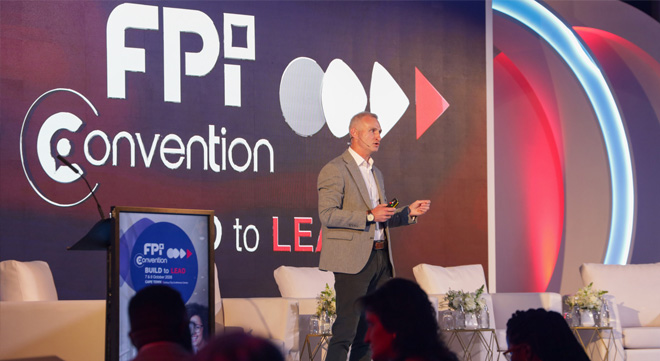
That was the test that Mark Hedderman (pictured), a Certified Financial Planner® professional, posed to advisers at the FPI Professionals Convention in Cape Town. A lasting practice, he argued, must transfer client trust, contextual knowledge, decision-making, and leadership beyond the person who built it.
In his presentation on 8 October 2026, Hedderman, the chief executive of Hedderman Financial Solutions in Ireland, asked delegates to consider what their practices would look like if they were designed to last for 100 years.
Hedderman, chief executive of Hedderman Financial Solutions in Ireland, asked delegates to consider what their practices would look like if they were designed to last for 100 years.
He was not advocating bigger or busier firms. His vision was of businesses built around continuity and relationships.
“What I want you to think about is businesses that are crafted on better relationships, greater levels of care, and more love.”
The question functioned as a design test: could the team maintain the firm’s standards and identity if the founder was no longer present to guide every relationship and decision?
When the founder becomes the business
Founder-led firms can build strong relationships and deep client trust while remaining vulnerable because too much knowledge and authority are concentrated in one person.
In the early years of his family’s practice, clients expected their engagements to pass through Hedderman’s father, Maurice Hedderman. He was the person they had known for decades and whose judgement they trusted.
This left the practice heavily dependent on its founder. Service standards were understood but not necessarily documented, and the client experience depended significantly on one person.
The risk was not confined to client relationships. Decisions within the business could also depend too heavily on its founder or chief executive. Hedderman acknowledged that being a capable financial planner did not automatically equip someone to lead a business.
Growth would not resolve these weaknesses if relationships, knowledge, and decision-making remained concentrated in one person.
Hedderman’s argument was that succession involves more than an eventual ownership transfer. Client trust, institutional knowledge, authority, and responsibility must also move beyond the founder.
A client file is not a client relationship
A client file can be assigned to another adviser when ownership or leadership changes. The trust developed through years of conversations and difficult decisions cannot be transferred on a particular date.
A successor may know which products a client holds and how much the client has invested without understanding the family relationships, personal priorities, and reasoning that shaped earlier advice.
Hedderman said younger advisers could inherit information about clients’ assets and policies without understanding the family dynamics and personal characteristics behind the financial plan.
Continuity therefore requires more than maintaining complete administrative records. The wider practice needs to retain the context behind important recommendations and decisions, while clients need an opportunity to build confidence in the people who may eventually assume greater responsibility for their affairs.
This is why succession cannot begin only when the founder is preparing to leave.
Hedderman argued that firms should develop younger professionals and introduce them into client relationships early. Clients need opportunities to experience the knowledge, values, and contribution of other team members before the founder steps back.
These introductions are more than succession administration. They give the next generation time to earn clients’ trust while the established adviser remains available to support the relationship.
At Hedderman Financial Solutions, clients are reintroduced to team members when they visit the practice. Each person explains the role they play in supporting the client and the client’s family. The aim is to build confidence in the firm as a whole rather than preserve an exclusive relationship with one adviser.
Make knowledge and standards transferable
Transferring responsibility requires more than moving information from one client-management system to another. A practice must also ensure that its approach to client service no longer depends on the founder’s personal memory, availability, or judgement.
Hedderman said his firm’s client experience had once depended too much on the individual adviser and the circumstances of the day. Annual or quarterly engagements lacked a sufficiently consistent structure, while the adviser’s perceived value could become tied to whether markets had risen or fallen.
The firm subsequently developed a consistent structure for client “visits”. Conversations began with changes in the client’s personal, professional, family, or health circumstances before moving to the financial plan, decisions requiring attention, and responsibility for follow-up.
The term “visits”, rather than meetings, reflected the firm’s intention to focus the interaction on an ongoing relationship instead of treating it primarily as a technical review.
The firm also began ending client visits with a simple question: “How can we be of greatest service to you and your family?”
Hedderman said the question sometimes brought forward family concerns that had not emerged earlier in the conversation, giving the practice a better understanding of where it could help directly or involve another professional.
Hedderman also said the firm maintained a direct client touchpoint every 90 days. This was an internal service practice, not a benchmark for other firms, but it illustrated his argument that continuity depends on what happens between formal reviews as well as during them.
A personal client experience does not have to be improvised. A practice can give each engagement a consistent structure while retaining attention to the client’s circumstances.
Develop leaders, not only successors
Client succession and leadership succession are related, but they are not identical.
A practice may develop technically capable advisers without preparing anyone to make decisions about people, culture, capacity, and the direction of the business.
Hedderman said his firm had moved from a model in which judgement and direction came largely from the founder towards one in which the team had greater ownership of the business’s direction.
Not every team member could become a shareholder, but team members could still have a meaningful voice in how the firm operated and developed. Decisions could continue to be made while the chief executive was away because the team understood the firm’s values and direction.
Hedderman described four areas of continuity that his family and firm had considered:
- Client continuity, so trust extended beyond the founder or primary adviser.
- Leadership continuity, so decisions did not depend on one person.
- Cultural continuity, so the firm’s values remained intact under pressure.
- Commercial continuity, so the business remained financially viable while maintaining its professional and service standards.
Succession planning must therefore develop people who can lead the firm, not only professionals who can inherit client relationships.
The founder’s role can change without disappearing
Succession need not require the founder to move abruptly from full involvement to complete withdrawal.
Hedderman described founders moving from building a practice to translating their accumulated experience, mentoring younger professionals, protecting the firm’s culture, and serving as brand ambassadors.
Responsibilities can shift while the founder’s experience remains available to the team and clients.
Maurice Hedderman retired from the operating business in 2021 but continued contributing as a mentor and chair of an advisory group of retired clients. The group helped the firm test its services for people entering retirement, while his revised role allowed the practice to retain his perspective and relationships.
The example suggests that succession planning should consider what the founder will move towards, not only what the founder will leave behind. A revised role can preserve institutional memory and purpose while creating space for new leadership.
Protect enough capacity for continuity
Continuity also depends on the team having enough capacity to respond when clients face bereavement, serious illness, or another urgent event.
Hedderman said his practice aimed to operate at about 60% capacity. This was the firm’s own operating principle, not an evidence-based benchmark for other advice practices. Its purpose was to preserve margin for exceptional demands without overwhelming the team or weakening service to other clients.
The transferable lesson is not necessarily the percentage. It is that a practice should decide whom it can serve well, which work it must protect, and when additional demands would compromise its standards.
A firm that depends on an exhausted founder or team remains vulnerable, even if it has documented a formal succession plan.
Start before succession becomes urgent
Drawing on Hedderman’s presentation, practice owners could begin by asking four questions:
- Where do client relationships, contextual knowledge, and decisions depend on the founder?
- What service could the team continue delivering if the founder was unexpectedly unavailable?
- Which younger professionals need greater client or leadership responsibility now?
- What do trusted clients believe would weaken without the founder?
The practical response will differ by firm size and structure.
A sole practitioner may not be able to introduce clients to several advisers, but the underlying question remains: could clients still access their information, receive appropriate service, and obtain necessary decisions if the owner became unexpectedly unavailable?
For a larger practice, the test may be whether clients trust the team, whether leadership decisions can continue, and whether service standards are understood across the business.
Hedderman’s six-month test brings these questions together: what would clients continue experiencing consistently if the founder disappeared from the business, and what would immediately weaken?
The 100-year vision is therefore not primarily about institutional longevity. It asks whether the practice is transferring the qualities that made the founder valuable and whether those qualities can continue benefiting clients in another form.
“I think the real test of this is not whether our firms last 100 years, but in 100 years’ time, will people’s lives be better off as a result of our firms existing in the first place?”


