

Bestmed Medical Scheme will increase its average weighted contribution by 7.35% in 2027, with changes to day-to-day benefits, preventative care, medicine, and clinical cover across its Beat, Pace, and Rhythm options.
South Africa’s fourth-largest open medical scheme ended 2025 with 126 124 principal members and 262 190 beneficiaries, according to its latest financial results.
The 2027 increase is slightly higher than the scheme’s 6.8% average weighted increase for 2026, but below the 12.75% increase implemented for 2025.
The 7.35% increase comes as medical schemes face continued pressure from healthcare utilisation and rising treatment costs. The Council for Medical Schemes’ 2027 guidance recommends that schemes anchor contribution increases and cost assumptions at 3.8%, while allowing for reasonable utilisation and requiring justification for higher increases.
The annual benefit design process brings together input from members, healthcare advisers, and other stakeholders, which is assessed against clinical evidence, affordability, and long-term sustainability before changes are introduced.
That process sits alongside the scheme’s decision to increase average weighted contributions by 7.35% for 2027. The changes are intended to provide greater choice, strengthen preventative care, and add value while protecting long-term sustainability.
“Healthcare is a key part of this financial equation. Hence, our approach for 2027 has been to understand stakeholder feedback, and make changes that provide greater choice, strengthen preventative care and deliver more value, while protecting the scheme’s long-term sustainability,” says Leo Dlamini (pictured), chief executive and principal officer.
The scheme says its solvency ratio is 37.3%, compared with the statutory minimum of 25%. Its audited 2025 financial statements reported a solvency ratio of 35.14% at 31 December 2025.
What members will pay in 2027
The increase looks different across the options. Based on the principal-member contributions in the 2026 and 2027 brochures, the monthly changes range from R130 on the lowest Rhythm1 income band to R1 069 on Pace4.
The figures are based on the principal-member contributions in the 2026 and 2027 benefit brochures. The percentage increases are calculated from the monthly contributions.
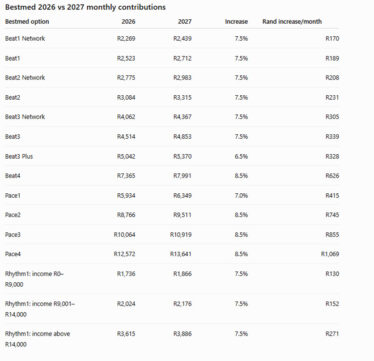
Note: Contributions shown are for the principal member only. Adult and child dependants are charged separately, so the total increase for a household will depend on the number and type of dependants. The percentage increases are calculated from the monthly principal-member contributions in Bestmed’s 2026 and 2027 benefit brochures.
Rhythm2 is not included in the table because its contribution bands changed between 2026 and 2027. The 2026 structure had three income bands, compared with two in 2027, so the full year-on-year increase cannot be calculated on a like-for-like basis.
The 2027 brochure lists a monthly principal-member contribution of R3 214 for an income of R0 to R5 500, and R3 762 for income above R5 501.
A new R1 000 benefit
The most visible new benefit is Best Bucks, which gives qualifying families R1 000 to use towards eligible out-of-hospital healthcare costs.
The benefit is unlocked when every adult beneficiary on the membership completes the free Tempo Lifestyle Screening. Once activated, Best Bucks can be used for eligible consultations, radiology, pathology, acute and over-the-counter medicine, and supplementary services, including mental-health services. It is used before the member’s normal day-to-day or savings benefits.
Tempo itself is not new. Bestmed already offered the lifestyle screening in 2026. The change for 2027 is the link between completing the screening and unlocking the additional R1 000 benefit.
More cover outside hospital
The 2027 benefits introduce a separate casualty benefit on qualifying options.
Members will have access to two emergency-room or casualty visits per family a year, at 100% of the scheme tariff, up to R3 000 per visit. The limit includes the doctor’s consultation, facility fees, radiology, pathology, and medicine used during the emergency treatment. The 2027 Pace4 brochure, for example, sets out the two-visit limit and R3 000-per-event cap.
On options such as Beat4 and Pace4, emergency-unit visits were included within the GP, nurse and specialist consultation benefit in 2026. The 2027 brochures separately list emergency-room and casualty visits on qualifying options.
Existing day-to-day limits are also being increased, although the increases vary between options.
On Beat4, for example, the overall day-to-day limit for a principal member rises from R16 227 in 2026 to R16 876 in 2027, an increase of about 4%. The contribution for the option rises by 8.5%, from R7 365 to R7 991.
On Pace4, the overall day-to-day limit increases from R45 375 to R47 190 for a principal member, while the contribution rises by 8.5%, from R12 572 to R13 641.
Major depression medicine added to selected options
One of the more specific changes is the introduction of a separate medicine benefit for major depression on selected Beat options.
On Beat1, formulary medicine for major depression will be covered at 100% of the scheme tariff up to R160 per beneficiary per month. The limit rises to R180 on Beat2 and R200 on Beat3. The Beat1 brochure specifies the R160 monthly limit and formulary restriction.
The hospital mental-health benefit itself is not being substantially changed. The 21-day inpatient or 15-session outpatient psychotherapy limits remain on the options reviewed.
Preventative care
The 2027 changes add or extend several preventative benefits.
These include:
- RSV protection for infants born between January and May, across all options;
- paediatric immunisations on Beat1;
- a R151-a-month maternity supplement on Beat2;
- two postnatal consultations across the Beat and Pace ranges and Rhythm2;
- bone-density screening for female beneficiaries aged 45 and older every 24 months on Pace1; and
- HPV vaccination extended to male beneficiaries aged 9 to 26.
Eligible babies born between January and May will also have access to RSV protection during the infection season. The 2027 Beat1 brochure specifies a single RSV dose for infants born during this period, from birth up to six months of age.
Bestmed said these preventative benefits will be paid from the Scheme’s risk pool rather than members’ savings or day-to-day allocations, subject to the rules of the relevant option.
The changes build on a broader expansion of preventative care in 2026, when colon cancer screening and HIV rapid testing were added across the options, the qualifying age for PSA screening was reduced to 45, and a separate IUD benefit was introduced. The 2026 and 2027 Beat1 brochures show the change in the preventative-care offering.
Medicine and clinical benefits
There are several other changes to medicine and clinical cover.
The scheme is increasing some over-the-counter and take-home medicine limits, as well as limits for orthopaedic and medical appliances. On Beat4, for example, the OTC medicine limit rises from R1 214 to R1 396 per family.
It is also introducing cover for clinically appropriate corneal cross-linking on selected Beat and Rhythm options. The 2027 Beat1 brochure, for example, provides for the treatment at 100% of the scheme tariff, subject to pre-authorisation.
Wound care is being split from negative-pressure wound therapy (NPWT), with the scheme saying clinically appropriate NPWT will be paid from risk at 100% of Scheme tariff, subject to pre-authorisation and clinical criteria.
The 2027 benefit information is subject to approval by the Registrar of Medical Schemes and may change. The registered scheme rules will prevail.