
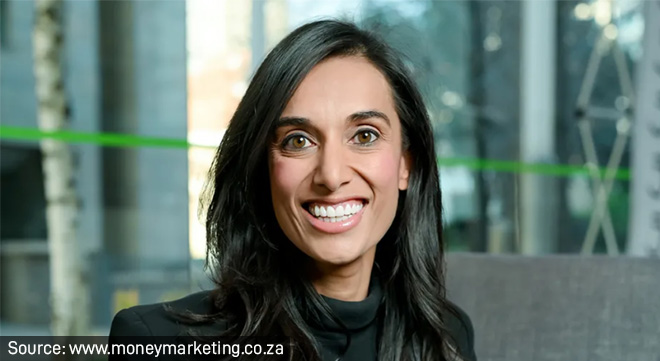
The Johannesburg Stock Exchange wants to convert improved sentiment towards South Africa into durable capital formation, while warning that geopolitical uncertainty and weak domestic growth remain key risks to sustaining momentum, says JSE group chief executive Valdene Reddy (pictured).
Reddy was interviewed by journalist Alishia Seckam in a PSG Financial Services Think Big webinar on Tuesday.
Reddy, who is about six weeks into the CEO role, described the job as a “baptism by fire”, given geopolitical fragmentation, shifting capital flows, and market volatility, but added she was “energized, motivated” and “ambitious to run and run fast” as the exchange enters its next strategic phase.
Asked what investors are seeing in South Africa now that they were not seeing two or three years ago, Reddy said the country’s investment appeal has strengthened after what she described as “almost a decade overhang” ahead of the 2024 Government of National Unity (GNU), during which South Africa was on a “sell bias”.
Reddy said South Africa’s global relevance had been “diluted” as other emerging markets “flexed their muscles”, while delayed domestic structural reforms weighed on sentiment. She said increased public-private collaboration, capital deployment, and the post-2024 political chapter contributed to a shift in perception.
Reddy said the change in sentiment has not been limited to a short-lived rebound, describing South Africa as having performed strongly for roughly 24 months, while adding that outcomes remain sensitive to global political developments.
Foreign flows: conviction versus ‘fast money’
Seckam said non-resident equity ownership on the JSE rose from just over 29% to nearly 33% in 2025 and asked whether this reflected long-term conviction or short-term yield-seeking.
Reddy said recent inflows have been mixed, combining long-horizon interest with shorter-term yield-chasing and passive flows, including passive shifts linked to changes in South Africa’s standing in global indices and ratings-related positioning.
She said converting that mix into durable conviction requires follow-through: “The narrative has to be deliberate, and it has to be sustained, and we have to follow through with execution or delivery criteria” to achieve a lasting shift in investor sentiment.
She said the type of capital the market needs to retain is money invested for the “next five-to-seven-year opportunity that the country presents” rather than “fast money that comes in and out”.
Reddy also pointed to South Africa’s weight in global emerging market indices, saying the country is about 4.5%, and argued that at around 5% a market becomes “too hard to ignore” – “you’re not a rounding error”.
Reddy said South Africa can improve competitiveness through policy enablement and regulatory reforms and described government engagement as improving, saying the market is “pushing against an open door”.
She referred to the industry-led reform initiative Operation Phumelela in the context of proposals aimed at strengthening South Africa’s financial-sector competitiveness and advancing the concept of a Synthetic Financial Centre.
Listings ‘pipeline’
Seckam raised concerns that a financially strong exchange means little if it continues to shrink in relevance to the real economy, citing fewer major listings and muted IPO activity in recent years.
Reddy said the JSE is unlikely to see a “burgeoning” of fresh IPOs because South Africa remains a predominantly institutional market, but she said the medium-term pipeline is “much stronger and much higher quality”, describing a “fundamental shift” over the past 24 to 26 months.
She said two constraints still shape the near-term picture: “Two things: timing matters” – and second, because the market is institutional, “your smaller and mid-caps will still be a concern factor” even if overall capital-raising activity looks healthier.
Reddy cited several examples in discussing activity and prospects, including Canal+ (linked to its acquisition of MultiChoice), Coca-Cola Bottling in the context of Coca-Cola Hellenic, and Fidelity Security.
As an illustration of demand depth, Reddy pointed to the Optasia listing, saying it was “multiple times oversubscribed”.
Reddy added that the pipeline is not limited to IPOs, pointing to additional capital raises and sustainability bonds as areas that appear healthier, while reiterating that market readiness matters when timing turns favourable.
Forge 2031: modernising the exchange
Reddy said the JSE’s next strategic phase is captured in “Forge 2031”, which she described as building on the exchange’s existing priorities through 2026 while positioning it as a “resilient exchange of the future”.
She said the focus includes modernising market infrastructure and technology, improving client service, and strengthening the JSE’s overall competitiveness as global markets evolve.
Asked whether the traditional stock exchange model is under pressure in a world where companies have more funding options, Reddy said public markets remain “well recognised and well established” in South Africa, citing the depth of institutional assets and the long-standing scale of the market.
She added that the JSE is “one of the few exchanges in the world where a market cap far surpasses that of the GDP of the country”, framing this as evidence of the capital market’s enduring role.
Despite that scale, Reddy acknowledged the growth of alternative funding routes and said the JSE aims to provide capital-raising solutions beyond traditional listings. She pointed to the group’s private-market offering, JSE Private Placements, which the JSE describes as a digital marketplace connecting private companies raising equity or debt with investors.
Reddy said the JSE has spent roughly four to four-and-a-half years reforming listing products, requirements, and regulation to improve the appeal of listing while maintaining investor protection and integrity.
She said reforms include simplifying the JSE rule book, splitting the Main Board into General and Prime segments to right-size obligations, reducing red tape for smaller issuers, and aligning requirements with globally recognised markets to ease conversions into South Africa.
Reddy said broadening participation among younger and retail investors remains a significant growth opportunity and said market access needs to be “easy”, including “real-time information processing” and access to data.
On artificial intelligence, she said the JSE has embraced AI and expects it to enable faster delivery and innovation, while noting the need to balance benefits with risks in market infrastructure.
Growth and African integration
Reddy said two of the factors that most concern her are global geopolitics and South Africa’s domestic growth trajectory.
She said South Africa’s growth ambitions sit at around 1% to 2%, adding that lifting growth above 5% would materially shift the country’s success story, with broader implications for wealth distribution and economic outcomes.
She also addressed whether South Africa’s market is big enough on its own, saying the country still has untapped potential, but she argued that longer-term relevance could be amplified by deeper African integration, describing the continent as having “exponential” potential if it mobilises collectively.
Asked how South Africans should judge her leadership, Reddy said success should be measured in terms of “impact and innovation”, including building a globally relevant, resilient exchange, and helping to unlock South Africa’s potential.

