
With weeks of hearings concluded, the Standing Committee on Public Accounts (SCOPA) is moving into the final phase of its inquiry into the Road Accident Fund (RAF): drafting a report that could shape criminal referrals, legislative reform, and the future governance of one of South Africa’s most troubled public entities.
According to SCOPA chairperson Songezo Zibi, the committee will meet this week to approve the framework of its final report, after which members are expected to begin deliberating on a draft by the end of February.
Portions of the draft affecting individuals and institutions outside the RAF will be circulated for comment before the report is finalised and tabled for a vote in the National Assembly.
Zibi outlined the process in an interview with SABC News, emphasising that the inquiry has now shifted from evidence-gathering to accountability and recommendations.
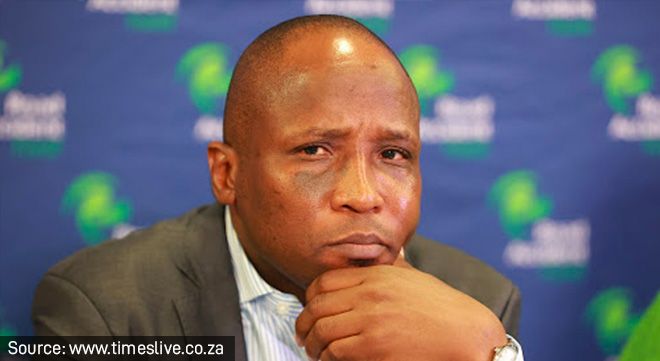
The report is expected to address not only alleged financial mismanagement and governance failures at the RAF, but also whether criminal charges should follow the unprecedented refusal by the Fund’s former chief executive, Collins Letsoalo (pictured), to comply with a parliamentary summons.
Why SCOPA intervened
SCOPA resolved in June 2025 to launch a full inquiry after months of unsuccessful attempts to obtain complete and credible information from the RAF’s board and executive management. The committee cited allegations of maladministration, reckless and wasteful expenditure, governance failures, and resistance to oversight.
Among its early concerns were failures to conduct adequate background checks on senior appointments, prolonged vacancies in critical executive positions, refusal to disclose the location and purpose of significant funds, and multiple whistleblower accounts pointing to supply-chain irregularities involving more than R1 billion.
The committee argued these issues fell squarely within its constitutional mandate to oversee public finances and financial governance, and persistent non-cooperation left it with little choice but to escalate matters through a formal inquiry.
What the inquiry covered
From October 2025 to February 2026, SCOPA heard testimony from a range of stakeholders, including the RAF, the Department of Transport, National Treasury, the Auditor-General, the Accounting Standards Board, the Special Investigating Unit, former executives, and service providers.
Rather than proceeding as a narrow forensic probe, the inquiry exposed a systemic breakdown across several fronts:
Governance and board oversight
Evidence pointed to weak fiduciary oversight by successive boards, including approval of contentious litigation against the Auditor-General and major procurement decisions despite mounting financial strain.
Accounting policy and litigation
A central focus was the RAF’s decision to move from IFRS 4 to IPSAS 42, a shift repeatedly found unlawful by the courts. Former executives testified that slowing the processing of claims kept large liabilities “in transit” and off the balance sheet, masking the fund’s true financial position. The RAF has spent more than R11 million litigating against the Auditor-General over this issue.
Claims processing and liabilities
Testimony disclosed a backlog exceeding 400 000 claims, persistent non-payment to medical service providers, and legal risks linked to the controversial RAF 1 claim form. If the RAF loses ongoing litigation over the form, additional liabilities of up to R100bn could arise.
Procurement and expenditure
SCOPA examined the procurement of close protection services for the former CEO, the dismantling of the RAF’s panel of attorneys, and media and marketing contracts worth about R1bn, including a staff awards event costing nearly R4m, at a time when hundreds of thousands of claims remained unpaid.
Impact on service providers and claimants
Witnesses described hospitals closing, medical experts going unpaid for years, and escalating legal costs and interest judgments – consequences that ultimately deepen the RAF’s financial distress.
Key conclusions emerging
Although SCOPA’s formal findings are still pending, Zibi indicated in the SABC News interview that the committee believes it has no material information gaps. He said the interim RAF board and the Department of Transport co-operated fully, providing internal documents, board minutes, and records that allowed the committee to build a comprehensive picture.
Zibi described the RAF as “technically insolvent”, estimating near-term liabilities of more than R100bn against annual revenue of about R50bn from the fuel levy. Even with perfect governance, he said, it would take more than a decade to clear the backlog of claims.
Beyond management failures, Zibi argued that the RAF’s legislative model is structurally unsustainable, with unavoidable legal costs consuming a significant share of annual revenue. In his view, changing boards and executives without reforming the underlying system would not resolve the crisis.
The Letsoalo stand-off
Running parallel to the inquiry’s findings has been a growing confrontation between SCOPA and Letsoalo – a dispute that has now raised constitutional and criminal-law implications.
SCOPA attempted repeatedly to secure Letsoalo’s voluntary appearance, sending multiple letters inviting him to respond to allegations concerning financial mismanagement, irregular appointments, procurement decisions, the abandonment of the attorneys’ panel, and disputes with the Auditor-General. When those efforts failed, the committee resolved to issue a summons in terms of the Powers, Privileges and Immunities of Parliament and Provincial Legislatures Act.
The summons instructed Letsoalo to appear before SCOPA on 25 and 26 November 2025. After unsuccessful attempts at personal service, Parliament effected substituted service via publication, email, and affixing the summons to a door. Letsoalo nonetheless did not appear.
Hours before the scheduled hearing, his attorneys issued a cease-and-desist letter challenging SCOPA’s authority, arguing that oversight of the RAF fell to the Portfolio Committee on Transport, and warning that the inquiry could be subject to judicial review. Letsoalo subsequently described the proceedings as a “kangaroo court” and reiterated his refusal to participate.
Read: Letsoalo stand-off: SCOPA vs RAF’s former CEO
SCOPA rejected these arguments, maintaining that the inquiry concerns financial governance and public expenditure – matters firmly within its mandate. On 26 November, the committee resolved to seek the Speaker’s concurrence to lay criminal charges against Letsoalo for contempt of Parliament.
In the SABC News interview, Zibi said Letsoalo’s failure to appear under summons was “a very serious matter” and emphasised that defying Parliament would not carry no consequences. He explained that because this was an unprecedented situation, Parliament was seeking external legal guidance on the correct process before proceeding.
What happens next
Once SCOPA’s final report is adopted by the National Assembly, it may trigger several parallel outcomes: referrals to law-enforcement agencies, recommendations for executive action, and calls for legislative reform of the RAF.
The Letsoalo matter remains live. If the Speaker concurs with SCOPA’s resolution, criminal charges related to contempt of Parliament could follow, shifting the dispute from parliamentary oversight to the criminal justice system.
At the same time, SCOPA has signalled that its work does not end with individual accountability. The committee is expected to make recommendations aimed at stabilising governance at the RAF, strengthening board appointment processes, and confronting the structural unsustainability of the compensation model.


My son in law has been waiting for payout after a motorbike accident he is paralized has a small child with no income by the time that somebody wakes up him and his family might be dead of hunger the people must stop stealing and have parties
Throw him and.his co- conspirators in jail for goodness sake – where have you ever heard of such blatant theft and fraud been committed and all these committee people asked to investigate – throw him in jail
We saw it coming especially former CEO at Prasa etc that coming to RAF was a mistake.All hell broke loose suspensions Left Right to the experienced incumbents will take toll, resignations after another.. working systems change and to challenge such sucks… billions wasted
My sister inlaw has been waiting for years she is paralyzed and she cannot work anymore she fell into an extreme depression waiting, her whole family is depending on her due to multiple medical operations and loss of income and valuable time!! WHATS THE PLAN HERE LEAVE EVERYONE WAITING
All I want to know, where does this whole thing leave the claimants who were seriously injured and still suffering but their claims were rejected with out any reason by this Letsoale and his people? Some died after waiting for more than 5 to 7yrs still hoping that they will be compensated one day and their families are still struggling even now, yhooo😭
I can’t believe what I have just read Zongeso Zibi has described RAF as technically insolvent and has suggested that it might take 10 years for our claims to be processed. I am now in my fourth year since I submitted my claim every time I called in to enquire about the status of my claim I am told the same story. No progress at all
Show me which ANC GOVERNMENT INSTITUTION is FUNCTIONAL :
POLICE – HIT SQUADS , ZAMA ZAMA’S
HEALTH – CORRUPTION , MURDER
EDUCATION- CADRES & COMMUNISTS
SANDF – INCOMPETANT & USELESS
SABC – PROPAGANDA & LIES
PRASA – NOT ALL ARE IN COURT
RAF – ENORMOUS THEFT
I have lodged a claim since 2011 till now there are only promises while my case has been in and out of the Courts. I have lost everything
Gauteng Liquor Board also non functional and nothing is being done about it.Waiting since 2021 for a liquor licence to be considered.
Why do afriforum & Gerie Nel put their total energy, focus & lots of money waste, to someone who shoots harmless ammunition into the sky, instead of Challenging the so called GNU for failure to arrest the obvious RAF thief who says he won’t appear before the parliament ad hoc commette, even when there is solid evidence that he is the cause of the RAF financial collapse. This is the department that also the Afriforum is claiming from, in case of their families accidents. If Gerie Nel doesn’t know the name of the culprit and wants assistance, he is free to contact the so called GNU useless SCOPA
From 2021 I am stel waiting my. I try by all means promis untill when plse help. me