
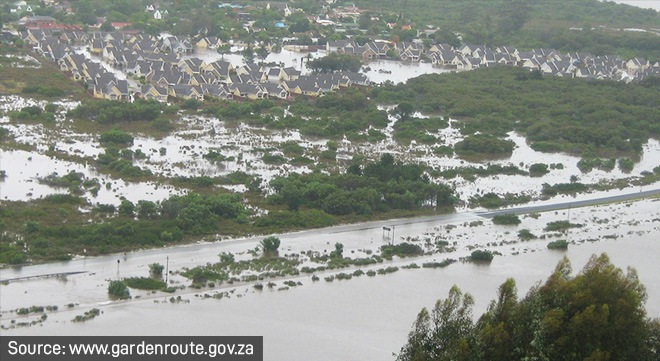
National Treasury has published two documents relating its plan to reduce municipalities’ financial exposure to natural disasters by transferring more risk to the insurance sector.
Historically, disaster response in South Africa has relied on reallocating funds from essential services, such as education, health, and safety. This, Treasury says, erodes current and future development gains because the funds for repairing and rebuilding infrastructure and assisting affected households and businesses are taken from development funds. This approach is unsustainable because funds for development reduce while losses increase.
Property insurance policies covering natural disaster risk (including earthquake, strong wind, flood, hailstorm, landslide, and subsidence) are widely available. But Treasury says these policies are tailored to and bought by middle- and upper-income households. Most public infrastructure is uninsured, placing a large contingent liability on the government.
Treasury says some large municipalities, such as Cape Town and eThekwini, have municipal insurance pools. But the amount of cover offered tends to be limited because of poor data quality and poor asset maintenance records.
“There is a significant opportunity to build on these facilities to increase asset cover and expand cover to important public infrastructure.” The non-life insurance markets present a viable opportunity for South Africa to better manage risk by transferring key risks off-budget.
Treasury says the government will engage the insurance sector on the potential for insurance, particularly parametric insurance, to improve South Africa’s approach to disaster risk.
Parametric insurance is index-based insurance, which pays out when an adverse event (such as a flood) occurs. It is increasingly used by governments, municipalities, and households to insure against climate-related risk.
Treasury and municipalities will undergo a pilot to determine the structure and pricing of potential insurance products by the end of the third quarter of 2025.
The two documents published by Treasury are:
- A Disaster Response Financing Strategy.
- A survey of municipalities’ experience of managing disaster risk.
Read: Why insurance plays a limited role in municipal risk financing
National Disaster Risk Finance strategy
To better plan for disasters, Treasury conducted a National Disaster Risk Finance (DRF) Diagnostic with the World Bank and prepared a DRF strategy in 2024.
The DRF Diagnostic found that disaster relief costs in South Africa cost an average of R3.7 billion a year, with uninsured losses accounting for 86% of the total, necessitating significant government support. The annual funding gap is projected to exceed R2.3bn, compared with the current pre-arranged funding of R1.4bn.
The National DRF Strategy identified three priority areas for reform:
- Increase the availability of funds to strengthen fiscal and financial resilience to shocks.
- Improve the distribution of funds to address response gaps with a focus on efficiency and timeliness.
- Enhance data collection to support better budgeting and effective risk management.
1. Increase the availability of funds
The strategy proposes that, where appropriate, disaster response involves financial sources beyond the fiscus, such as a contingency fund and risk transfer (for example, sovereign and private insurance). This could involve the private sector or alternative public-private sector providers – for example, international development finance institutions or risk pools offering sovereign insurance.
Where it is more efficient for the fiscus to retain risks, appropriate processes are required to ring-fence funds and minimise the cost of emergency reallocations.
2. Improve the distribution of funds
The government’s capacity to distribute funds efficiently to provincial and municipal governments must be improved. The strategy involves a comprehensive review of the grant system for disasters, which includes incentives for preparedness and financial instruments designed to meet the response needs of municipalities.
The proposed programme will streamline the approval processes and leverage technology to support intergovernmental transfers with automatic triggers, thereby expediting the availability of funds during emergencies.
The strategy will also ensure that municipalities have access to and provide high-quality data, which is required for informed decision-making and effective disaster response.
3. Enhance disaster-related data collection
The strategy emphasises the need to strengthen data collection efforts. This includes gathering detailed information on the sources and use of funds related to specific disasters, as well as on the maintenance public assets to facilitate their insurability.
The strategy advocates for making disaster risk financing data publicly available and sharing this with the private sector, specifically insurance companies. This is vital for fostering a collaborative environment and enabling more informed decision-making across all sectors. This could be complemented by creating incentives for private insurance companies to share their loss data, which could improve the understanding of risks and pricing of insurance products.

