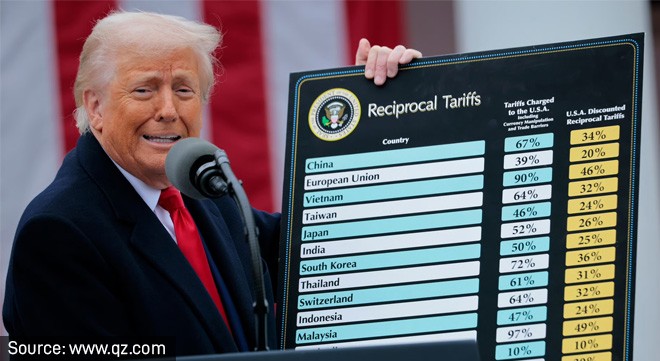
The United States administration has replaced the emergency tariffs struck down by the Supreme Court last week with a new 15% temporary global import levy under a different statutory authority, reshaping tariff exposure for trading partners, including South Africa.
On 20 February, the Supreme Court ruled 6-to-3 that the International Emergency Economic Powers Act (IEEPA) does not authorise the president to impose broad import duties. The decision invalidated the administration’s April 2025 tariff programme, which introduced a 10% baseline duty on most imports and higher country-specific “reciprocal” rates.
Chief Justice John Roberts, writing for the majority, held that tariff-setting is constitutionally vested in Congress, and IEEPA does not contain clear language permitting the imposition of duties. The Court applied the “major questions” doctrine, concluding that Congress must speak plainly when delegating powers of significant economic consequence.
Lower courts previously found that the IEEPA-based tariffs exceeded presidential authority. The Supreme Court affirmed those findings.
Following the ruling, US Customs and Border Protection confirmed it would stop collecting the IEEPA-based tariffs and deactivate the associated tariff codes.
Analysts estimate that between $130 billion and $175 billion in duties were collected under the IEEPA regime in 2025. The Supreme Court did not rule on how refunds should be administered, leaving that issue to lower courts.
Within hours of the ruling, President Donald Trump invoked section 122 of the Trade Act of 1974, which allows the president to impose import surcharges of up to 15% for up to 150 days to address what the statute describes as large and serious balance-of-payments deficits.
The administration initially signalled a 10% rate but subsequently confirmed that the levy would be set at 15%, the statutory maximum.
Unlike IEEPA, section 122 explicitly permits tariff surcharges, but it is time-limited. Any extension beyond roughly five months would require congressional approval.
The presidential proclamation outlines specific product exclusions. As with the prior regime, tariff treatment depends on product classification and the interaction with other trade statutes.
The Supreme Court’s decision affects only the IEEPA-based tariffs.
The following remain in force:
- Section 232 duties imposed on national security grounds (including steel and automotive measures);
- Section 301 tariffs arising from unfair trade practice investigations; and
- Anti-dumping and countervailing duties under longstanding trade law.
These were not part of the litigation and continue to apply where relevant.
Impact on South Africa
Under the invalidated IEEPA regime, certain South African exports were subject to a 30% reciprocal tariff rate. However, that rate did not apply uniformly to all South African goods exported to the US.
South Africa’s export exposure to the US market is structured across multiple tariff regimes:
- A portion of exports qualified for duty-free treatment under the African Growth and Opportunity Act (AGOA).
- Some products – including specific agricultural goods and critical minerals – were exempted under the IEEPA framework.
- Sector-specific tariffs, such as those on steel or vehicles under section 232, operate independently of IEEPA.
- A share of South African exports historically faced zero or low Most Favoured Nation tariff rates under the standard US schedule.
The US accounts for about 7.5% of South Africa’s global exports, according to the Department of Trade, Industry and Competition. Roughly a quarter of South Africa’s exports to the US enter under AGOA preferences, and about a third of exports are exempt from tariffs under various classifications.
With the IEEPA tariffs invalidated:
- The 30% reciprocal tariff no longer applies to affected South African goods.
- A 15% temporary global tariff under section 122 now applies to qualifying imports unless specifically excluded.
- AGOA preferences and other exemptions continue to operate subject to the terms of US trade law.
- Sector-specific tariffs imposed under other statutory authorities remain unchanged.
The practical effect is a shift from a higher country-specific reciprocal rate on certain goods to a uniform temporary surcharge that applies more broadly but at a lower level. However, the precise impact depends on product classification, eligibility for exemptions, and overlap with existing trade measures.