
The National Department of Health (NDOH) and National Treasury have discussed changes to the medical tax credit, which will end once National Health Insurance (NHI) provides the services covered by medical schemes.
The NDOH presented its 2024/25 annual report to the National Assembly’s Standing Committee on Health on 10 October, during which it was asked questions about NHI’s implementation and funding.
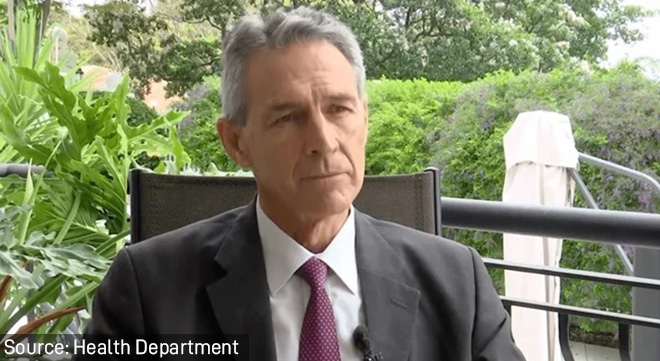
Dr Nicholas Crisp (pictured), the deputy director-general responsible for NHI, said section 49 of the NHI Act provides for four major sources for funding the NHI Fund. The first is the money that is currently allocated to the national department and the provincial health departments. The second is reallocating funding for the tax credit to the NHI Fund.
“There have been discussions with National Treasury. There have been lots of correspondence forwarded to the minister. There [were] various exchanges of papers that have taken place between bodies outside of government, with government, about the implications of the tax credit.”
The state currently provides credits to the value of almost R34 billion to members and beneficiaries of medical schemes, Crisp said.
“Once those services are paid for by the [NHI] Fund, it would serve no purpose. In fact, it would be double funding, for the government, yourselves [Parliament], and the tax authorities to allow that money to be paid back to members of the public when that money is actually being spent for the delivery of their health services through the services of the NHI Fund.”
He said the phasing out the tax credit could not occur “at once”, but it could happen systematically, “and that is what we have been discussing with Treasury – where would various thresholds be over a period of time without collapsing the current services”.
Until the NHI Fund has been established as a public entity, it cannot be awarded a budget by Parliament. The Fund will not run any health services. It will purchase health services from the public and private sectors, and those benefits will be paid for at rates fixed by the Fund.
The medical tax credit consists of two main components: the Medical Scheme Fees Tax Credit (MTC) for contributions to registered medical schemes, and the Additional Medical Expenses Tax Credit (AMTC) for other qualifying expenses not covered by schemes.
For the 2025/2026 tax year, MTC rates are fixed at R364 per month for the primary member, R364 for the first dependant, and R246 for each additional dependant. The rates were not adjusted for inflation in this year’s Budget. This effectively erodes the credit’s real value over time amid rising costs.
The AMTC calculation varies by category: for taxpayers aged 65 or older, or those with a disability in the family, it is 33.3% of excess contributions plus qualifying expenses; for others, it is 25% after exceeding 7.5% of taxable income.
Supporters of the credits say phasing them out will reduce disposable income, disproportionately affecting middle- and lower-income households, pensioners, and those with disabilities who rely on enhanced credits. In addition, discontinuing the credits will stifle economic growth by diminishing spending power and may drive members out of private schemes, overburdening public healthcare with costs exceeding the credits’ value.
Implementation of Phase 1 is ‘on schedule’
In terms of section 57 of the Act, NHI will be introduced in two phases, between 2023 and 2026, and between 2026 and 2028.
Crisp said the NDOH is on track to complete the five targets prescribed for Phase 1.
“Some of them have already been fully implemented and others are in progress. So, in terms of Phase 1 as outlined in the Act, I think we can be fairly confident that we are not behind schedule.”
Phase 2 will involve getting “the machinery” of implementing to work, and it is during this phase – between 2026 and 2028 – that the first funds will go into the NHI Fund.
“There are no funds in the National Health Insurance at this stage […] because there is no National Health Insurance Fund, and there’s no National Health Insurance entity yet […] The Fund itself as an entity […] will only be established when section 9 of the Act is proclaimed, and that can only happen once the mechanics of a board and the various governance structures have been approved. They have been through Cabinet. They’ve been through the state law advisers. They’ve been published in the [Government] Gazette. They’ve been amended. They’ve now been translated a second time. And we’re waiting for the final translations. The meeting between the department and National Treasury to get the guidance and the instructions of the committee that is authorised to do so has taken place, to establish what the rates will be that will be paid to board members and other members of committees, and the proclamation has been drafted.
“So, what we are waiting for now is just to get the translations back, and then all of this will go from the minister to the President for the proclamation of the first set of sections which will enable government – that’s the Department of Health, Treasury, and others – to implement the activities or the requirements in Phase 1,” Crisp said.




You, the NDOH and the ANC cannot be serious about having this discussion. NHI is a stillborn baby. It will never happen. SA cannot afford it and it is baffling that you still don’t understand this.
This country will stop the implementation in a number of ways. The various organisations that represent the people of this country will continue to fight it on our behalf – how many more court cases do you want?
The people on the ground themselves will also not allow you to create this instrument to facilitate corruption and theft at a level even higher than all the criminals mentioned in the Zondo commission bible.
IF it was allowed to go ahead, it would have been the biggest bucket in SA with the most holes in it. The only way stop this corruption is to stop the implementation itself.
The taxpayers of South Africa will have to unite to stop this. We won’t need the stupid tiny medical rebate if we all stop paying any tax. Yes, a tax revolt if that is what it takes to stop this madness.
NDOH, stop wasting our time, roll up your sleeves and get to work on fixing the state hospitals that YOU have broken over the last 3 decades.