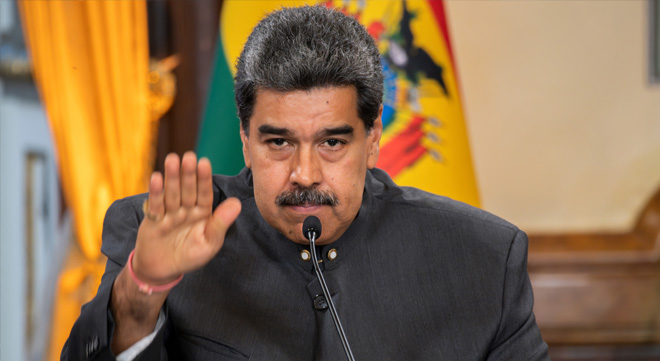
The internet wasted no time. Within hours of the United States’ military removal of Venezuelan president Nicolás Maduro, pictured, on 3 January, social media was awash with memes lampooning Maduro, Donald Trump and Washington’s latest foreign-policy intervention. As ever, humour proved faster than analysis.
But while the memes travelled light, investors were left weighing a far heavier question: what this latest geopolitical shock says about energy, risk and where capital is likely to flow next.
According to Simonetta Spavieri, active ownership manager – Climate Engagement Lead at Schroders, the US action in Venezuela should be read less as a one-off event and more as part of a broader geopolitical realignment, particularly around energy.
She said energy access, sanctions policy and resource control are increasingly being deployed as tools of international influence, even as the global energy system undergoes structural change. Hydrocarbons, she noted, continue to shape foreign-policy choices.
Spavieri added that Washington’s posture towards Venezuelan oil does not amount to a dramatic reversal. The Maduro government had already been cooperating with the US on energy under constrained conditions, with Chevron continuing to operate in the country. Against that backdrop, renewed US attention on Venezuelan oil was better understood as an incremental move rather than a strategic pivot.
Short-term market reaction, limited fundamentals
Markets responded swiftly but selectively. Shares of major US refiners rose as investors anticipated easier access to Venezuelan heavy crude should sanctions be eased. US Gulf Coast refineries are structurally well suited to process these grades, having been configured decades ago for Venezuelan, Mexican and Canadian crude.
Spavieri said this explained the initial reaction but cautioned against over-interpreting it. Sanctions policy can change quickly, and crude flows can be rerouted far faster than new supply can be developed. While China currently absorbs about 80% of Venezuelan exports, a shift in trade routes does not materially alter the global supply picture.
Venezuela’s strategic relevance lies in the scale of its reserves – nominally the world’s largest – rather than in its current output. Production has collapsed from peaks above 3.5 million barrels a day to roughly one million barrels a day, following decades of mismanagement, underinvestment and governance failures. Oil still accounts for more than 90% of the country’s exports, leaving the economy acutely exposed to disruption.
She warned that claims Venezuela could rapidly re-emerge as a major producer ignore hard realities. Production is dominated by heavy and extra-heavy crudes from the Orinoco Belt, which are expensive to extract, carbon-intensive to upgrade and dependent on imported additives. Breakeven costs for new projects rank among the highest globally.
While limited production gains may be technically possible, Spavieri said above-ground risks – political instability, legal uncertainty, degraded infrastructure and unresolved arbitration claims – are far more binding.
Those risks collide with a changed investment environment. Oil markets entered 2025 well supplied, inventories have been building and prices remain moderate. At the same time, investors are demanding capital discipline. Listed oil and gas companies have shifted away from growth towards free cash flow, dividends and buybacks.
That discipline, she said, initially cut low-carbon investment but is increasingly constraining upstream exploration, particularly in high-risk jurisdictions. In that context, large-scale greenfield investment in Venezuela appears misaligned with prevailing investor expectations.
Geopolitics versus investment reality
Spavieri argued that Venezuela highlights a growing tension. From a geopolitical perspective, oil remains powerful enough to motivate military intervention. From an investment perspective, however, Venezuela embodies the very risks investors are trying to avoid: high costs, long payback periods, political exposure and uncertain long-term demand.
Energy security itself is being redefined. Electrification, grid resilience, and control over technologies and critical minerals are increasingly prioritised over securing incremental oil supply. Since Russia’s invasion of Ukraine, reducing dependence on imported oil and gas has become explicit policy across Europe and parts of Asia.
She says, for investors, the lesson is not that oil no longer matters, but that political urgency does not resolve economic reality. Assets that rely on geopolitical intervention to become competitive are precisely those most at risk of stranding.
According to Herman van Papendorp, Momentum Investments’ head of Asset Allocation, Venezuela’s direct role in global markets remains limited, but the episode adds to a broader layer of geopolitical uncertainty that investors are watching closely.
He said Venezuela accounts for just 0.1% of global GDP and about 1% of global oil production, meaning the near-term economic and market impact should be marginal. The greater effect is likely to be behavioural. Heightened geopolitical risk tends to support gold and encourages diversification away from traditional US assets.
While Venezuela holds the world’s largest proven oil reserves, reversing decades of industry mismanagement would require enormous private-sector investment – estimated at about US$100 billion over a decade – across oil production, infrastructure, roads and ports. Whether global companies would commit such capital depends on the security, legal and financial guarantees on offer.
Given Venezuela’s negligible current role in oil markets, Van Papendorp said the near-term impact is more likely to be increased oil price volatility rather than a sustained directional move in prices.
He added that the broader uncertainty created by a more aggressive US foreign-policy stance provides a supportive backdrop for gold and other precious metals, as investors reassess the US dollar and Treasuries as default safe havens. A weaker dollar could also benefit non-US equity and bond markets, particularly emerging markets, including South Africa.
Looking beyond the noise to 2026
Despite events in Venezuela and Iran, geopolitical risk likely peaked in 2025, according to Sahil Mahtani, director at the Investment Institute. He said the US and China appear to be entering a more pragmatic phase of détente driven by domestic economic priorities, even as China-Europe relations may face renewed strain.
The Investment Institute expects 2026 to deliver a “Goldilocks” macro backdrop, with above-trend growth, mild disinflation and risks skewed modestly to the upside. While geopolitical shocks, divergent policy cycles and questions around the sustainability of the AI boom persist, the Investment Institute argues that the overall outlook for cross-asset returns is relatively benign.
Philip Saunders, director at the Investment Institute, said investors may find that 2026 feels unexpectedly balanced, characterised by firm real growth, falling inflation and improved earnings visibility. However, he cautioned that this is not a year for single narratives, but for selective and diversified positioning.
Traditional market-cycle frameworks have become less useful amid disjointed fiscal and monetary dynamics and asynchronous policy tightening. Even so, he says a clear theme is emerging: growth, not inflation, is expected to be the dominant market driver.
Mahtani said global growth is likely to run above trend, supported by policy easing from 2025, resilient labour markets and cooling inflation. While the backdrop is constructive, risks remain two-sided, including a disorderly labour-market slowdown or a reassessment of AI-related capital expenditure.
Fears of an AI “super-bubble” collapse also appear overstated. The more likely outcome is a modest recalibration that reinforces discipline around earnings and unit economics, rather than a crash.
Against this backdrop, the Investment Institute sees 2026 as a year for rebalancing. Stretched US valuations argue for broader equity leadership, fixed income is regaining its diversifying role, emerging markets look more attractive in a weaker-dollar environment, and gold’s structural bull case remains intact.
As Mahtani concluded, the world remains fragmented but resilient. For investors willing to look past the memes and focus on fundamentals, the coming year may offer more opportunity than the headlines suggest.