
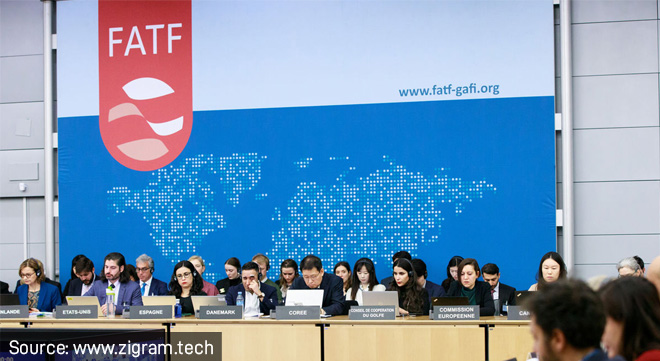
South Africa has spent years addressing the shortcomings that led to its grey-listing. Now, as the country faces a new evaluation by the Financial Action Task Force (FATF), National Treasury says it is confident the reforms are delivering progress.
“Government is confident that the submissions we have made demonstrate continued progress in strengthening the anti-money laundering system,” Treasury said in response to concerns raised by Business Leadership South Africa (BLSA) about the risk of South Africa returning to the FATF grey list.
However, it said the confidential nature of the mutual evaluation meant that “we cannot speculate about outcomes”.
South Africa’s fifth-round mutual evaluation began earlier this year and will conclude at the FATF Plenary in October 2027.
In its October 2026 Reform Tracker, BLSA warned that stalled anti-corruption reforms and weaknesses in law enforcement could put the country at risk of being reinstated on the grey list, barely a year after its removal in October 2025.
Read: Grey list comeback? South Africa’s anti-corruption warning
Treasury told Moonstone that it welcomed independent efforts to monitor and assess reform implementation, including the BLSA Reform Tracker, saying such assessments “provide valuable perspectives that can enrich public dialogue and inform ongoing reform efforts”.
“That said, because the Mutual Evaluation process is led by the FATF, government will not be issuing any progress updates until the process is finalised.”
Asset forfeiture and money laundering cases
Treasury outlined several reforms initiated by the government that could assist in the fight against corruption and financial crime, as well as in the current mutual evaluation.
Between 1 April 2020 and 31 October 2026, the Asset Forfeiture Unit froze R10.2 billion, obtained final orders for R3.8bn and recovered R5.8bn in relation to the Prevention of Organised Crime Act.
The government has also begun building registries of the beneficial owners of companies and trusts, which Treasury said would allow law enforcement quickly to identify the beneficiaries of suspicious transactions.
It has also begun building the foundations of a system for supervising non-financial entities that are sometimes used and abused for money laundering, including estate agents, lawyers, and gold and diamond dealers.
Treasury said the government had increased its use of mutual legal assistance to secure evidence against offenders who had sought to escape justice or export the proceeds of their crimes.
It had also ensured that the police and prosecution services had more resources and capacity to combat money laundering. Treasury said this had resulted in a significant increase in the number of money laundering cases enrolled in court.
The government had also improved compliance with its international obligations relating to the enforcement of targeted financial sanctions imposed by the United Nations on people and entities associated with international terrorist organisations.
Corruption and financial crime
Treasury said corruption was a major source of illicit proceeds and money laundering. It said the proceeds of corruption were generally laundered into the financial system, linking the fight against corruption to the fight against financial crimes.
“Any successes in the fight against corruption also contribute to the strengthening of our anti-money laundering and the combating of the financing of terrorism (AML/CFT) capability,” Treasury said.
BLSA’s October Reform Tracker records limited progress on several anti-corruption reforms. Its corruption reform index remained unchanged at 51.2 in the third quarter of 2026, after falling from 53.6 in the third quarter of 2025.
The tracker has been monitoring implementation of the recommendations made by the Zondo Commission, which handed over the final parts of its state capture report in June 2022. President Cyril Ramaphosa committed to implementing the recommendations that year.
Progress on the reforms tracked by BLSA initially improved, with the index rising from 19.6 in March 2024 to 53.6 between June and August 2025. It then plateaued for three consecutive periods before falling to 51.2 in the second quarter of 2026.
BLSA warned that the FATF evaluation was likely to focus on law enforcement, with disclosures before the Madlanga Commission exposing vulnerabilities in the criminal justice system.
The commission, chaired by retired Constitutional Court Justice Mbuyiseli Madlanga, submitted two interim reports in December 2025 and May 2026, recommending criminal investigations and disciplinary action against police officials. Several law enforcement officials have since been arrested and charged.
Read: Madlanga Commission: Why fixing policing matters to business
Its final report is due to be submitted to Ramaphosa on 25 January 2027. BLSA said it would incorporate the commission’s recommendations into the Reform Tracker once the report was published, but it warned that the timing left limited room for implementation before the FATF evaluation concludes in October 2027.
Treasury did not address Moonstone’s questions about the implementation of the Zondo Commission’s recommendations or the implications of the Madlanga Commission’s findings for South Africa’s FATF evaluation.
A test of effectiveness
The FATF’s fifth-round mutual evaluation will examine whether South Africa has implemented the organisation’s 40 Recommendations and, crucially, whether its AML/CFT system is working in practice.
The assessment has two parts. Technical compliance looks at whether the necessary laws, regulations and other legal measures are in place. Effectiveness looks at whether authorities are using those measures to produce results, taking account of the money-laundering and terrorist-financing risks the country faces.
Having laws on the books is not enough; countries must show that their systems are working together to protect the financial system from abuse.
Effectiveness is assessed against 11 “immediate outcomes”. These cover whether authorities understand the risks, use financial intelligence, investigate and prosecute money laundering and terrorist financing, recover criminal proceeds, supervise financial and other relevant sectors, and apply targeted financial sanctions.
Assessors will be looking for evidence that the system is delivering tangible results – not simply that the required structures exist.