


The average replacement ratio achieved by members retiring from funds administered by Alexforbes increased from about 30% in 2021 to 40% in 2025, with strong investment performance accounting for most of the improvement.
But the progress has not removed the retirement shortfall. Nine out of 10 active contributing members were still not projected to replace at least 75% of their pensionable salary at retirement.
A replacement ratio measures the retirement income a member receives, or is projected to receive, as a percentage of the member’s pensionable salary before retirement. Alexforbes uses 75% as its benchmark for a targeted retirement outcome, although the income required by individual members would depend on their circumstances.
The findings are contained in Member Insights 2026, released by Alexforbes on 14 October 2026.
Among active contributing members, whose eventual outcomes are projected rather than observed, the average expected replacement ratio rose from 40% in 2021 to 46% in 2025.
The proportion expected to reach at least 75% increased from 6% to 10%. The represents a four-percentage-point rise, or a relative improvement of about two-thirds.
The proportion of members who actually retired with a replacement ratio of at least 75% also increased, from 7.45% in 2021 to 14.06% in 2025.
Analysis draws on 1.3 million member records
Member Insights is a quantitative analysis of retirement savings behaviour and outcomes. It examines factors that affect the income members may receive after retirement, including contribution and preservation rates, retirement ages, investment returns, salary progression, and the cost of converting accumulated savings into retirement income.
The analysis draws on more than 1.3 million member records for the period from 2021 to 2025. These include about 1.1 million active contributing member records across more than 310 retirement funds.
Four of the funds are umbrella funds representing more than 2 300 participating employers. The statistics are generally measured at 31 December each year.
The yearly results do not track a fixed group of members over the full five years. The composition of the funds, employers, and members included in the analysis changed as people joined, left, or retired and as participating employers moved into or out of the administered funds.
Investment performance provides most of the lift
During an online presentation of the report, Vickie Lange, the head of solutions enhancement in Alexforbes’ Corporate Solutions division, said investment performance was the principal reason for the improvement in both actual and projected replacement ratios.
Higher interest rates also supported annuity pricing, while salary increases that were lower relative to investment growth contributed to the movement in the ratios.
One illustration in the report is the performance of the Alexforbes Performer portfolio. It delivered an annualised return of 15% over the five years to 31 December 2025, compared with a benchmark return of 14.4% and an inflation-plus-5% objective of 10.1%.
During 2025, the portfolio returned 21.8%, compared with 21.9% for its benchmark.
The portfolio figures illustrate the strength of the investment environment but do not represent the returns achieved by every member. Actual member outcomes depend on the investment strategy followed, the timing of contributions and withdrawals, and the period for which savings remained invested.
The comparison between projected replacement ratios in 2021 and 2025 is also not made on an identical basis. Alexforbes increased the long-term return assumption used in its broader projections from inflation plus 4.5% to inflation plus 5%.
That change contributed to the higher projected outcomes, although the report identified actual investment performance over the five-year period as the main driver of the improvement.
Michael Prinsloo, executive for corporate solutions at Alexforbes, said investment returns are “possibly the biggest factor” in retirement outcomes, particularly growth after fees.
He said strong returns helped to improve the replacement ratios over the past five years but cautioned that this performance may not repeat and could not close the retirement savings gap on its own. The contribution rate and the number of years for which a member saves remain important determinants of the eventual retirement income.
The proportion of members remaining in their funds’ default investment strategies rose from 86.32% in 2021 to 91.84% in 2025. This means 8.16% were invested outside the default strategy at the end of the period.
Contributions move in the opposite direction
The improvement in outcomes occurred despite a slight decline in the proportion of pensionable salary allocated to retirement savings.
The average total contribution rate fell from 13.9% in 2021 to 13.6% in 2025. After deductions for expenses and insured risk benefits, the average net contribution allocated to retirement savings declined from 11.6% to 11.2%.
Prinsloo said most of the difference between the total and net rates was attributable to risk benefits, including group life and disability cover, rather than administration costs alone.
The average net rate of 11.2% was 3.8 percentage points below the 15% contribution used in Alexforbes’ standardised model for targeting a replacement ratio of about 75% over a full working career.
The 15% figure is not presented as a universal minimum for every member. The model assumes a particular contribution period, retirement age, investment return, salary progression, and annuity-conversion basis. The contribution required by an individual member will depend on their age, accumulated savings, expected retirement date, investment experience, and targeted income.
Lange said even a difference of half-a-percentage point in the contribution rate could have a material effect when compounded over a working lifetime.
Fewer savings years widen the shortfall
Alexforbes’ standardised modelling shows the effect of contributing for a shorter period.
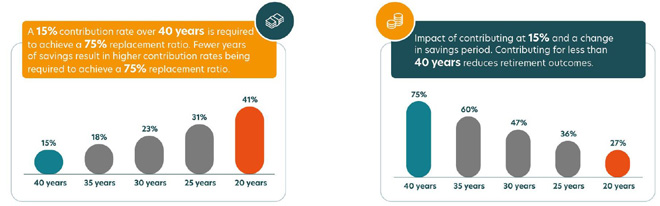
A member contributing 15% of pensionable salary for 40 years could achieve a replacement ratio of about 75% under the model’s assumptions. If the same member contributed at that rate for only 20 years, the projected replacement ratio would fall to about 27%.
To reach a replacement ratio of about 75% over 20 years, the member would have to contribute approximately 41% of pensionable salary under the same assumptions.
The report’s member data reflects this relationship. Among active members aged 25 to 30, those who began contributing at a younger age, or who had accumulated more contribution years, generally had stronger projected outcomes than comparable members with shorter contribution histories.
The effect becomes more pronounced closer to retirement. Among members aged 50 to 55, additional contribution years materially improved expected replacement ratios because members had accumulated savings for longer and had experienced more years of investment growth.
The findings do not mean that time alone guarantees an adequate outcome. The result also depends on contribution levels, preservation, investment performance, and the cost at which accumulated savings are converted into an income. But a shorter savings period leaves less time for both contributions and compounded returns to build the retirement benefit.
Members are retiring before normal retirement age
The average actual retirement age among the retirees included in the analysis declined from 62 in 2021 to 61 in 2025.
This was lower than the normal retirement ages stipulated by most of the funds and employers in the dataset. The report shows that delaying retirement can improve a projected replacement ratio because the member contributes for longer, accumulated assets remain invested for longer, and the savings must fund a shorter expected retirement period.
The extent of the improvement would depend on the member’s circumstances and whether they remained employed and contributing during the additional years.
Prinsloo said the findings highlighted the importance of the choices available to funds, employers, advisers, and members. These include contribution levels, retirement timing, preservation, and the use of advice.
Preservation improves, but the result remains incomplete
The proportion of retirement assets preserved when members left their funds increased from 43.46% in 2022 to 52.23% in 2025.
This is an asset-weighted measure. It shows the proportion of the value of retirement benefits preserved rather than the proportion of exiting members who chose preservation. A relatively small number of members with large benefits can therefore have a material effect on the result.
The 2025 figure also includes assets in the retirement component created under the two-pot retirement system, which took effect on 1 September 2024. Retirement-component savings generally cannot be taken in cash when a member leaves employment.
Only about 15 to 16 months of retirement-component contributions had accumulated by the end of 2025. Alexforbes said it was therefore too early to determine how much of the improvement represented a lasting change in members’ treatment of their vested retirement savings.
The briefing’s practical message was that the improvement represented progress, but not retirement adequacy for most members.
Prinsloo said members need to focus on making the choices that influence optimal outcomes. These include contributing at an adequate rate, allowing savings sufficient time to grow, preserving vested benefits when changing employment, using the savings component sparingly, and obtaining advice appropriate to the member’s circumstances.


